
Stablecoin Regulatory Compliance Calculator
Compare Stablecoins for EU Compliance
Evaluate USDQ against USDC and USDT based on your business needs in Europe
Regulatory Compliance Comparison
USDQ
Regulatory Oversight
Dutch Central Bank (DNB) + AFM
Reserve Backing
102% (cash + U.S. Treasuries)
Primary EU Use
Regulatory compliance for European businesses
Compliance Score: 92/100USDC
Regulatory Oversight
U.S. regulators (FinCEN, NYDFS)
Reserve Backing
~100% (cash, bonds, short-term debt)
Primary EU Use
Global payments, DeFi applications
Compliance Score: 65/100USDT
Regulatory Oversight
Minimal public oversight in Europe
Reserve Backing
~100% (mixed assets, unclear breakdown)
Primary EU Use
Global trading, liquidity
Compliance Score: 48/100Transaction Cost Analysis
USDQ
Transaction Fee
$0.02
Average Gas Fee
USDC
Transaction Fee
$0.01
Average Gas Fee
USDT
Transaction Fee
$0.015
Average Gas Fee
Quantoz USDQ isn't just another crypto coin. It’s a digital dollar built for Europe’s strict financial rules, not for speculation. If you’ve ever wondered how a cryptocurrency can be both legal and stable, USDQ is one of the clearest answers out there. Unlike Bitcoin or even USDT, USDQ doesn’t try to be a store of value or a speculative asset. It exists to move real US dollars across blockchain networks - safely, legally, and transparently.
What Exactly Is USDQ?
Quantoz USDQ (USDQ) is a stablecoin that’s always worth $1.00 - or very close to it. As of November 2025, its price hovered at $0.9989, with daily swings under 1%. That stability isn’t luck. It’s the result of a legal structure designed by the Dutch Central Bank (DNB). Quantoz Payments BV, the company behind USDQ, is licensed as an Electronic Money Institution (EMI). That means it operates under the same rules as banks when handling digital money.
USDQ is built on Ethereum as an ERC-20 token. Its contract address is 0xc83e27f270cce0a3a3a29521173a83f402c1768b, and you can verify every transaction on Etherscan. Each USDQ token is backed by $1.02 in reserves - not $1.00. That extra 2% acts as a buffer against minor market shifts and operational costs. These reserves aren’t hidden. They’re held in cash deposits at major Dutch banks like ING and Rabobank, plus highly liquid U.S. Treasury bills. The money is managed by Stichting Quantoz, a bankruptcy-remote foundation supervised by DNB. That means even if Quantoz goes under, the reserves stay safe.
Why Does Regulation Matter?
Most stablecoins like USDT and USDC are global players. They’re used everywhere - from New York to Nairobi. But they’re not all built the same way under the law. USDT operates under vague regulatory claims. USDC follows U.S. rules, which don’t always align with Europe’s.
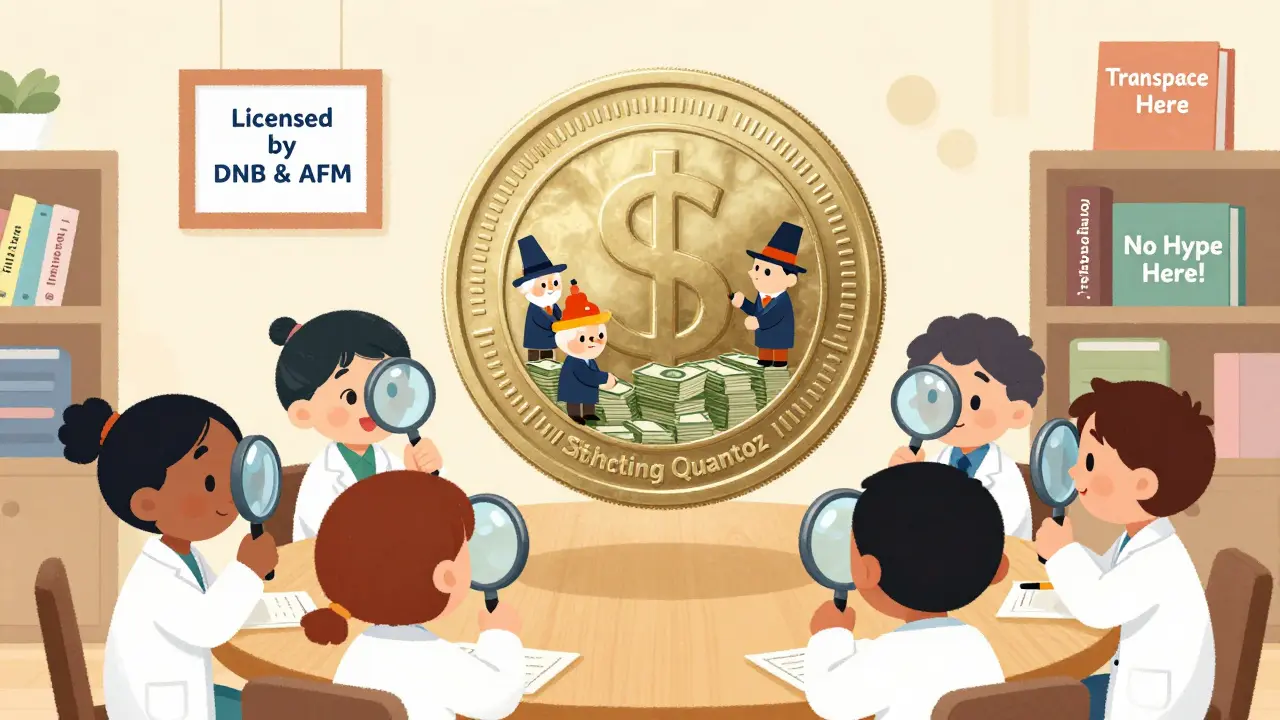
USDQ was made for one purpose: to meet Europe’s new crypto law, MiCA (Markets in Crypto-Assets Regulation). MiCA requires full transparency, regular audits, and clear issuer responsibilities. Quantoz was the first stablecoin issuer in Europe to get official approval under this framework. The Dutch Central Bank and the Netherlands Authority for the Financial Markets (AFM) both supervise it. That’s not a marketing claim - it’s a legal reality.
For businesses operating in the EU, this matters. A German fintech company using USDQ can show auditors official regulatory documentation. With USDC or USDT, they’d be stuck explaining why a U.S.-based company’s reserve reports are acceptable under European law. USDQ removes that gray area.
How Does USDQ Compare to Other Stablecoins?
Here’s a quick comparison of USDQ against the biggest players:
| Feature | Quantoz USDQ | USDC (Circle) | USDT (Tether) |
|---|---|---|---|
| Regulatory Oversight | Dutch Central Bank (DNB) + AFM | U.S. regulators (FinCEN, NYDFS) | Minimal public oversight in Europe |
| Reserve Backing | 102% (cash + U.S. Treasuries) | ~100% (cash, bonds, short-term debt) | ~100% (mixed assets, unclear breakdown) |
| Market Cap | $7.97 million | $34 billion | $112 billion |
| Trading Volume (24h) | $4.35 million | $4.8 billion | $28 billion |
| Exchanges Listed | 7 (e.g., Bitvavo, Bitstamp) | 100+ | 150+ |
| Primary Use Case | EU regulatory compliance | Global payments, DeFi | Global trading, liquidity |
USDQ’s market cap is tiny compared to USDC or USDT. It’s not trying to be the biggest. It’s trying to be the most trustworthy for European institutions. If you’re a bank or a regulated crypto exchange in Amsterdam, Frankfurt, or Paris, USDQ gives you legal cover. For traders moving millions globally, USDC is still the go-to.
Who Uses USDQ - and Why?
Most USDQ users aren’t retail investors. They’re businesses. About 78% of USDQ’s transaction volume comes from European fintechs and crypto exchanges. These are companies that need to move dollars across borders without triggering compliance red flags.
One user on Bitcointalk, who identifies as a compliance officer at a German fintech, said: “USDQ has simplified our dollar operations significantly. The transparency reports from Stichting Quantoz give our auditors confidence that doesn’t exist with U.S.-based stablecoins.”
Another user on Reddit, trading $50,000 worth of USDQ, noted: “The transaction settled in 15 seconds with $0.02 gas fee. But finding liquidity was challenging - I had to split my order across three exchanges.” That’s the trade-off. You get regulation, but you sacrifice liquidity.
On average, USDQ sees 175 monthly active addresses - up 68% from the previous month. That’s explosive growth for a niche product. The European stablecoin market as a whole is growing at 22% per month. USDQ is growing three times faster.
Can You Buy USDQ Easily?
Not like you can buy Bitcoin on Coinbase. USDQ is only listed on seven centralized exchanges, including Bitvavo and Bitstamp. It’s not on Binance, Kraken, or Coinbase. You can’t just tap a button and buy $100 of USDQ with a credit card.
For individuals, the easiest way is to buy euros on Bitvavo, convert them to USDQ, and store it in an Ethereum wallet like MetaMask. For businesses, Quantoz requires working through authorized brokers. There’s no direct minting. You can’t just send $1 million to Quantoz and get USDQ back. You need to go through KYC, compliance checks, and integration - a process that takes 2-3 weeks.
That’s by design. Quantoz isn’t trying to onboard millions of users. It’s trying to onboard the right ones: regulated institutions that need legal certainty.

What’s Next for USDQ?
Quantoz isn’t standing still. In November 2025, they announced new banking partnerships with ING and Rabobank to improve reserve liquidity. They’ve also integrated with the European Central Bank’s TIPS system, which lets users convert USDQ to euros in real time - same-day settlement.
By January 2026, they plan to launch USDQ on other blockchains beyond Ethereum, like Polygon and Solana. That’s a big deal. Right now, you’re stuck with Ethereum’s gas fees and slower speeds. Multi-chain support will make USDQ faster and cheaper to use.
They’re also building programmable payment features aligned with the EU’s Digital Euro framework. That means future USDQ transactions could include rules - like “this payment can only be made to a verified business” or “this amount expires in 48 hours.” That’s not just a stablecoin. It’s a smart financial tool.
Is USDQ Right for You?
If you’re a retail trader looking to flip coins for quick profits, skip USDQ. Its price barely moves. The trading volume is low. Slippage on a $100,000 trade can hit 0.8% - way higher than USDC’s 0.1%.
If you’re a business operating in the EU and need to move dollars legally, efficiently, and auditable, USDQ is one of the best options available. It’s not the cheapest or the most liquid. But it’s the most transparent and the most legally defensible.
For European fintechs, crypto exchanges, and compliance-heavy institutions, USDQ isn’t just a token. It’s a legal shield wrapped in blockchain technology.
Final Thoughts
Quantoz USDQ proves that crypto doesn’t have to be wild or unregulated to be useful. It shows that digital money can be built on trust - not hype. It’s slow to grow, hard to access, and niche in scope. But for the right users, it’s the most reliable dollar token in Europe.
As MiCA rolls out fully in 2026, more companies will need solutions like USDQ. It won’t replace USDC or USDT. But it will carve out a space no other stablecoin can: the legal, audited, European-approved digital dollar.
Is USDQ backed by real U.S. dollars?
Yes. Every USDQ token is backed by $1.02 in reserves, held in cash deposits at major Dutch banks and U.S. Treasury bills. The reserves are managed by Stichting Quantoz, a bankruptcy-remote foundation supervised by the Dutch Central Bank. This means the backing is real, transparent, and legally protected.
Can I buy USDQ on Coinbase or Binance?
No. As of November 2025, USDQ is only listed on seven exchanges, including Bitvavo and Bitstamp. It’s not available on Coinbase, Binance, Kraken, or most major U.S.-based platforms. This is intentional - Quantoz focuses on regulated European markets, not mass retail adoption.
Is USDQ safe from bank failures?
Yes, because the reserves are held by Stichting Quantoz, a separate legal entity that’s bankruptcy-remote. Even if Quantoz Payments BV goes under, the reserves remain protected and can still be used to redeem USDQ tokens. The Dutch Central Bank oversees this structure to ensure user funds are always secure.
How does USDQ differ from the Digital Euro?
The Digital Euro would be a central bank digital currency (CBDC) issued directly by the European Central Bank. USDQ is a private stablecoin issued by a licensed company under EU regulation. While both are euro- or dollar-backed digital currencies, USDQ is already live, regulated, and usable today. The Digital Euro is still in testing and won’t be available until at least 2027.
Why is USDQ’s price sometimes above $1?
USDQ’s price can briefly rise above $1 due to high demand and low supply. With only 7.98 million tokens in circulation and limited exchange availability, even small buying pressure can push the price up. The 102% reserve backing ensures it won’t stay far above $1 for long - arbitrageurs quickly buy and sell to bring it back to parity.
Can I use USDQ for DeFi or NFTs?
Technically yes - since it’s an ERC-20 token, it can interact with Ethereum-based DeFi apps. But practically, it’s not designed for that. Most DeFi platforms don’t list USDQ because of its low liquidity and limited user base. It’s built for institutional transfers, not yield farming or NFT purchases.


Stanley Wong
December 6 2025So USDQ is basically the boring cousin of USDT who shows up to family reunions wearing a suit and carrying a notepad full of compliance forms
And honestly I kind of love it
Most crypto stuff feels like a carnival ride-loud, flashy, and you’re not sure if the safety bar is even locked
But USDQ? It’s the guy who quietly checks your seatbelt before you even sit down
The 102% reserve thing is genius
It’s not just backing the token it’s backing the *trust* in the token
And the fact that it’s tied to Dutch banks and supervised by DNB? That’s not marketing that’s legal architecture
I’ve seen too many stablecoins get slapped with regulatory warnings
USDQ doesn’t even have to worry about that
It’s already playing by the rules before the rules even existed
Yeah it’s not on Binance
Yeah you can’t buy it with a credit card
But if you’re running a business in Frankfurt or Lyon and need to move dollars without getting auditors breathing down your neck
This is the quiet hero you didn’t know you needed
It’s not for traders
It’s for people who actually want to build something that lasts