
You’ve probably seen the numbers. Some platforms advertise staking returns of 3,000% or even 9,000% on a token called Gyro (GYRO). In the world of cryptocurrency, where safe yields are usually measured in single digits, those figures look like a golden ticket. But before you connect your wallet and stake everything, you need to know what this asset actually is. Is it a revolutionary new currency, or is it a high-risk experiment that could leave your funds stranded?
Gyro is not your typical Bitcoin or Ethereum altcoin. It’s also not a standard stablecoin like USDT or USDC. Instead, Gyro (GYRO) is a decentralized, treasury-backed cryptocurrency issued as a BEP-20 token on the BNB Smart Chain. Its goal is to function as a hybrid asset class: part hedge against volatility, part yield generator. The promise is simple-each token should be worth at least $1 USD because it’s backed by a protocol-controlled treasury, but unlike traditional stablecoins, it isn’t hard-pegged. This means if demand rises, the price can go above $1, giving holders upside potential.
However, the reality on the ground is much messier than the marketing suggests. As of mid-2026, data for GYRO is wildly inconsistent across different trackers. Some sources show it hovering near its $1 target, while others list it trading for fractions of a cent with almost zero volume. Understanding why this happens-and whether it’s still worth your time-requires looking under the hood at how the protocol works, where you can trade it, and the very real risks involved.
How Gyro Works: The Treasury and Bonding Mechanism
To understand GYRO, you have to forget about centralized companies holding bank accounts. Gyro operates as a Decentralized Autonomous Organization (DAO). This means there is no CEO, no customer support hotline, and no central server. Instead, smart contracts on the blockchain manage everything.
The core innovation-or controversy-of Gyro lies in its "Protocol-Controlled Value" (PCV) model. Here is how the mechanism is designed to work:
- Treasury Backing: The protocol holds a reserve of assets, primarily other stablecoins and liquidity pool tokens (specifically GYRO-USDT pairs). Theoretically, these reserves ensure that every GYRO token has a floor value of roughly $1 USD.
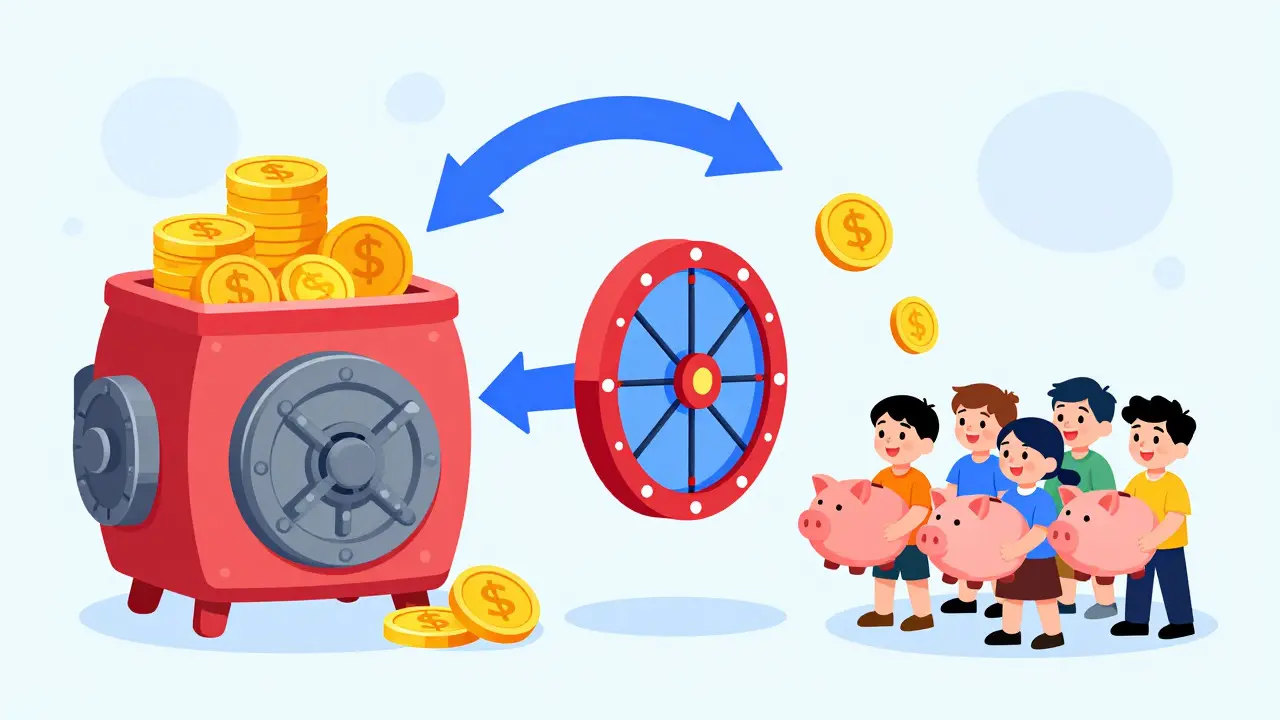
- Bonding: Users don’t just buy GYRO from an exchange. They often "bond" into the system. You deposit an asset (like USDT or BUSD) into the treasury at a discount, and the protocol mints new GYRO tokens for you over time. This process helps grow the treasury while distributing tokens.
- Staking for Yield: Once you hold GYRO, you can stake it back into the protocol. The protocol pays out rewards in GYRO. Because the supply expands rapidly to pay these rewards, the Annual Percentage Yield (APY) appears massive-often cited between 3,000% and 9,000% in community tutorials and blog posts.
This creates a flywheel effect: high yields attract users, who bond more assets, which grows the treasury, allowing the protocol to mint more tokens to pay the yields. It sounds efficient until you ask the critical question: where does the actual profit come from? In many cases, high APYs in DeFi are paid via inflation-printing more tokens to pay early holders. If new money stops flowing in, the value of the token can collapse quickly.
Technical Specifications and Where to Find It
If you decide to interact with Gyro, precision is non-negotiable. There are multiple tokens with similar names, and sending your funds to the wrong address is a common way to lose money permanently.
| Attribute | Detail |
|---|---|
| Blockchain | BNB Smart Chain (BSC) |
| Token Standard | BEP-20 |
| Contract Address | 0x1B239ABe619e74232c827FBE5E49a4C072bD869D |
| Primary Exchange | PancakeSwap v2 |
| Total Supply (Approx.) | ~741,210 GYRO (varies by source) |
| Target Price Floor | $1.00 USD |
You will rarely find GYRO on major centralized exchanges like Coinbase or Binance. While some aggregators list it, they often mark it as "not tradable" directly on their platforms. Your primary venue for buying, selling, or swapping GYRO is PancakeSwap, a decentralized exchange (DEX) on the BNB Chain.
To trade GYRO, you need a self-custody wallet like MetaMask, configured for the BNB network. You’ll need to add the specific contract address listed above to avoid scams. When swapping, you’ll typically pair GYRO with USDT, USDD, or BUSD. Be aware that liquidity can be thin. On days with low activity, slippage-the difference between the expected price and the executed price-can be significant, meaning you might get fewer tokens than you anticipated.
The Data Problem: Why Prices Vary So Wildly
One of the most confusing aspects of researching Gyro is the discrepancy in market data. If you check five different crypto tracking sites, you might see five different prices. This isn’t necessarily a conspiracy; it’s a symptom of being a micro-cap asset with fragmented liquidity.
In mid-2025, several reputable aggregators reported GYRO trading around $1.05 to $1.06, aligning with its theoretical backing. Some niche platforms even showed spikes up to $10.30, likely due to isolated trades in illiquid pools pushing the last traded price upward without reflecting true market depth.
However, by late 2025 and into 2026, other data providers painted a grimmer picture. Some snapshots showed GYRO trading at fractions of a penny (e.g., $0.0000004), with daily volumes under $10. This drastic divergence usually indicates one of two things:
- Liquidity Fragmentation: The main pool on PancakeSwap might be drying up, leaving only tiny, distorted pools on lesser-known DEXes that report erratic prices.
- Data Artifacts: Automated scrapers sometimes pick up testnet transactions or erroneous API calls, reporting false lows or highs.
For an investor, this means the "price" of GYRO is less important than the "liquidity." Can you actually sell 1,000 GYRO tokens right now without crashing the price by 50%? In many micro-cap DeFi projects, the answer is no. Always check the 24-hour volume on PancakeSwap before assuming the token is actively traded.

Risks and Security Considerations
High yield always comes with high risk. With Gyro, the risks are multifaceted. First, consider the smart contract risk. While the broader Gyroscope ecosystem (which includes related tokens like GYD and GYFI) has published audit reports, the original GYRO token’s security history is less transparent. Without regular, public audits from top-tier firms, you are trusting code that hasn’t been fully vetted by the wider community.
Second, there is inflationary dilution. The advertised 9,000% APY is attractive, but remember that these rewards are paid in GYRO itself. If millions of new GYRO tokens are printed every month to pay stakers, the value of each individual token drops unless new buyers enter the market to absorb that supply. This is known as a "death spiral" in algorithmic stablecoin design. If bonding slows down, the treasury shrinks, and the $1 floor becomes meaningless.
Third, beware of token confusion. There is a separate token called "Gyro Spin" on the Ethereum network, and the "Gyroscope" protocol issues GYD and GYFI. These are distinct entities. Sending ETH-based tokens to a BSC wallet, or vice versa, will result in lost funds. Always double-check the chain and the contract address.
Is Gyro Right for You?
Gyro (GYRO) occupies a unique but precarious spot in the crypto landscape. It appeals to "degen" traders-those comfortable with high-risk, high-reward DeFi strategies-who want to earn yield beyond what traditional savings accounts or conservative stablecoins offer. For them, the ability to hedge positions while potentially earning thousands in percentage points of APY is compelling, provided they understand the mechanics of bonding and staking.
However, for the average investor looking for stability, GYRO is likely too volatile and opaque. The lack of clear circulation data, the reliance on a single DEX for liquidity, and the historical precedent of algorithmic stablecoins failing make it a speculative bet rather than a secure store of value. If you choose to participate, treat it as venture capital: allocate only what you can afford to lose, verify all contract addresses manually, and keep a close eye on the treasury health and on-chain activity rather than just the advertised APY.
Is Gyro (GYRO) a stablecoin?
Technically, no. Gyro aims for a minimum value of $1 USD through treasury backing, but it is not hard-pegged like USDT or USDC. This means its price can fluctuate above or below $1 based on market demand and protocol mechanics, making it more volatile than traditional stablecoins.
Where can I buy Gyro (GYRO)?
Gyro is primarily traded on decentralized exchanges, specifically PancakeSwap v2 on the BNB Smart Chain. It is generally not available for direct purchase on major centralized exchanges like Coinbase or Binance. You will need a Web3 wallet like MetaMask and BNB for gas fees to swap assets for GYRO.
Why do different websites show different prices for GYRO?
Gyro is a micro-cap asset with low liquidity. Price discrepancies arise because different aggregators pull data from different liquidity pools. Some may track active, deep pools showing ~$1.00, while others might track tiny, illiquid pools where a single small trade skews the price drastically up or down.
Is the 9,000% APY on Gyro sustainable?
Sustainability is highly questionable. Such high yields are typically funded by token inflation (minting new GYRO to pay rewards) rather than external revenue. If new investors stop entering the system to bond assets, the yield may drop, or the token value may dilute significantly.
What is the difference between Gyro (GYRO) and Gyroscope (GYD/GYFI)?
They are related but distinct. Gyro (GYRO) is the original treasury-backed token on BNB Chain. Gyroscope is a broader protocol that includes GYD (a rules-based stablecoin) and GYFI (a governance token). While they share branding and concepts, they have different contract addresses, blockchains, and economic models.