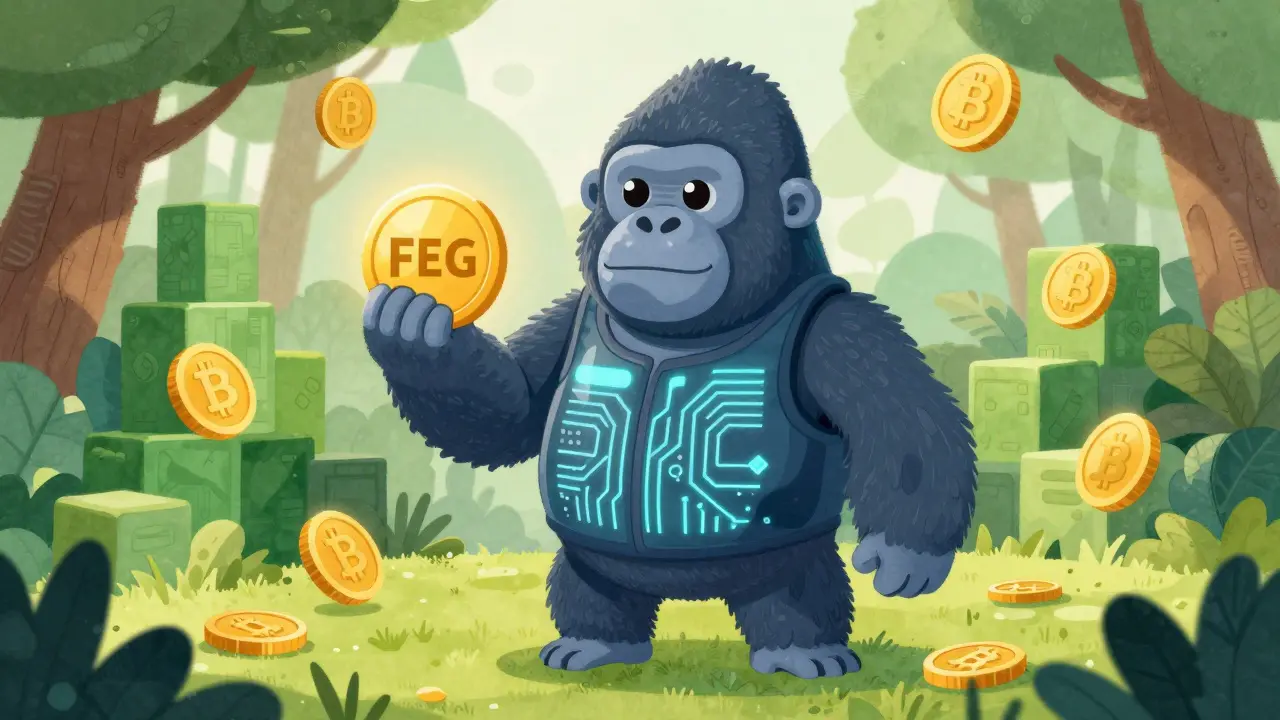
You’ve probably seen the name FEED EVERY GORILLA pop up on social media or crypto trackers. It sounds like a meme coin, and in many ways, it is. But if you look closer, you’ll see it’s trying to be something more: a decentralized finance platform built on the BNB Chain. So, what exactly is FEG, and why should you care?
FEG is a cryptocurrency token that started as a viral meme project in early 2021 but has since pivoted into a utility-focused DeFi ecosystem. Today, it operates primarily on the BNB Chain, offering staking rewards tied to its own transaction volume and the activity of other tokens launched through its platform. It’s not just about holding a coin; it’s about participating in a system designed to generate passive income for holders.
Key Takeaways
- FEG is a BNB Chain token: Originally on Ethereum and BSC, it now lives exclusively on BNB Chain with a much smaller supply.
- Deflationary by design: Every transaction burns a portion of tokens and redistributes fees to holders.
- SmartDeFi ecosystem: The project runs a launchpad for asset-backed tokens, sharing revenue with FEG stakers.
- High risk, high volatility: Like most small-cap meme-inspired coins, prices swing wildly, and transparency remains a concern.
- Charity angle: FEG partners with wildlife conservation groups, adding a philanthropic layer to its brand.
The Evolution from Meme to Utility
To understand where FEG is today, you need to know where it came from. In early 2021, during the peak of the meme coin craze, FEG launched simultaneously on Ethereum and Binance Smart Chain (now BNB Chain). Back then, it had a massive maximum supply of 100 quadrillion tokens. That number sounds absurd, right? It was meant to make the price per token seem tiny, encouraging people to buy millions of them.
But here’s the twist: FEG wasn’t just a joke. It introduced deflationary mechanics. This means that every time someone bought, sold, or swapped FEG, a small percentage of the tokens involved in the trade were permanently destroyed (burned). At the same time, another percentage was redistributed to all existing holders. If you held FEG in your wallet, you automatically earned more FEG just by sitting there. This model, often called "reflection," created a powerful incentive to hold rather than sell.
Over time, the project realized that managing two blockchains was complex and costly. They also wanted to streamline their vision. So, they consolidated everything onto the BNB Chain. This move involved creating a new token contract with a significantly lower total supply-now in the tens of billions rather than quadrillions. For current investors, this matters because the old Ethereum-based FEG tokens are essentially separate from the active ecosystem today. Always check which network you’re dealing with.
How the SmartDeFi Ecosystem Works
If FEG were just a reflection token, it would fade away like hundreds of others. Instead, the team built an infrastructure around it called SmartDeFi. Think of SmartDeFi as a toolkit for launching new crypto projects. Specifically, it’s a token launchpad that aims to create "asset-backed" cryptocurrencies.
Here’s how it works for you as a holder:
- Launchpad Activity: New projects use the SmartDeFi platform to issue their own tokens. These tokens are designed to have underlying value or liquidity backing.
- Revenue Sharing: When these new tokens are traded, a portion of the transaction fees goes back into the ecosystem.
- Staking Rewards: If you stake your FEG tokens, you earn a share of those fees. This means your rewards don’t just come from FEG trades; they come from the entire volume of the SmartDeFi network.
This creates a flywheel effect. More projects launch on SmartDeFi → more trading volume occurs → more fees are generated → FEG stakers earn more. It’s a clever way to give a meme coin actual utility. However, keep in mind that the success of this model depends entirely on whether other developers choose to build on SmartDeFi. Right now, it’s still a niche player compared to giants like Uniswap or PancakeSwap.

Tokenomics: Supply, Burns, and Reflections
Let’s break down the numbers, because in crypto, the math tells the real story. As of mid-2026, the circulating supply of FEG is approximately 97 billion tokens. While this sounds huge, remember that each token is worth fractions of a cent. Data aggregators like CoinGecko and CoinMarketCap list the price hovering around $0.000030. This puts the market capitalization in the low single-digit millions (around $2-$5 million).
The deflationary mechanism remains core to FEG’s identity. Here is the typical fee structure you might encounter when trading:
- Burn Tax: A percentage of each transaction is sent to a burn address, removing it from circulation forever. This slowly reduces supply over time.
- Reflection Tax: Another percentage is distributed instantly to all wallets holding FEG. You don’t need to claim it; it just appears.
- Liquidity/Development: Some fees may go toward maintaining liquidity pools or funding development, though specific allocations can change.
Why does this matter? Because it affects your slippage. When you swap FEG on a decentralized exchange like PancakeSwap, you won’t get the exact amount you expect based on the spot price. You need to set your slippage tolerance higher (often 5-10%) to account for these taxes. If you don’t, your transaction will fail.
Risks and Transparency Concerns
I’m going to be direct with you: FEG is a high-risk asset. It is not a blue-chip investment like Bitcoin or Ethereum. In fact, analysts from firms like Investing.com have historically flagged concerns about transparency. One major issue is wallet concentration. Early data showed that a small number of "whale" wallets controlled significant portions of the supply. When a few addresses hold so much power, they can dump their tokens at any time, crashing the price for everyone else.
Additionally, the project lacks fully doxxed founders. While community-driven initiatives are common in crypto, anonymity makes it harder to hold leadership accountable if things go wrong. There have also been past controversies regarding centralized exchange listings, with some users reporting issues on platforms like BitMart. Currently, FEG is not listed on major Tier-1 exchanges like Coinbase or Binance for trading, meaning you must use decentralized swaps, which carry their own risks of smart contract exploits or user error.
Volatility is another factor. FEG has experienced drops of over 50% in short periods. Its all-time high was around $0.0014, and it has spent much of its life trading far below that level. If you invest money you can’t afford to lose, you’re playing a speculative game, not a stable savings plan.

How to Buy and Store FEG
If you decide to take the plunge, here is the practical path. Since FEG is on the BNB Chain, you need a wallet that supports BEP-20 tokens. Popular choices include Trust Wallet or MetaMask (configured for BNB Chain).
- Get BNB: Buy BNB on a centralized exchange like Binance or Kraken.
- Transfer to Wallet: Send the BNB to your Trust Wallet or MetaMask address. Make sure you select the BNB Chain (BEP-20) network.
- Connect to DEX: Go to PancakeSwap or the official FEGex interface. Connect your wallet.
- Swap for FEG: Paste the correct FEG contract address. Double-check this! Scammers often create fake tokens with similar names. Set your slippage to accommodate the tax.
- Stake (Optional): If you want to earn reflections and SmartDeFi rewards, navigate to the staking section within the FEG ecosystem and lock your tokens.
Never share your private key or seed phrase. Legitimate projects will never ask for it.
Comparison: FEG vs. Traditional Meme Coins
| Feature | Standard Meme Coin | FEED EVERY GORILLA (FEG) |
|---|---|---|
| Primary Value Driver | Hype and Community Sentiment | Utility, Staking Yields, and Ecosystem Growth |
| Blockchain | Often Ethereum or Solana | BNB Chain (Exclusively) |
| Tokenomics | Fixed Supply or Inflationary | Deflationary (Burns) + Reflections |
| Ecosystem | None (Pure Speculation) | SmartDeFi Launchpad, DEX, Charity Partnerships |
| Risk Level | Very High | Very High (but with utility buffer) |
As you can see, FEG tries to bridge the gap between fun and function. But does it succeed? That depends on whether the SmartDeFi platform attracts enough volume to sustain rewards. Without that, it reverts to being just another volatile meme coin.
Future Outlook and Price Predictions
Analysts are divided. Some prediction models from sites like Cryptopolitan suggest potential upside, projecting prices could reach $0.0015 by 2025 or even higher by 2030 if adoption grows. Others remain skeptical, pointing out that the DeFi space is crowded and FEG faces stiff competition from established protocols.
The key metric to watch is the growth of the SmartDeFi launchpad. Are new, legitimate projects building there? Is the total value locked (TVL) increasing? If yes, FEG has a chance to stabilize and grow. If no, it likely continues its cycle of sharp spikes and long declines. Always do your own research (DYOR) and never invest based solely on price predictions.
Is FEED EVERY GORILLA (FEG) a scam?
There is no definitive evidence that FEG is a outright scam, as it has a functioning product, active development, and charity partnerships. However, it carries high risks due to lack of founder transparency, whale concentration, and extreme volatility. Treat it as a speculative asset, not a safe investment.
Which blockchain is FEG on?
Currently, the active FEG token exists exclusively on the BNB Chain (formerly Binance Smart Chain). The original Ethereum version is largely inactive for new ecosystem features. Always ensure you are interacting with the BNB Chain contract.
How do I earn rewards with FEG?
You earn rewards in two ways: through automatic reflections (passive distribution from transaction fees to all holders) and by staking your tokens in the SmartDeFi ecosystem to earn a share of protocol revenues from other launched tokens.
Can I buy FEG on Coinbase or Binance?
No, FEG is not currently listed for trading on major centralized exchanges like Coinbase or Binance. You must purchase it via decentralized exchanges (DEXs) like PancakeSwap using a compatible wallet.
What is the SmartDeFi Launchpad?
SmartDeFi is a platform within the FEG ecosystem that allows developers to launch new, asset-backed crypto tokens. FEG stakers benefit from the transaction fees generated by these new tokens, creating a revenue-sharing model.


Sylvia Mossman
June 23 2026Another meme coin trying to dress up as DeFi. Please.