Imagine a coin that promises to take you to the moon-literally. That is the pitch behind the DOGE-1 Satellite token is an Ethereum-based meme cryptocurrency created to ride the hype of a lunar mission. But before you put your money into it, there is a massive distinction you need to understand: the coin and the actual satellite are not the same thing. In the world of crypto, naming a token after a famous project is a common tactic, but in this case, the gap between the marketing and the reality is wider than the distance to the moon.
Quick Facts: DOGE-1 Token at a Glance
- Blockchain: Ethereum (ERC-20)
- Total Supply: 1 billion tokens
- Transaction Tax: 1% (for project development)
- Primary Exchange: Uniswap V2
- Connection to Mission: None (Purely inspired by the name)
The Great Disconnect: Token vs. Satellite
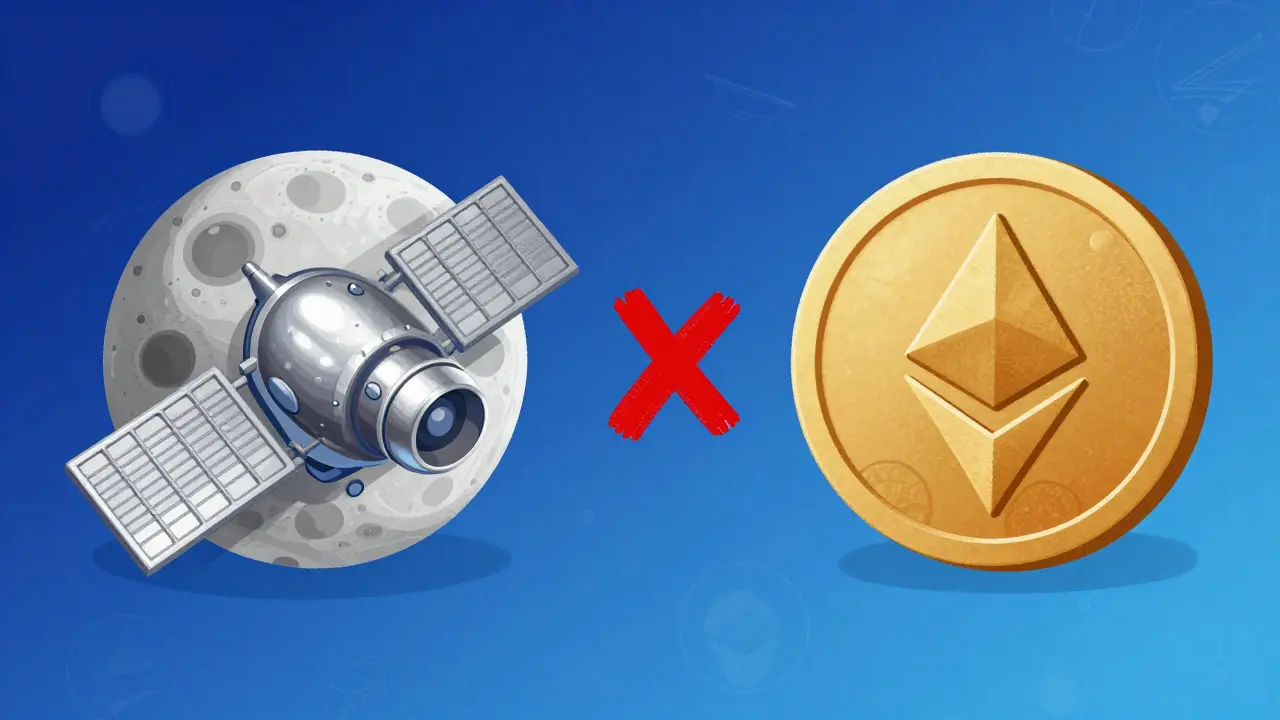
The biggest mistake people make is assuming the DOGE-1 token is the official currency of the lunar mission. It isn't. The actual DOGE-1 Satellite is a 12U CubeSat spacecraft managed by Geometric Energy Corporation and launched via SpaceX. Here is the kicker: that physical satellite was funded using Dogecoin (DOGE), the original meme coin with the Shiba Inu dog, not this specific DOGE-1 token.
While the real mission aims to enter a stable lunar orbit and operate for two years, the DOGE-1 token exists simply as a speculative asset on the Ethereum network. It doesn't control the satellite, it doesn't pay for the fuel, and it has no technical integration with the spacecraft. It is essentially a "fan token" that tried to capitalize on the buzz generated by Elon Musk and the space industry.
Technical Breakdown and Market Reality
Under the hood, DOGE-1 is a standard ERC-20 token. This means it uses the same technical blueprint as thousands of other tokens on Ethereum. There are no proprietary space-tech layers or innovative blockchain breakthroughs here. Its primary feature is a 1% tax on every transaction, which the creators claim goes toward development, though there is little evidence of a roadmap or active GitHub development to show for it.
If you look at the numbers, the market activity is concerningly low. For instance, in late 2025, the 24-hour trading volume on Uniswap V2 dropped to around $95. When trading volume is that low, you run into a problem called slippage. If you tried to buy or sell $100 worth of the coin, you might move the price significantly because there aren't enough buyers and sellers. This makes it an extremely illiquid asset.
| Feature | DOGE-1 Token | Dogecoin (DOGE) | SpaceChain / FOAM |
|---|---|---|---|
| Purpose | Speculative Meme | Payment/Community | Satellite Infrastructure |
| Blockchain | Ethereum | Dogecoin Network | Various |
| Actual Space Assets | None | Funded the DOGE-1 Satellite | Operational Nodes/Sats |
| Market Cap | ~$200,000 (Approx) | $15+ Billion | Variable (Institutional) |
The Risks of "Piggybacking" Tokens
DOGE-1 is a textbook example of a "piggyback" token. This happens when a developer creates a coin and gives it a name that sounds like a legitimate, high-profile project to trick retail investors into thinking there is a partnership. In this case, the token is piggybacking on the success of Geometric Energy Corporation and the prestige of SpaceX.
For a regular person, the risks are high. Not only is the price volatile, but the gas fees on Ethereum can be a nightmare. Imagine spending $8 or $10 in transaction fees just to buy $50 worth of a coin that might crash the next day. That's a scenario many new users have reported on platforms like Reddit. When you combine high entry costs (gas) with low exit liquidity (no buyers), you're essentially trapped in a position.
What the Experts Say (and What They Ignore)
If you search for professional analysis on the DOGE-1 token, you'll find a lot of silence. Serious space industry analysts and blockchain experts generally ignore it because it lacks fundamental value. Most reputable reports focus on the actual satellite mission and its impact on space commercialization, completely omitting the token from the conversation.
You will find price predictions on some niche sites suggesting the coin could jump 500% or more by 2026. However, these predictions are usually based on mathematical models that ignore the fact that the token has no utility. A coin doesn't go up because a chart says so; it goes up because people want to use it or believe it solves a problem. Currently, the only "use case" for DOGE-1 is hoping someone else will buy it from you at a higher price.
How to Spot Meme Traps in the Future
If you're looking at other "space coins" or hyped-up tokens, ask yourself these three questions to avoid the DOGE-1 pitfall:
- Who is actually funding the hardware? Check the official press releases of the company building the tech. If they say they are using "Dogecoin" or "USD," and not the specific token you're looking at, it's a red flag.
- Where is the liquidity? Check a site like CoinGecko. If the 24-hour volume is under $10,000, you may find it impossible to sell your coins without crashing the price.
- Is there a real product? Does the token provide a service (like satellite data or communication), or is the "product" just a promise of future space trading?
Is the DOGE-1 token the official coin of the moon mission?
No. The official lunar mission is funded by Dogecoin (DOGE), not the DOGE-1 token. The DOGE-1 token is a separate, unofficial project created on the Ethereum network to capitalize on the mission's popularity.
Where can I buy the DOGE-1 token?
The token is primarily available on decentralized exchanges, specifically Uniswap V2 on the Ethereum network. Because it isn't listed on major centralized exchanges, you'll need an Ethereum-compatible wallet like MetaMask to trade it.
Why is the DOGE-1 token price so low?
The low price is a result of very limited demand, a lack of real-world utility, and a small community. Most of its value was driven by initial hype, which has since faded as investors realized the token has no connection to the actual satellite.
What is the 1% transaction tax on DOGE-1?
A 1% tax is applied to every buy and sell transaction. This money is intended to fund the project's development, though there is very little public evidence of active development or a clear roadmap.
Is investing in DOGE-1 risky?
Yes, extremely. It has very low liquidity, no institutional backing, and no actual utility. It is a highly speculative meme coin where you risk losing your entire investment due to price crashes or an inability to find a buyer.


Siddharth Bhandari
April 8 2026The slippage mentioned here is a critical point for anyone looking at low-cap ERC-20 tokens. When liquidity is that thin, the price impact on a trade is massive, effectively making it impossible to exit a position without destroying the remaining value.