Most people hear about Bitcoin and think of it as a store of value. But in the last few years, a new layer has emerged on top of it: the BRC-20 standard. This protocol allows users to create and trade tokens directly on the Bitcoin network, something that was previously impossible without sidechains or wrapped assets. Amid this growing ecosystem, a specific project called BRC-20 DEX, with its native token BD20, has positioned itself as a key infrastructure piece. It aims to solve a major pain point: how do you easily move these Bitcoin-native tokens to other networks like Ethereum or Binance Smart Chain for trading?
If you are looking at BD20 on a price tracker and wondering what it actually does, you are not alone. The name suggests it is an exchange, but the reality is more nuanced. It is a specialized decentralized exchange (DEX) and a cross-chain bridge focused specifically on the BRC-20 asset class. Unlike generic DEXs that handle thousands of unrelated tokens, BRC-20 DEX is built to serve the niche community interested in inscribing and trading tokens on Bitcoin’s ledger. Understanding BD20 means understanding the unique challenges of bridging assets from a non-smart-contract chain (Bitcoin) to smart-contract chains (EVM).
The Core Function: A Bridge for Bitcoin Tokens
To grasp why BD20 exists, you have to look at the technical limitation of Bitcoin. Bitcoin was designed to be simple and secure, which meant it lacked the flexibility to run complex smart contracts natively. When the BRC-20 standard launched in 2023, it used data inscriptions to simulate tokens on Bitcoin. However, these tokens were stuck there. You couldn't easily use them in DeFi protocols on Ethereum or swap them on Uniswap because the networks didn't talk to each other.
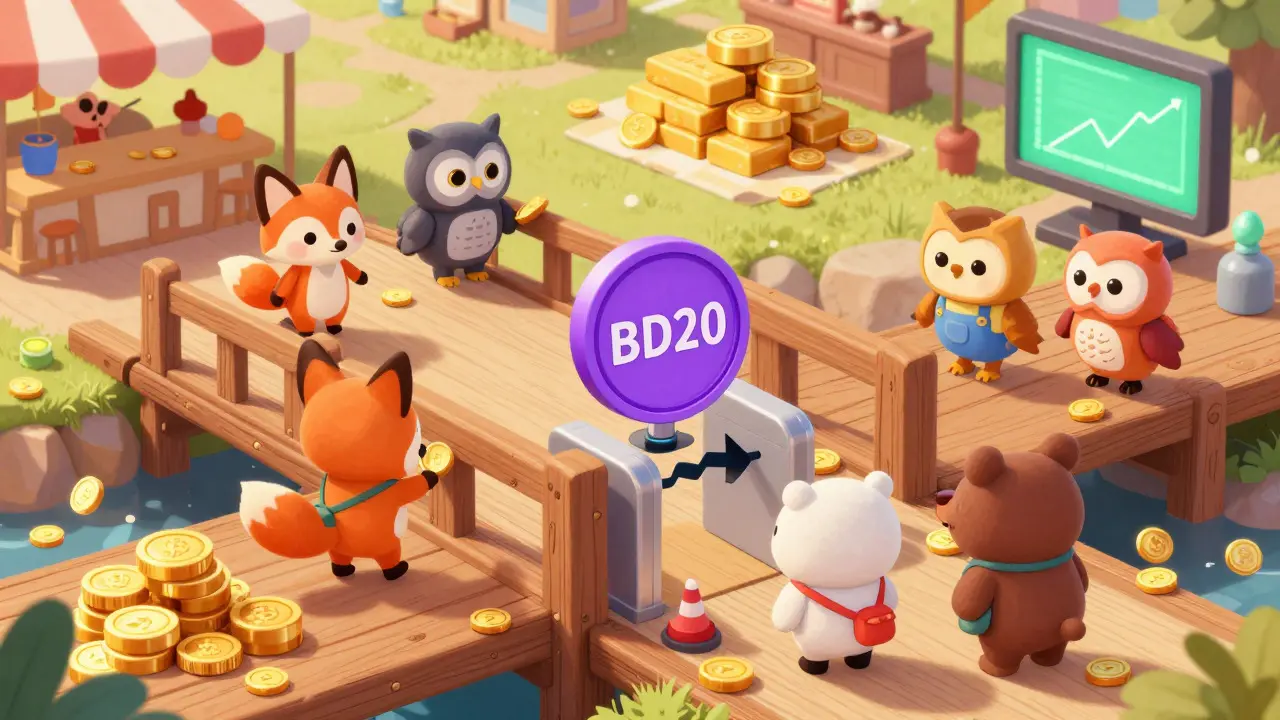
BRC-20 DEX acts as the translator. Its primary utility is a bridge that allows users to lock their BRC-20 tokens on the Bitcoin network and receive equivalent representations on EVM-compatible networks like Ethereum or BNB Chain. This process makes the assets usable in the broader DeFi ecosystem. The cross-chain bridge mechanism enables seamless transfer of BRC-20 assets between Bitcoin and EVM networks. For traders, this means they can hold their assets on Bitcoin for security but move them to Ethereum when they want to participate in yield farming or complex swaps.
The token, BD20, serves as the fuel for this system. Just as ETH pays for gas on Ethereum, BD20 is used to pay transaction fees within the BRC-20 DEX ecosystem. If you use the bridge or trade on the associated DEX, you pay in BD20. This creates a direct demand driver for the token: the more activity on the platform, the more BD20 is needed to cover those costs.
Tokenomics: Supply, Distribution, and Governance
When evaluating any crypto asset, the supply model is critical. BD20 has a fixed maximum supply of 1,000,000,000 (1 billion) tokens. This hard cap prevents inflationary pressure from eroding the token's value over time, a common concern with many utility tokens that have unlimited mints. As of mid-2025, data from aggregators like CoinStats indicated that the circulating supply was either very low or not fully integrated into public APIs, leading to some confusion regarding market capitalization figures.
The token serves two main purposes beyond fee payment:
- Governance: Holders can vote on proposals that affect the development of the BRC-20 DEX platform. This includes decisions on fee structures, new bridge integrations, and treasury management.
- Fee Discounts: Using BD20 to pay for transactions often comes with lower rates compared to paying in other stablecoins or native assets, incentivizing users to hold and use the token.
It is worth noting that unlike some newer projects that use algorithmic mechanisms to maintain price stability, BD20 relies on organic demand from usage. There is no peg to a fiat currency or another crypto asset. Its value is derived from its utility within the BRC-20 ecosystem. If the ecosystem grows and more people use the bridge, the demand for BD20 should theoretically increase. Conversely, if the BRC-20 trend fades, the utility demand could drop significantly.
Multi-Chain Deployment and Compatibility
One of the most interesting aspects of BD20 is its multi-chain nature. While it is born from the Bitcoin BRC-20 movement, it is not limited to Bitcoin. The token has been deployed on multiple networks to maximize accessibility:
| Network | Standard | Primary Use Case | Wallet Compatibility |
|---|---|---|---|
| Bitcoin | BRC-20 Inscription | Native holding, long-term storage | Unisat, OKX Wallet, Ordinals apps |
| Ethereum | ERC-20 | DeFi integration, high-security holding | MetaMask, Phantom |
| Binance Smart Chain | BEP-20 | Low-cost trading, PancakeSwap liquidity | Trust Wallet, MetaMask |
This multi-chain strategy lowers the barrier to entry. You don't need to be an expert in Bitcoin ordinals to interact with BD20. If you prefer the user-friendly interface of MetaMask on Ethereum or the low fees of BNB Chain, you can hold and trade BD20 there. The bridge ensures that the total supply remains consistent across these networks, preventing double-spending or inflation issues that can arise in poorly managed cross-chain systems.
Where to Trade BD20: Liquidity and Exchange Listings
A common question for new investors is: "Where can I buy BD20?" The answer is somewhat complicated by the fact that BD20 is not listed on the largest centralized exchanges like Binance or Coinbase for direct spot trading. Instead, its liquidity is concentrated on mid-tier centralized exchanges and decentralized venues.
Based on recent trading data, the most active markets for BD20 include:
- Gate.io: This exchange handles the majority of BD20 volume, particularly in the BD20/USDT pair. It is one of the primary entry points for retail traders looking to buy the token.
- Bilaxy: Another significant venue for BD20 trading, often paired with BNB.
- PancakeSwap: On BNB Chain, you can swap WBNB for BD20 using the v2 or v3 pools. This provides a decentralized option for those who prefer avoiding centralized custodial risk.
Because the liquidity is spread across these smaller platforms, slippage can be higher than on major exchanges. If you plan to move a large amount of BD20, it is advisable to break your order into smaller chunks or use limit orders to avoid impacting the price unfavorably. Additionally, price discrepancies between these venues are common. For instance, the price on Gate.io might differ slightly from the price on PancakeSwap due to differences in order book depth and arbitrage activity.

Risks and Considerations for Investors
No investment is without risk, and BD20 carries specific risks tied to its niche status. First, it is a micro-cap asset. Market capitalization figures have varied widely across trackers, ranging from near-zero placeholders to low five-figure valuations, depending on how circulating supply is calculated. This volatility makes it difficult to assess true market size and adoption levels.
Second, there is technological risk. The BRC-20 standard is still relatively new. While it has gained traction, it competes with other Bitcoin scaling solutions like Lightning Network and various Layer-2 rollups. If the community decides that BRC-20 is not the future of Bitcoin tokens, the utility of BD20 could diminish. Furthermore, cross-chain bridges are historically vulnerable to exploits. While BRC-20 DEX aims for security, the complexity of moving assets between such different architectures (Utxo-based Bitcoin vs. Account-based EVM) always introduces potential attack vectors.
Finally, regulatory clarity is lacking. Because BD20 operates on multiple chains and functions as both a utility and governance token, its classification under securities laws varies by jurisdiction. Investors should consider their local regulatory environment before committing significant capital.
How to Get Started with BD20
If you decide to explore BD20, here is a practical roadmap to get involved safely:
- Choose Your Venue: Decide whether you want to use a centralized exchange (like Gate.io) for ease of use or a DEX (like PancakeSwap) for decentralization. CEXs are generally easier for beginners, while DEXs offer more control over private keys.
- Set Up a Wallet: If using a CEX, just create an account. If using a DEX, ensure you have an EVM-compatible wallet like MetaMask or Trust Wallet funded with BNB or ETH for gas fees.
- Execute the Trade: Search for the BD20 pair. On Gate.io, look for BD20/USDT. On PancakeSwap, search for the BD20/WBNB pool. Start with a small position to test the waters and familiarize yourself with the interface.
- Monitor the Ecosystem: Keep an eye on the official channels of BRC-20 DEX for updates on bridge upgrades, new listings, or governance votes. Since the project is young, developments can happen quickly.
Remember, BD20 is not a passive investment like Bitcoin. It requires active monitoring of the BRC-20 ecosystem and the specific performance of the BRC-20 DEX platform. Its success is tied directly to the growth of Bitcoin-native tokenization.


David Powell
August 27 2026Finally, a token that actually tries to solve the 'bridge' problem instead of just minting another memecoin with a monkey on it. The BRC-20 standard is technically fascinating, but let's be honest, most people using it are just gambling on inscriptions. BD20 positions itself as infrastructure, which is a bold claim for something with such thin liquidity. If they can maintain the bridge security without getting exploited like every other cross-chain protocol from the last three years, maybe there is some merit here. But until we see real volume on Gate.io beyond bot activity, I am keeping my distance. It is nice to see someone trying to build utility on Bitcoin rather than just shouting about halving cycles.