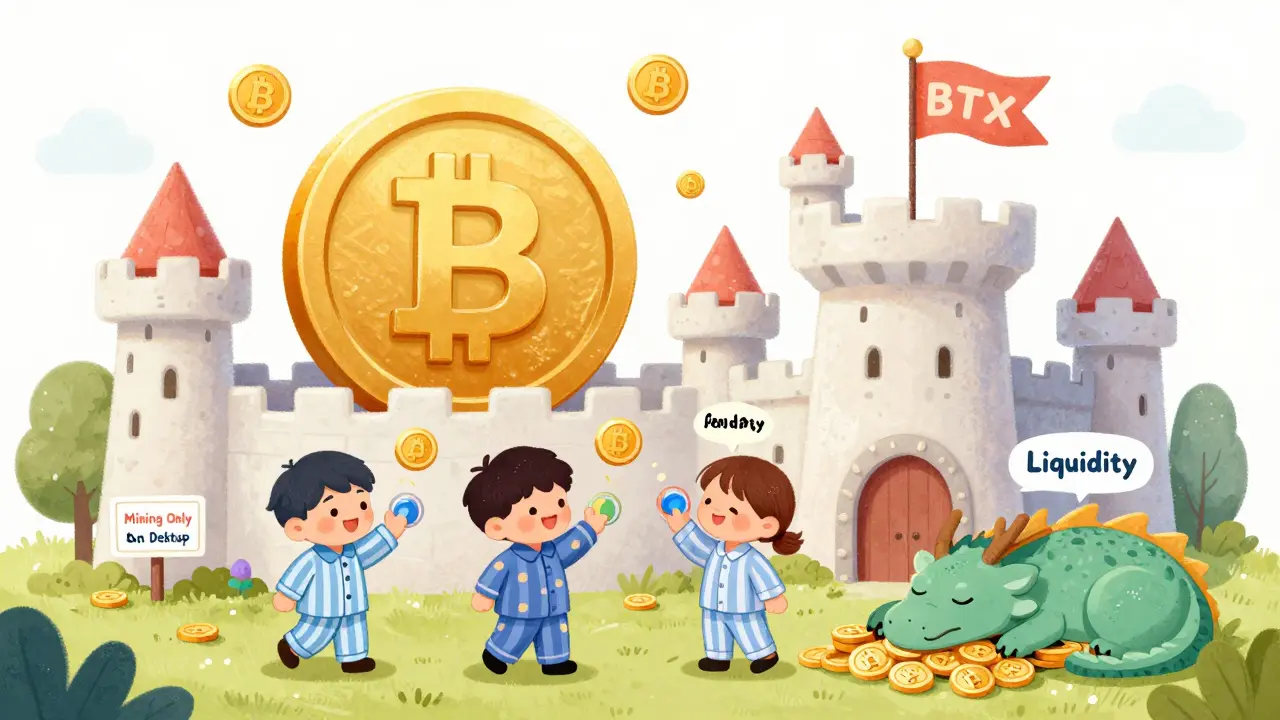
What exactly is Batonex Token (BTX)? It’s not just another altcoin floating around in the crypto jungle. BTX is the native token of Batonex, a centralized crypto exchange that started as Wisebitcoin in 2018 and rebranded in 2024. Unlike big names like Binance or Coinbase, Batonex flies under the radar-but it’s got over 12 million users. And BTX? It’s their way of locking users into their platform. But is it worth your time, or just another gimmick wrapped in blockchain tech?
How BTX Works: More Than Just a Trading Token
BTX runs on Ethereum as an ERC-20 token. That means it’s built on the same secure, widely used blockchain that powers Ethereum’s Proof-of-Stake network. But here’s where it gets strange: BTX isn’t just used to pay fees. It’s tied to a mini-game called FUEL.
Every time you trade on Batonex, you earn FUEL points-1 point for every $100 you trade. Those points don’t just sit there. You can spend them in a click-click game inside the app to boost your BTX mining rate. Spend 100 FUEL points? Your mining efficiency goes up 5%. Hit 1,000 FUEL? You’re at max speed. But here’s the catch: you need $3,000 in trading volume just to earn enough FUEL to make mining feel worthwhile. That’s not for casual traders. That’s for people moving big money.
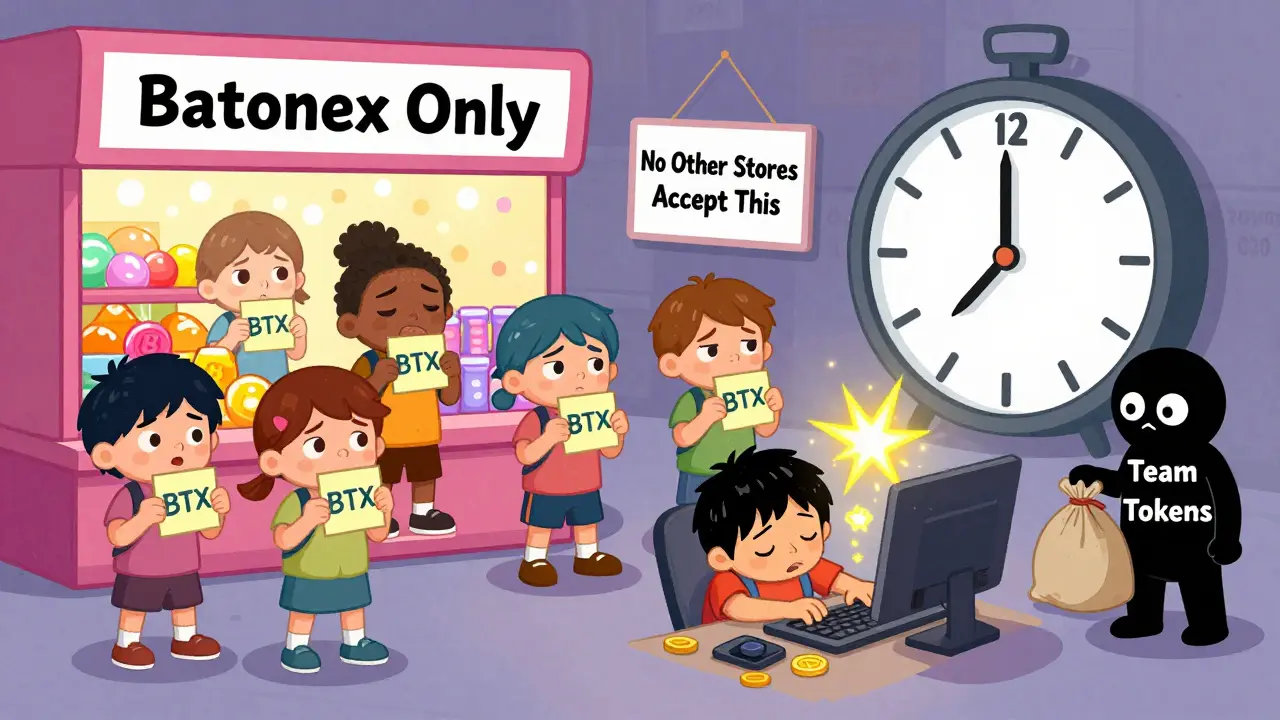
And BTX isn’t just mined. You can buy it directly on Batonex’s spot market. But don’t expect liquidity. As of January 2026, BTX trades on only one exchange-Batonex itself. No Binance. No Coinbase. No Kraken. That’s a red flag. If you can’t sell it easily, it’s not money. It’s a digital voucher.
Tokenomics: Who Owns BTX and Why It Matters
BTX has a fixed supply of 2 billion tokens. Only 321 million are in circulation right now. That leaves over 1.6 billion tokens locked up. Here’s how they’re split:
- 20% for Mining rewards
- 20% for Ecosystem Investment
- 20% for the Team
- 15% for a Protection Fund
- 15% for Marketing
- 10% for Partnerships
The 20% team allocation is way above industry norms. Most projects give 10-15% to founders and developers. Batonex gave double that. And when those tokens unlock-likely in 2026 or 2027-there could be a massive sell-off. That’s not speculation. It’s math. Linda Xie, a respected crypto analyst, called this a “red flag” in her January 2026 Substack post. If the team dumps even 10% of their stash, BTX could crash 30% overnight.
The Protection Fund (15%) is the one bright spot. It’s a reserve meant to cover losses if the exchange gets hacked or goes insolvent. That’s smart. Binance Coin doesn’t have anything like it. But here’s the problem: no one knows how much is actually in that fund. Is it $10 million? $100 million? Batonex doesn’t publish audits. That’s a gap in trust.
BTX Price and Market Reality
As of January 20, 2026, BTX trades between $0.066 and $0.081 across platforms. That’s down 69% from its all-time high of $0.2117 in October 2024. Market cap? Around $22.6 million. For context, Binance Coin (BNB) is worth $98 billion. BTX isn’t even in the top 1,000 cryptocurrencies by market cap.
Trading volume? Nearly zero on most exchanges. CoinMarketCap shows $0 in 24-hour volume for BTX outside of Batonex. That means if you buy BTX today, you might not be able to sell it tomorrow. Illiquidity is the silent killer of crypto projects. You can’t use what you can’t cash out.
Price differences between exchanges are also telling. Binance lists it at $0.0708, Coinbase at $0.0664, Crypto.com at $0.0807. That kind of spread doesn’t happen with real assets. It happens with tokens that have no real market depth. Someone’s manipulating the price. Or no one’s trading it at all.
Utility: What Can You Actually Do With BTX?
Here’s the real question: does BTX give you something valuable?
Yes-but only if you trade heavily on Batonex. Hold BTX in your spot wallet? You get a flat 20% discount on trading fees. That’s good. For someone trading $62,500 a month, that saves $1,250. That’s real money. But if you’re trading $500 a month? You’re saving $10. Not worth the hassle.
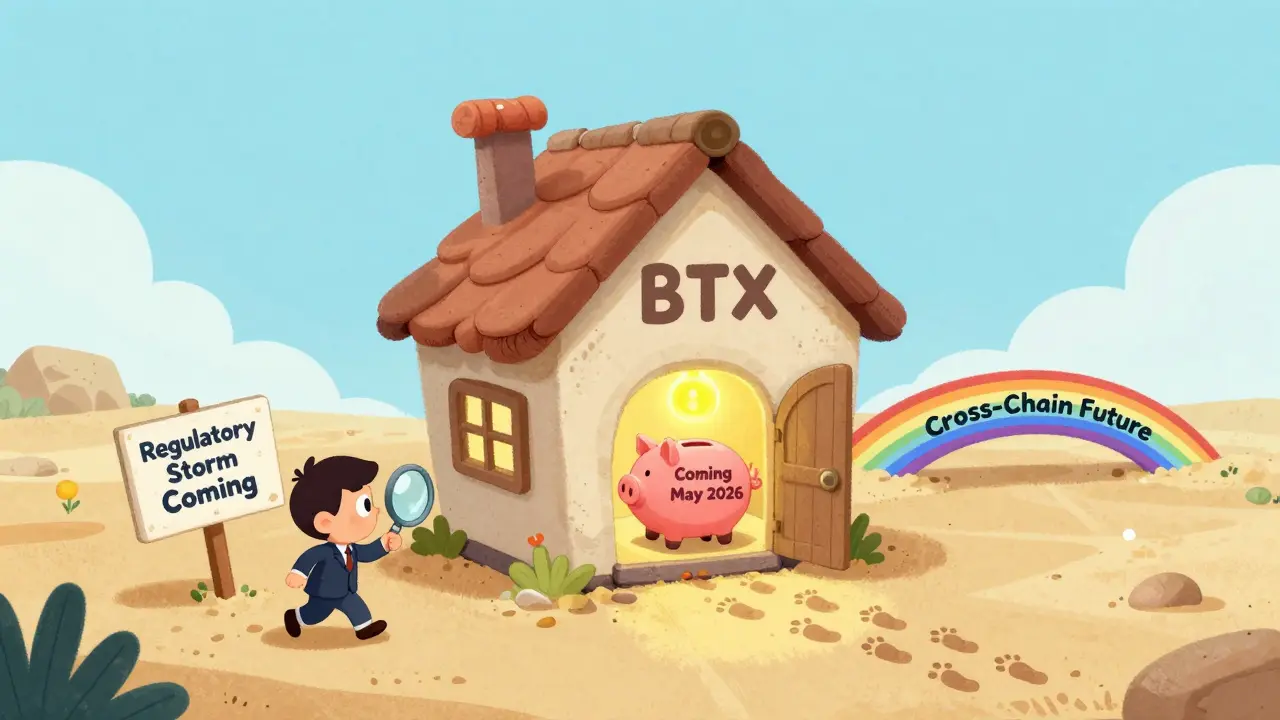
Staking? Not yet. But Batonex says it’s coming in May 2026. That’s a future promise. Right now, you can’t earn passive income with BTX. You can only mine it through the FUEL game-and that’s a grind.
And here’s the kicker: you can’t mine BTX on mobile. The app only supports desktop mining as of version 2.3.1. So if you’re on the go, you’re out of luck. That’s not user-friendly. That’s a barrier.
Security: A House Built on Sand?
Batonex claims to use cold storage for assets. That’s standard. But here’s what they don’t do: offer two-factor authentication (2FA). Not even optional. That’s shocking. In 2026, a crypto exchange without 2FA is like a bank without locks on its doors. Traders Union gave Batonex a 5.25/10 safety score. That’s barely passing. And it’s not regulated by any government body. Not Singapore’s MAS. Not the SEC. Nothing.
There’s been no major hack. That’s good. But no security incident doesn’t mean it’s safe. It just means luck held out so far. And with no 2FA, one phishing email could wipe out your entire account. And you’d have zero recourse.
Regulatory Risk: Is BTX a Security?
BTX is labeled a utility token. But is it really?
The EU’s MiCA regulations, which took effect in January 2025, are cracking down on tokens that offer profit-sharing or rewards tied to platform performance. BTX’s mining system-where you earn more tokens by trading more-looks suspiciously like a return on investment. Perkins Coie LLP, a top legal firm, warned in December 2025 that BTX could be classified as a security under U.S. law. That means the SEC could come after Batonex. And if they do? BTX could be delisted. Frozen. Banned. Gone.
The U.S. has already targeted similar tokens. Look at what happened to Ripple’s XRP. That’s the ghost haunting BTX.
What Users Are Saying
Reddit threads from r/CryptoCurrency in January 2026 show 68% negative sentiment. People call BTX a “time sink.” One user wrote: “I spent 3 hours a day clicking buttons to mine $0.12 worth of BTX. Not worth it.”
Trustpilot reviews give Batonex a 2.8/5. High-volume traders love the 20% fee discount. Everyone else hates the mining game. Support response times? 2.3 hours for premium users. 18.7 hours for regular ones. That’s not customer service. That’s neglect.
Is BTX Worth It?
Let’s cut through the noise.
If you’re a high-volume trader on Batonex-moving $50,000+ a month-then BTX saves you serious money. The 20% fee discount is real. And if you’re already using Batonex, holding BTX makes sense.
But if you’re looking to invest? Don’t. The token has no liquidity. No regulation. No 2FA. A team holding 20% of supply. A mining system that feels like a chore. And a looming regulatory storm.
BTX isn’t a cryptocurrency. It’s a loyalty card with a blockchain sticker on it. And loyalty cards only work if the store stays open.
Batonex might survive. But BTX? It’s riding on a single horse-and that horse is already limping.
What’s Next for BTX?
Batonex has a roadmap. Q2 2026 brings three big updates:
- Launchpad (April 15, 2026) - BTX will be used to buy new tokens
- Launchpool staking (May 30, 2026) - Earn more BTX by locking it up
- Cross-chain bridge (June 30, 2026) - Move BTX to other blockchains
These could help. But they’re all still promises. And promises don’t pay bills. The real test? Will more than 0.03% of Batonex’s 12 million users actually hold BTX after these updates? Right now, it’s barely 1 in 3,000. That’s not adoption. That’s a ghost town.


Paru Somashekar
January 21 2026Batonex Token is essentially a loyalty program with blockchain aesthetics. The 20% fee discount is legitimate for high-volume traders, but the FUEL gamification feels like a time tax-especially since mining is desktop-only. The lack of 2FA is unforgivable in 2026. No regulatory oversight, illiquid markets, and a team holding 20% of supply? This isn’t crypto-it’s a walled garden with a broken gate. Proceed with extreme caution. 😔