AID Token Verification Tool
This tool helps you verify which AID project your token address belongs to. As explained in the article, there are two completely different projects sharing the same ticker. Enter the contract address to check:
Paste the token contract address you want to verify
Enter a contract address to verify the AID project
When you search for AID crypto, you’re not looking at one coin - you’re looking at two entirely different projects that happen to share the same ticker. This isn’t a typo. It’s a mess. And if you’ve ever tried to send AID to a wallet and got the wrong token, you know exactly how confusing this is.
The Charity Coin: AidCoin (AID)
The original AID, often called AidCoin, was launched in late 2017 by a Swiss company called CharityStars. Its goal was simple: make charitable donations transparent. Every dollar you give through AidCoin was supposed to be trackable - from your wallet, to the charity’s wallet, to the food, medicine, or shelter it actually bought. It runs on Ethereum as an ERC-20 token. Total supply? 42,547,119 AID. That’s fixed. No more will ever be created. The smart contract is public, verified on Etherscan. You can see every transaction that’s ever happened. The platform, called AIDChain, includes a wallet, a public tracker called AIDTrack, and an internal exchange to swap BTC, ETH, or LTC for AID. Sounds great, right? Especially when you consider the global charity sector loses billions every year to fraud and poor tracking. But here’s the problem: almost no one uses it anymore. As of December 2025, AidCoin’s 24-hour trading volume is $0.00. Zero. Not $1. Not $10. Zero. CoinMarketCap shows over 42.5 million tokens in circulation, but nobody’s buying or selling. The price? Around $0.011. That’s not a crash - it’s a ghost town. Why? Because the system doesn’t work for small donations. If you try to send $3 to a charity using AidCoin, the Ethereum gas fee might be $5. That’s not transparency - that’s a tax on kindness. A 2024 Red Cross test found 67% of donations under $5 were uneconomical to process. CharityStars, the company behind it, has all but abandoned the project. In 2025, they spent 8% of their resources on blockchain and 72% on traditional fundraising. Only 147 charities are registered on their platform. There are over 1.5 million registered charities in the U.S. alone. User reviews on Trustpilot average 2.1 out of 5. Complaints? Slow support, frozen interfaces, and wallets that don’t connect. One Reddit user tried to send $5,000 to a Ukraine aid campaign. The system froze. Support took 14 days to reply - with a copy-paste template. And then there’s the legal shadow. In 2023, the SEC classified AidCoin as a security under the Howey Test. That means it’s effectively banned from being sold to U.S. investors. That killed any real chance of adoption in the world’s largest donor market.The AI Blockchain Coin: AID (The Other One)
Now, here’s the other AID - the one you’re more likely to hear about in 2025 if you’re into AI and DeFi. This AID isn’t about charity. It’s about artificial intelligence running on blockchain. It’s a standalone blockchain platform with four integrated modules: AID.Data (for AI training data), AIDefi (AI-powered lending and yield optimization), AIDSocialFi (AI-driven social finance), and AID.Ex (a decentralized exchange built for AI agents). Total supply? 100 million tokens. It doesn’t run on Ethereum. It has its own chain. And it’s fast - claims 1,200 transactions per second. Ethereum does 15 to 30. That’s a big deal if you’re building AI bots that need to trade or execute contracts in real time. Price? Around $8.03 as of December 2025. Daily volume? Nearly $1 million. That’s not a dead coin. That’s a living project with traction. It’s backed by Digital Currency Group, which also owns Grayscale and CoinDesk. In November 2025, it secured a $15 million Series B round. It’s integrated with Chainlink’s oracle network, so it can pull real-world data into AI models - like stock prices, weather, or supply chain info - to make smarter financial decisions. AIDefi v2, its AI lending protocol, outperformed non-AI competitors by 17.3% in yield optimization during Q3 2025, according to internal tests. That’s not marketing fluff - it’s measurable. User reviews? 4.3 out of 5 on Trustpilot. People love the dashboard. They hate the learning curve. If you’re not technical, this isn’t for you. But if you’re a developer or a DeFi power user, this is one of the few projects trying to merge AI and blockchain in a real, usable way. Critics say it’s overpromising. A third-party audit in November 2025 found only 43% of claimed AI features were fully functional. But the team is active - 84 GitHub commits in November 2025 alone. They’re building. The charity AID? Two commits in Q4 2025.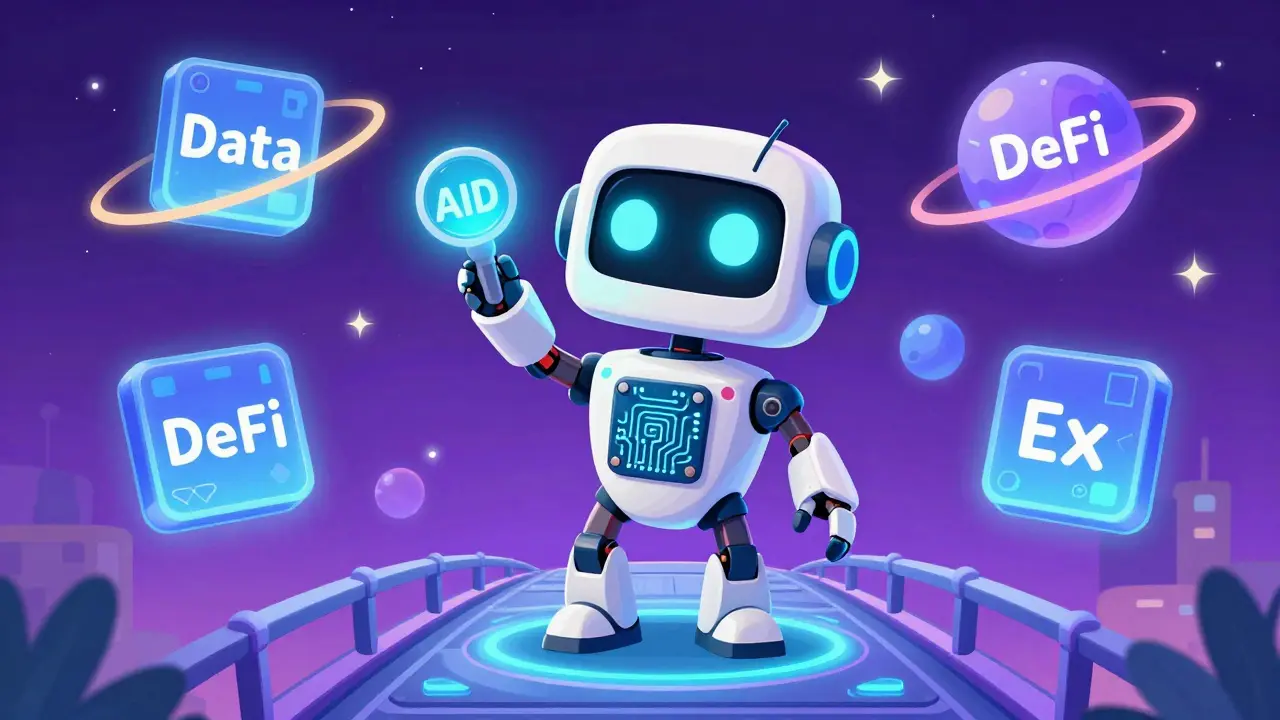
Why This Confusion Matters
You think this is just a naming issue? Think again. CoinDesk reported that 27% of all AID-related support tickets at major exchanges in 2025 were from people who sent the wrong token. Someone meant to send AI-focused AID to their wallet. They sent charity AID instead. The charity AID vanished. No recovery. No refund. Just gone. Exchanges haven’t fixed this. They still list both under “AID.” No clear labels. No warnings. Just two coins with the same name, different blockchains, different purposes, and zero compatibility. If you’re a donor? You want AidCoin. But you need to know it’s dead. No liquidity. No support. No future. If you’re an investor or developer? You want the AI AID. But you need to understand the risks. It’s still early. Features are incomplete. The market is competitive - Fetch.ai and SingularityNET are bigger, more established.Who’s Winning?
The charity blockchain space is growing. Grand View Research says it’ll hit $4.3 billion by 2025. But AidCoin’s market share has dropped from 0.3% in 2022 to 0.08% in 2025. It’s being crushed by Binance Charity, which processed $120 million in crypto donations last year - all with simple BNB transfers. No fancy token. No blockchain tracker. Just a trusted platform. The AI blockchain market? Even bigger. MarketsandMarkets predicts $18.9 billion by 2027. AID (AI version) holds 0.7% of that. Not huge. But growing. With institutional funding, active devs, and real use cases, it has a shot.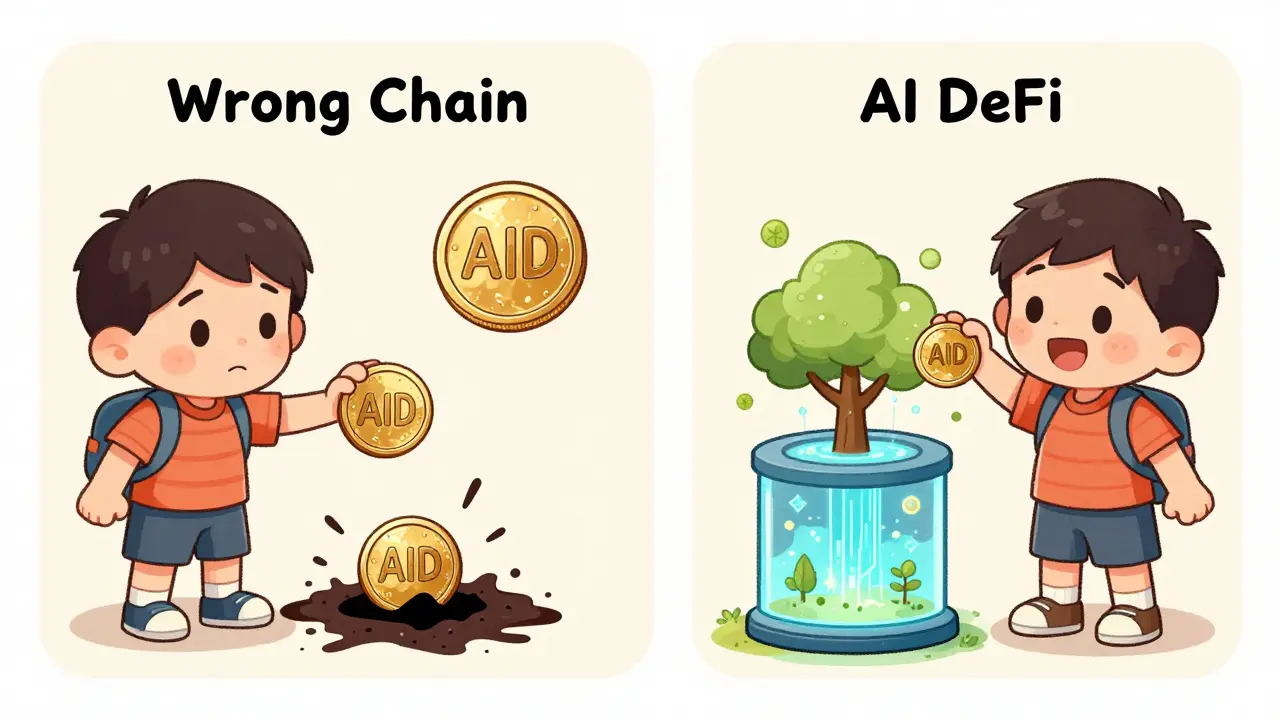


Joe West
December 7 2025Just wanted to say this post saved me from a total disaster. I almost sent $2k worth of AID to my wallet thinking it was the AI one, but I checked the contract address last minute. Thank you for the clarity. The charity one is a ghost town - don’t waste your time. The AI AID? Still early, but the dev activity is real. GitHub commits don’t lie.
Also, Binance Charity is way easier. No gas fees, no confusion. Just send ETH or USDT and move on.