Before mining pools, solo miners had a slim chance of earning anything. Imagine trying to win the lottery by buying one ticket every month. That’s what solo Bitcoin mining felt like in 2011. The difficulty kept rising, and your home rig was just too slow. Then came mining pools - a simple idea that changed everything: join forces.
Why Mining Pools Exist
Bitcoin’s blockchain requires solving a complex math puzzle to add a new block. The first miner to solve it gets rewarded with new Bitcoin plus transaction fees. But as more miners joined, the puzzle got harder. By 2013, even powerful rigs took years to find a block alone. That’s when miners started teaming up. Instead of waiting months for a big payout, they shared the work - and the rewards. A mining pool is a group of miners who combine their computing power (hashrate). Each miner contributes their rig’s processing strength to solve the puzzle faster. When the group finds a block, the reward is split among participants based on how much work each one did. It’s like a weekly lottery where everyone buys a ticket together - you get smaller wins more often, but you never go home empty-handed.How Mining Pools Actually Work
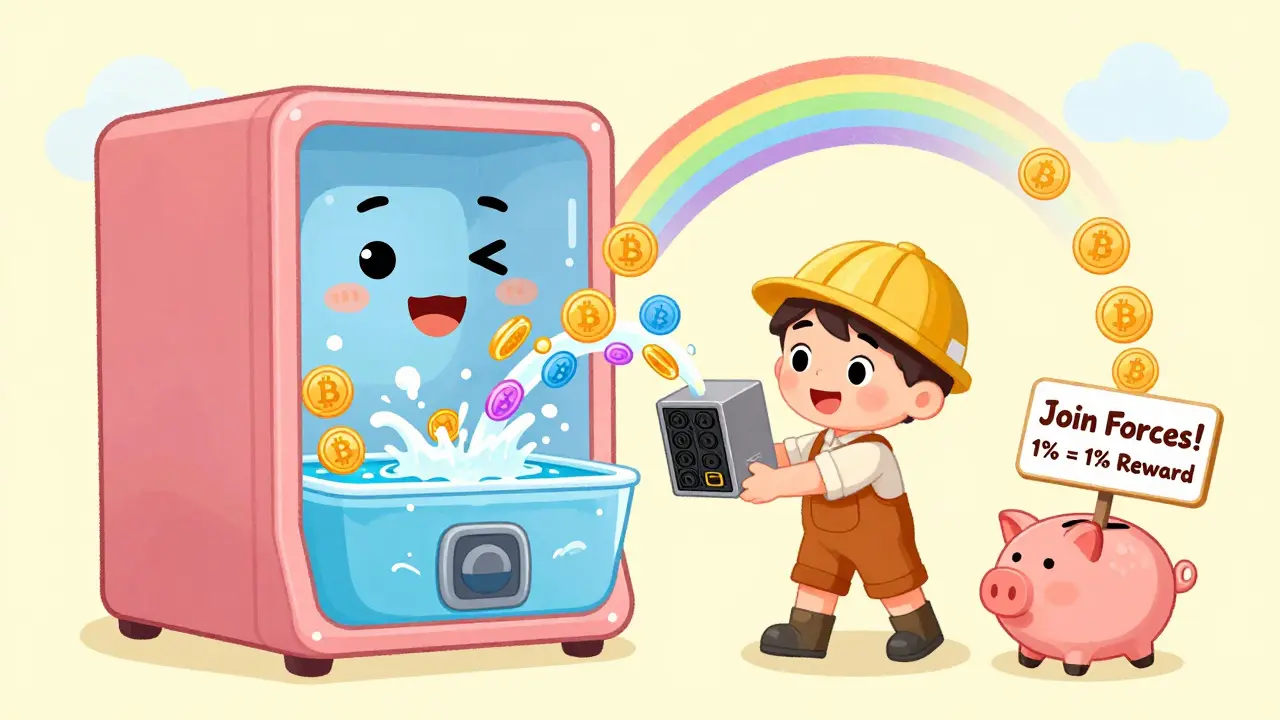
Here’s the technical side, broken down simply. Your mining rig doesn’t try to solve the full Bitcoin puzzle alone. Instead, the pool sends you smaller, easier versions of the puzzle called “shares.” These aren’t blocks - they’re proof you’re doing work. You submit shares to the pool server every few seconds. The pool tracks how many shares each miner submits over time. When the pool finally solves the real block, it pays out rewards based on your share of total shares submitted during that round. For example, if you contributed 1% of the pool’s total hashrate, you get roughly 1% of the block reward. The pool operator takes a fee - usually between 1% and 4% - to cover server costs and maintenance. Most pools today use the Stratum protocol, which cuts down on bandwidth by 90% compared to older systems. This means your miner doesn’t need a super-fast internet connection. Just stable Wi-Fi or Ethernet will do. You connect your mining software (like CGMiner or BFGMiner) to the pool’s server address, enter your wallet details, and start mining.Top Mining Pools in 2025
As of October 2024, just a handful of pools control most of Bitcoin’s network. The top five - Foundry USA, AntPool, F2Pool, Viabtc, and Poolin - hold over 70% of the total hashrate. Here’s how they compare:| Pool Name | Hashrate Share | Fee | Payout Threshold | Best For |
|---|---|---|---|---|
| Foundry USA | 28.1% | 0% | 0.01 BTC | Institutional miners |
| AntPool | 22.7% | 2.5% | 0.001 BTC | Global users, auto-conversion |
| F2Pool | 14.3% | 3% | 0.001 BTC | Chinese-speaking miners |
| Viabtc | 9.8% | 2.5% | 0.005 BTC | Altcoin miners |
| Luxor | 4.1% | 2.5% | 0.001 BTC | US-based retail miners |
Foundry USA charges no fees but only accepts large-scale operations. Luxor is popular among North American users because it follows U.S. regulations. F2Pool and AntPool are trusted by millions, but they’ve raised fees before - sometimes without warning. One user on Reddit reported losing $12 in earnings after F2Pool jumped from 2.5% to 3% in January 2024.
Pros and Cons of Joining a Pool
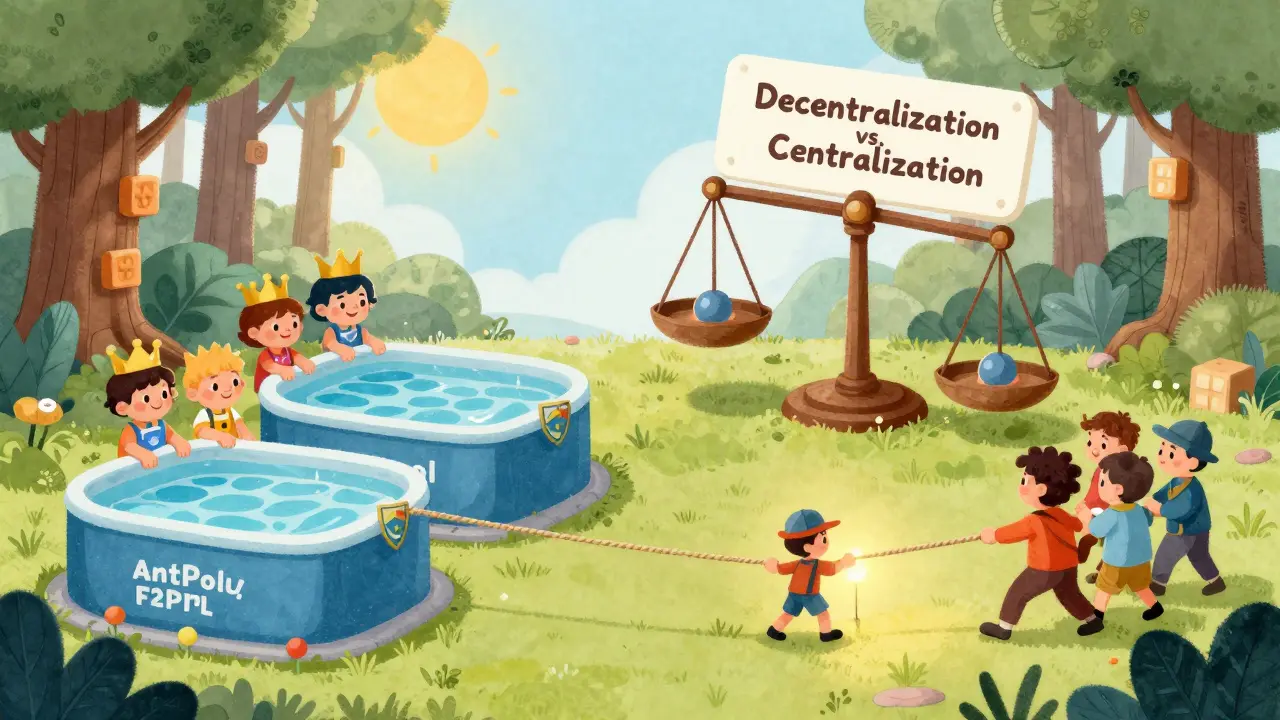
The biggest advantage? Predictability. A miner with 100 TH/s of power might wait 3.5 years to find a block solo. In a pool, they earn about 0.002 BTC per day - enough to cover electricity and keep mining. That consistency is why 90% of all Bitcoin miners use pools today. But there are downsides. Centralization is the biggest concern. If just three pools control over 65% of Bitcoin’s hashrate, they could theoretically team up to take over the network. That’s called a 51% attack. So far, it hasn’t happened because it would destroy Bitcoin’s value - and the pool operators’ own investments. There’s also counterparty risk. If a pool shuts down, freezes payments, or gets hacked, you could lose earnings. In 2023, 12 pools were compromised, leading to $8.2 million in stolen rewards, according to Kudelski Security. And if your internet connection drops, you might submit “stale shares” - work that arrives too late to count. That can cut your earnings by 3-7%.Choosing the Right Pool
If you’re starting out, here’s what to look for:- Fees: Lower is better, but 0% pools often exclude small miners.
- Payout threshold: Some pools pay out only after you earn 0.01 BTC. Others pay daily at 0.001 BTC. Smaller thresholds mean more frequent payouts.
- Location: Pick a pool with servers near you. Latency causes stale shares. If you’re in Texas, avoid a pool based in China.
- Support: AntPool offers 24/7 English and Chinese support. Smaller pools? You’re on your own.
- Regulation: If you’re in the U.S. or EU, pick a pool that follows KYC rules. The EU’s MiCA law requires full identity checks by January 2025.
Slush Pool is still respected for its beginner-friendly guides. Luxor has the best reputation among U.S. miners. For altcoins like Litecoin or Dogecoin, Viabtc and F2Pool are solid choices.
What About Solo Mining?
Solo mining is almost dead for Bitcoin. Even with a $10,000 ASIC rig, you’d need to run it for years to earn one block. The math doesn’t work unless you have access to cheap power (under 3 cents per kWh) and thousands of rigs. For most people, solo mining is a gamble with near-zero odds. But for some altcoins - like Monero or Ravencoin - solo mining still makes sense. They’re designed to be ASIC-resistant, meaning regular GPUs can compete. If you have a gaming rig sitting idle, mining Monero solo might be worth a try.The Future of Mining Pools
The industry is moving toward consolidation. Bernstein Research predicts the top five pools will control 75% of Bitcoin’s hashrate by 2026. Why? Because running a pool is expensive. You need servers, bandwidth, security teams, and legal compliance. Only big players can afford it. Some are trying to fix centralization. P2Pool, a decentralized pool, uses blockchain technology to remove the operator entirely. Miners connect directly to each other. But rewards are less predictable - you might wait days between payouts. It’s a trade-off: decentralization vs. consistency. Regulation is the biggest wild card. The U.S. and EU now treat mining pools as money services businesses. That means they must collect IDs, verify users, and report suspicious activity. Many small pools have shut down. The ones left are bigger, safer, and more regulated - but less anonymous.Getting Started
Here’s how to join a pool in under an hour:- Buy or rent a mining rig (ASIC for Bitcoin, GPU for altcoins).
- Set up a crypto wallet (like Electrum for Bitcoin).
- Sign up for a pool (Luxor or Slush Pool for beginners).
- Download mining software (CGMiner, BFGMiner, or EasyMiner).
- Enter your pool username, password, and wallet address in the software.
- Start mining. Check your dashboard - you should see shares submitted within minutes.
Common mistakes? Wrong worker name, unstable internet, or using a pool that doesn’t support your coin. Double-check the pool’s documentation. Most have step-by-step videos.
Don’t expect to get rich. Mining is a cost of doing business. Your goal isn’t to become a Bitcoin millionaire - it’s to cover your electricity bill and maybe earn a few extra dollars a month.
Are mining pools safe?
Most major pools are safe, but they’re not risk-free. You’re trusting the operator to pay you fairly. Choose pools with long track records, transparent fee structures, and good reviews. Avoid pools that ask for your private keys - that’s a red flag.
Can I mine without joining a pool?
Technically yes, but it’s not practical for Bitcoin. Solo mining only makes sense if you have access to massive amounts of cheap electricity and hundreds of ASICs. For altcoins like Monero or Dogecoin, solo mining with a GPU is still possible and sometimes profitable.
Do mining pools pay in Bitcoin only?
No. Most pools let you choose your payout currency. You can receive Bitcoin, Ethereum, Litecoin, or even stablecoins like USDT. Some pools, like AntPool, even let you auto-convert your earnings to fiat currency like USD or EUR.
How much do mining pools charge?
Fees range from 0% to 4%. Foundry USA charges 0% but only works with large operators. Most retail pools charge 1-2.5%. Higher fees usually mean better support, faster payouts, or extra features like auto-conversion. Always compare net earnings, not just the fee percentage.
Is mining still profitable in 2025?
It depends. If you have access to electricity under 6 cents per kWh and a modern ASIC miner, yes - you can break even or make a small profit. If you’re using old hardware or paying over 12 cents per kWh, you’re likely losing money. Always run a profitability calculator before buying gear.


Jake Mepham
December 23 2025Man, I remember when I first tried solo mining back in 2012 with a couple of old GTX 780s. Spent three months and got nada. Then I joined Slush Pool and started seeing tiny payouts every day. It’s not glamorous, but it keeps the lights on. Honestly, if you’re not in a pool, you’re just donating electricity to the Bitcoin network. 😅