
Swiss Crypto Wealth Tax Calculator
How It Works
Switzerland taxes your crypto holdings as wealth (not capital gains). Calculate your annual wealth tax based on your crypto value and canton.
Estimated annual tax:
CHF 0.00
Based on 0.5% average rate (actual rate varies by canton). No capital gains tax for private investors.
Switzerland doesn’t tax your crypto profits - but it does tax your crypto holdings. That’s the key difference that makes its approach unique. While most countries chase after capital gains from Bitcoin or Ethereum trades, Switzerland looks at what’s in your wallet on December 31st each year. If you’re sitting on $100,000 worth of crypto, you pay a small annual fee - not because you sold anything, but because you own it.
How Switzerland Classifies Crypto
Switzerland doesn’t treat crypto like cash. The Federal Tax Administration (FTA) calls it kryptobasierte vermögenswerte - crypto-based assets. That means it’s grouped with stocks, bonds, and real estate under private wealth. This classification matters because it determines how it’s taxed.The FTA recognizes three main types:
- Payment tokens - like Bitcoin and Litecoin. These are treated as digital money and are included in your wealth tax base.
- Utility tokens - tokens that give access to a service or platform. Their tax treatment depends on how they’re used. If they’re held for investment, they’re taxed as wealth. If they’re used to pay for services, they might trigger income tax.
- Security tokens - these represent ownership in a company or asset, like shares. They’re taxed just like traditional stocks.
The Swiss Financial Market Supervisory Authority (FINMA) sets the rules for token classification, and the FTA follows suit. If you hold a token that’s classified as a security, you’re subject to the same rules as if you owned Apple or Nestlé shares.
How Much Do You Pay in Wealth Tax?
Switzerland doesn’t have a federal wealth tax. Instead, each of its 26 cantons sets its own rate. That means your tax bill can vary wildly depending on where you live.Most cantons charge between 0.3% and 1% per year on your total net wealth - including crypto. Here’s what that looks like in practice:
- If you live in Zurich and have $200,000 in crypto, you might pay around $600-$2,000 a year.
- If you live in Zug, known as “Crypto Valley,” rates are on the lower end - often under 0.5%.
- In Geneva or Basel, rates can climb toward 1%, especially for higher net worth individuals.
The FTA publishes official year-end exchange rates for major cryptocurrencies like Bitcoin, Ethereum, Ripple, Bitcoin Cash, and Litecoin. You must use these rates to convert your holdings into Swiss francs for your tax return. For lesser-known tokens - say, a new DeFi coin - you use the price on the exchange where you traded it. If you can’t find a price? Use your original purchase cost in CHF.
Capital Gains? Not for Private Investors
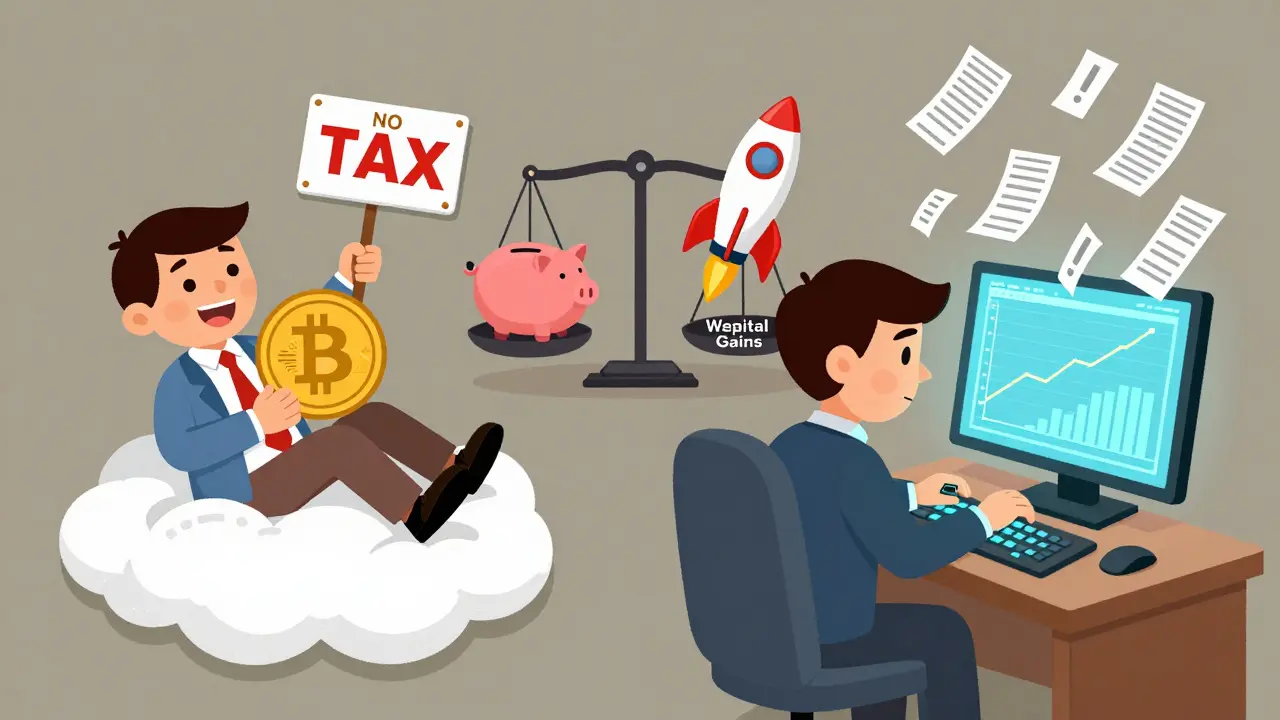
Here’s the real kicker: if you’re a private individual, you don’t pay capital gains tax on crypto - ever. Sell Bitcoin for a $500,000 profit? No tax. Trade Ethereum for Solana and make $2 million? Still no tax. This exemption applies to all private assets: stocks, bonds, real estate, and crypto.This rule is rooted in Swiss tax law dating back decades. The logic? Personal wealth appreciation isn’t income - it’s just a change in value. The Swiss government taxes income and wealth, not gains. So long as you’re not running a business, your crypto profits stay completely tax-free.
But there’s a catch.
When You Become a Professional Trader
If you’re buying and selling crypto constantly - day trading, arbitraging, running a crypto fund - the FTA might classify you as a professional trader. How do they decide? They look at your behavior:- Frequency of trades (daily or weekly activity)
- Volume of transactions (large, recurring buys and sells)
- Time spent managing positions (full-time focus)
- Use of leverage or derivatives
- Whether you’re registered as a business or have employees
If you’re flagged as a professional, your crypto gains become taxable income. You’ll pay federal income tax (up to 11.5%), plus cantonal and municipal taxes. Combined, that can push your rate to 30-40% depending on your location and income level. You also lose the exemption on wealth tax for crypto held as business assets - those are taxed separately under commercial regulations.
What About Staking, Mining, and DeFi?
Staking rewards? Mining income? DeFi yield? These aren’t capital gains - they’re income. And income is taxed.Staking rewards and DeFi interest are treated like interest income. You report them as earnings in the year you receive them, converted to Swiss francs at the time of receipt. Same goes for mining: if you’re doing it regularly, it’s considered a business activity. You pay income tax on the value of the coins mined, and you can deduct equipment and electricity costs.
NFTs are trickier. If you buy an NFT as an investment and sell it later for profit, it’s treated like any other asset - included in your wealth tax base, but no capital gains tax if you’re a private investor. If you’re flipping NFTs weekly, you’re likely a trader. The FTA doesn’t have special rules for NFTs - they just apply the same principles used for crypto and stocks.
Record-Keeping Is Non-Negotiable
Switzerland doesn’t make it easy to cheat. Tax authorities require detailed records for every crypto transaction. You need to track:- Date and time of every purchase and sale
- Amount and type of crypto involved
- Value in Swiss francs at the time of the transaction
- Exchange or wallet used
- Original purchase cost (for cost basis)
Many investors use tools like Koinly or CryptoTaxCalculator to auto-import exchange data and generate Swiss-compliant reports. But you still need to verify the year-end valuations match FTA rates. For tokens not listed by the FTA, you must document where you got your price from - a screenshot of Binance or Coinbase’s closing price on December 31st is often enough.
Missing records can trigger audits. Swiss tax offices are known for being thorough. One investor in Lucerne had his wealth tax reassessed after the FTA found unreported tokens from a 2020 airdrop he’d forgotten about. He ended up paying back taxes plus penalties.

Where to Live Matters More Than You Think
Your canton can save you tens of thousands of francs a year. Zug, Lucerne, and Schwyz have the lowest wealth tax rates. Zurich and Geneva are higher. Some investors even move their legal residence to a low-tax canton just for tax purposes - as long as they actually live there.Family trusts and holding structures are also common. Married couples can split assets to reduce individual tax burdens. Some set up foundations in Liechtenstein or use Swiss private foundations to hold crypto, though that adds complexity and legal costs.
The bottom line: don’t just pick a canton because it’s scenic. Pick it because the tax rate fits your portfolio.
Why Switzerland Stays Ahead
Switzerland didn’t get here by accident. The DLT Act of 2021 laid the legal groundwork for digital assets. The FTA followed with clear guidance. No new crypto-specific taxes. No bans. No confusion.Unlike the EU, which is rolling out MiCA rules that could bring new reporting burdens, Switzerland keeps its system simple: tax wealth, not gains. The Swiss Blockchain Federation reports over 1,200 crypto companies now operate in the country, many because of this clarity.
Even as DeFi, AI tokens, and tokenized real estate grow, the FTA says existing rules apply. No special tax for NFTs. No new category for staking. No surprise changes. That predictability is what keeps investors coming.
What’s Next in 2025?
No major changes are expected. The FTA’s last update came in December 2024, reaffirming the 2021 framework. Experts at Ark-fid.ch and Koinly agree: Switzerland’s system remains the most investor-friendly in Europe.That doesn’t mean it’s perfect. The administrative burden is real. Getting accurate prices for obscure tokens is a headache. Some cantons still lack digital filing systems for crypto. But compared to the U.S., Germany, or France - where capital gains can hit 30-50% - Switzerland is a haven.
If you hold crypto in Switzerland, your goal isn’t to avoid taxes - it’s to manage them wisely. Declare your holdings. Know your canton’s rate. Keep your records. And don’t trade like a pro unless you’re ready to pay income tax.
For private investors, Switzerland offers something rare: the chance to grow your crypto wealth without the taxman taking a cut. All you need to do is own it - and report it.


Reggie Herbert
December 6 2025Switzerland's 'tax wealth, not gains' model is a masterclass in regulatory clarity - but let's be real, it only works because their cantonal systems are fragmented enough to avoid enforcement fatigue. The FTA's year-end exchange rates? A bureaucratic relic. Try reporting a 2024 airdrop of a token that traded at $0.0003 on a decentralized exchange with zero liquidity. You're not filing taxes - you're doing forensic accounting with a Swiss Army knife. And don't get me started on how Zug's 0.3% rate is just a lure for hedge funds who then offshore the real gains via Liechtenstein foundations. This isn't investor-friendly - it's regulatory arbitrage dressed up as philosophy.