
Imagine you just bought a coffee with Bitcoin. You hand over the digital cash, but the barista doesn't smile until three minutes later. Why? Because in the world of Cryptocurrency, which is a decentralized digital currency that uses cryptography for security, money doesn't move instantly like it does on a Visa card. It has to be verified by a global network of computers. This verification process is called confirmation, and the time it takes is known as confirmation time.
If you are new to blockchain technology, this waiting period can feel frustrating. You might wonder if your money is lost or if the system is broken. In reality, this delay is a feature, not a bug. It is the mechanism that prevents fraud and ensures that the coins you spent weren't already spent elsewhere. Understanding how these times work helps you manage expectations, avoid costly mistakes, and choose the right coin for the job.
How Confirmation Time Actually Works
To grasp why transactions take time, you need to look under the hood of a blockchain, which is a distributed ledger technology that records transactions across many computers. When you send crypto, your transaction isn't sent directly to the recipient's wallet. Instead, it is broadcasted to a pool of pending transactions. Think of this pool as a crowded airport terminal where everyone is waiting for their flight.
Mining nodes-powerful computers dedicated to securing the network-pick transactions from this pool to pack into a block. Once a miner solves a complex mathematical puzzle, they create a new block and add it to the chain. Your transaction is now "confirmed" once. But here is the catch: one confirmation isn't enough to say the transaction is final. It just means it is in the most recent block.
Each subsequent block added to the chain adds another layer of security. If a malicious actor wanted to reverse your payment, they would have to redo the work of your block plus all the blocks after it. As more blocks pile up, that becomes computationally impossible. So, confirmation time is really about building a wall of proof around your transaction. The higher the wall, the safer the money.
The Difference Between Block Time and Confirmation Time
People often mix up two terms: block time and confirmation time. They are related, but they are not the same thing. Block time is the average interval between when one block is mined and the next one is created. For example, Bitcoin aims for a block every 10 minutes. Ethereum, on the other hand, creates blocks roughly every 12 seconds.
Confirmation time is the total duration from when you hit "send" until the transaction has enough confirmations to be considered safe. If a merchant requires six confirmations on Bitcoin, and each block takes 10 minutes, your confirmation time is approximately one hour. If you are using a faster chain like Litecoin, which has a 2.5-minute block time, those same six confirmations would only take 15 minutes.
This distinction matters because it explains why some coins feel instant while others feel sluggish. It is not necessarily about the efficiency of the software; it is about the architectural choices made by the developers regarding security versus speed.
Bitcoin’s Confirmation Hierarchy
Bitcoin is the gold standard for understanding confirmations because its rules are strict and well-documented. However, there is no universal rule for how many confirmations you need. It depends entirely on the value at stake and who is taking the risk.
For small, everyday purchases, many merchants accept Zero Confirmations, or "Zeroconf." This means they accept the payment the moment they see it in their wallet app, before it is even in a block. This works for low-value items like a $5 coffee because the cost of attempting a double-spend attack (creating a fake transaction to steal the goods) outweighs the profit. Who would go through the trouble of hacking the network for a latte?
As the value increases, so does the required wait time. Here is a general guide used by exchanges and large merchants:
- 0 Confirmations: Small retail purchases under $100. Fast but carries slight risk.
- 3 Confirmations: The standard for medium-sized transactions. Takes about 30 minutes on Bitcoin. This is considered a safe middle ground for most online stores.
- 6 Confirmations: Required for high-value transfers, typically over $1,000. Takes about one hour. This is the industry standard for major exchanges to release funds.
- 60+ Confirmations: Reserved for institutional-grade movements or extremely large sums. Can take 10 hours or more. This provides near-absolute certainty against any realistic attack vector.
You should always check what your counterparty requires. Sending money to an exchange that demands six confirmations? Don't panic if it says "pending" for an hour. That is normal.

Factors That Slow Down Your Transaction
Even if you know the target number of confirmations, the actual clock time can vary wildly. Three main factors influence how long you wait in that initial "mempool" (the waiting area for unconfirmed transactions).
1. Network Congestion
When everyone wants to use the blockchain at the same time, the mempool gets clogged. Imagine a highway during rush hour. Even if your car is fast, you can't move if the lanes are full. During periods of high demand, such as when Bitcoin prices spike or a popular NFT drops, thousands of transactions compete for space in the limited block size. Miners prioritize the ones paying the most, leaving lower-priority transactions stuck for hours.
2. Transaction Fees
In a Proof-of-Work system like Bitcoin, miners are volunteers. They don't get paid a salary; they earn fees from users. If you set your fee too low, miners will ignore your transaction in favor of someone else who offered more. This is known as "fee market" dynamics. To speed things up, you can sometimes "bump" your fee-a feature called RBF (Replace-By-Fee)-which allows you to resend the same transaction with a higher price tag to jump the queue.
3. Transaction Complexity
Not all transactions are created equal. A simple transfer from Wallet A to Wallet B is small and cheap to verify. But a transaction involving multiple inputs (like consolidating dust from dozens of old addresses) or complex smart contract interactions takes up more data space. Larger data sizes mean higher fees and potentially slower inclusion in blocks.
The Rise of Zeroconf and Layer 2 Solutions
Because waiting 10 minutes for a single confirmation is too slow for buying groceries, the industry has developed workarounds. One approach is Zeroconf, which we touched on earlier. By accepting unconfirmed transactions, merchants mimic the speed of credit cards. However, this relies on trust and economic disincentives rather than cryptographic finality.
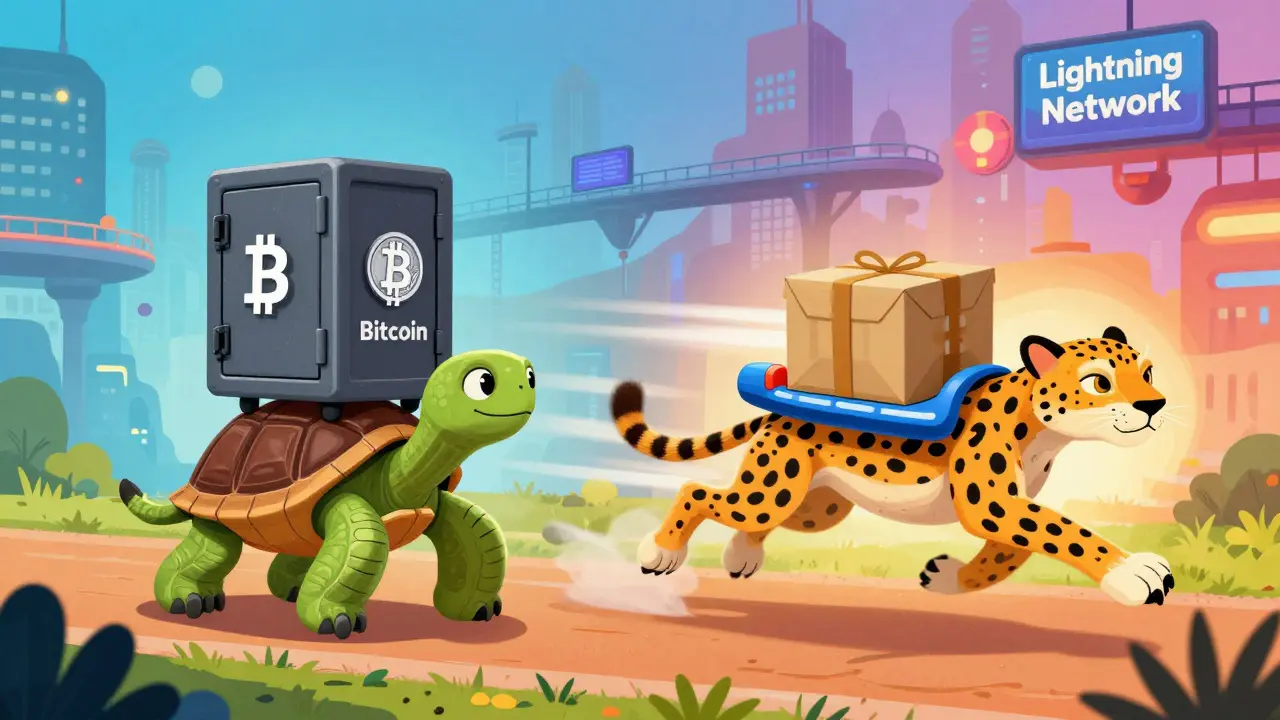
A more robust solution is Layer 2 scaling. Technologies like the Lightning Network for Bitcoin allow millions of micro-transactions to happen off-chain almost instantly. These transactions are settled on the main blockchain only when the channels are closed. For the user, the experience feels instantaneous, bypassing the congestion of the main chain entirely.
Similarly, newer blockchains like Solana or Polygon were built from the ground up with high throughput and sub-second block times, making confirmation times negligible for most users. Choosing the right network depends on whether you prioritize maximum security (Bitcoin) or maximum speed (Solana/Lightning).
| Cryptocurrency | Avg. Block Time | Typical Confirmations Needed | Est. Finality Time | Best Use Case |
|---|---|---|---|---|
| Bitcoin (BTC) | 10 Minutes | 1 - 6 | 10 min - 1 hour | Store of Value, Large Transfers |
| Ethereum (ETH) | 12 Seconds | 12 - 64 | 2 - 13 minutes | Smart Contracts, DeFi |
| Litecoin (LTC) | 2.5 Minutes | 6 | 15 Minutes | P2P Payments, Retail |
| Solana (SOL) | 400 Milliseconds | 32 Slots | ~13 Seconds | High-Frequency Trading, Apps |
| Bitcoin Lightning | N/A (Off-chain) | Instant | < 1 Second | Micro-payments, Coffee |
Security Risks of Ignoring Confirmation Times
The biggest danger in ignoring confirmation times is the Double-Spend Attack. This occurs when a sender broadcasts two conflicting transactions: one sending you money, and another sending that same money back to themselves. If you release goods after seeing only zero or one confirmation, the attacker might successfully get their second transaction included in the next block, effectively reversing the first one.
While rare for small amounts, this risk scales with value. Merchants who accept large orders without waiting for sufficient confirmations are essentially gambling. They are betting that the attacker won't have enough computing power to rewrite the blockchain history. For a $10 purchase, that bet is safe. For a $10,000 purchase, it is reckless.
Another risk is Transaction Malleability, though largely solved in modern networks. This allowed attackers to alter the transaction ID slightly after it was broadcast, causing confusion about whether the payment went through. While less common now, it highlights why relying on visual cues in a wallet app without checking the blockchain explorer can be misleading.
Practical Tips for Managing Confirmation Times
If you want to ensure your transactions move smoothly, follow these practical steps:
- Check the Mempool: Before sending, look at a site like mempool.space. If the network is red (congested), expect delays. If it is green, you can use lower fees.
- Set Appropriate Fees: Don't always use the "slow" option if you need the money today. Use dynamic fee estimators in your wallet to gauge the current market rate.
- Know Your Counterparty's Rules: Always ask exchanges or sellers how many confirmations they require. Never assume.
- Use Layer 2 for Small Buys: If you are buying daily essentials, use Lightning Network or a stablecoin on a fast chain like Polygon or Solana. Save Bitcoin mainnet for savings.
- Verify on Explorer: Don't trust the wallet UI alone. Copy the transaction hash (TXID) and paste it into a blockchain explorer to see the real-time status and block height.
Understanding confirmation times transforms frustration into strategy. You stop wondering why your money is stuck and start understanding the security guarantees being built behind the scenes. Whether you are a merchant setting policies or a user trying to pay for dinner, knowing the mechanics of blocks, fees, and confirmations puts you in control of your digital assets.
What is the difference between block time and confirmation time?
Block time is the average interval between the creation of two consecutive blocks on a blockchain (e.g., 10 minutes for Bitcoin). Confirmation time is the total duration from when you submit a transaction until it has accumulated enough confirmations to be considered secure. Confirmation time is usually a multiple of the block time depending on how many confirmations are required.
How many confirmations do I need for Bitcoin?
It depends on the value. For small retail purchases, 0-1 confirmations may suffice. For medium transactions, 3 confirmations (approx. 30 minutes) is standard. For large transactions or exchange deposits, 6 confirmations (approx. 1 hour) is recommended to prevent double-spending attacks.
Why are my cryptocurrency transactions taking so long?
Slow transactions are usually caused by network congestion or low transaction fees. When many people are transacting, the "mempool" fills up. Miners prioritize transactions with higher fees. If your fee is too low, your transaction waits until the network clears or you increase the fee via Replace-By-Fee (RBF).
What is a Zeroconf transaction?
Zeroconf (Zero Confirmation) refers to accepting a cryptocurrency payment immediately after it is broadcasted, before it is included in a block. It offers instant speed similar to credit cards but carries a slight risk of double-spending, making it suitable only for low-value transactions.
Can I speed up a pending transaction?
Yes, if your wallet supports it. Most modern wallets offer "Replace-By-Fee" (RBF) or Child-Pays-For-Parent (CPFP) features. These allow you to broadcast a new version of the transaction with a higher fee, incentivizing miners to pick it up sooner.
Is it safe to accept payments with zero confirmations?
It is generally safe for small amounts (e.g., under $100-$500) because the cost of executing a double-spend attack exceeds the potential profit. However, for larger values, it is risky. Merchants should wait for at least 1-3 confirmations for medium values and 6+ for high values.
Which cryptocurrency has the fastest confirmation time?
Networks like Solana, Polygon, and Binance Smart Chain have block times measured in seconds or milliseconds, offering near-instant confirmations. Bitcoin Lightning Network also offers instant settlement for off-chain transactions, though the underlying Bitcoin chain remains slower.
What happens if a transaction never confirms?
If a transaction fee is too low, it may remain in the mempool indefinitely until the network congestion subsides. Eventually, the wallet software may drop the transaction, returning the funds to your available balance. You can then resend it with a higher fee.