
APY vs APR Calculator
Calculate Your Actual Returns
See how compounding affects your yield farming earnings. Enter your APR and compounding frequency to see the equivalent APY.
How Compounding Works
APY is always higher than APR when compounding occurs. The more frequently rewards compound, the higher your actual return. For example:
- 10% APR with yearly compounding = 10.00% APY
- 10% APR with monthly compounding = 10.47% APY
- 10% APR with daily compounding = 10.52% APY
Real yield farming returns are often lower due to impermanent loss, fees, and token volatility.
When you see a DeFi platform promising 15% APY on your ETH, it sounds amazing. But if another offers 14% APR, is it really worse? The difference isn’t just a percentage point-it’s how your money grows over time. Many new yield farmers lose money not because the protocol is risky, but because they don’t understand whether they’re looking at APY or APR. And that mistake can cost them hundreds-or thousands-of dollars in missed earnings.
What’s the difference between APY and APR?
APR stands for Annual Percentage Rate. It’s the simple interest you earn-or pay-over a year. No tricks. No compounding. If you stake 100 USDC at 10% APR, you get 10 USDC after 12 months. Period.
APY, or Annual Percentage Yield, includes compounding. That means you earn interest not just on your original deposit, but on the interest you’ve already earned. If that same 10% is compounded daily, your actual return isn’t 10%. It’s closer to 10.52%. That extra half-percent might seem small, but over months or years, it adds up fast.
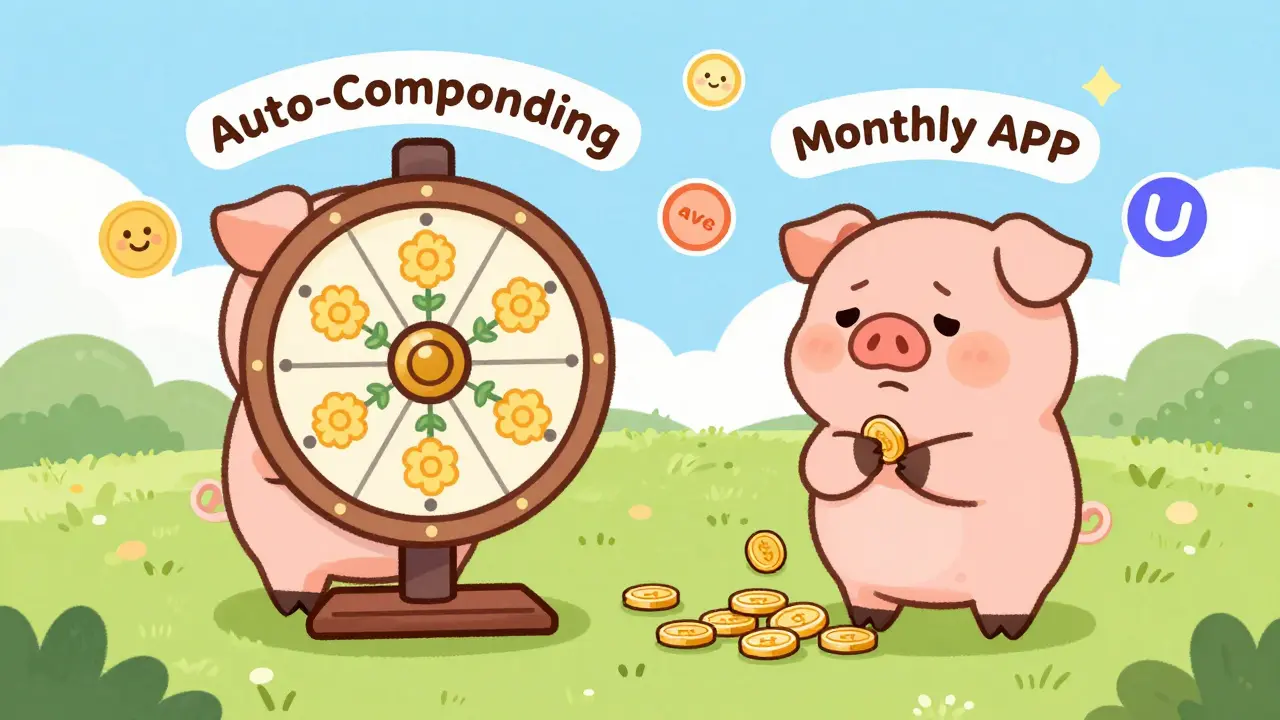
Think of it like a snowball rolling downhill. APR is the size of the snowball when you start. APY is how big it gets after picking up more snow along the way.
Why does compounding matter in yield farming?
In traditional banking, interest might compound monthly. In DeFi, it’s often daily-even hourly. Some protocols auto-reinvest your rewards into the pool. That means every time you earn a little more token, it starts earning too. That’s the magic of APY.
Take a liquidity pool on Uniswap that offers 12% APY with daily compounding. If you put in 1,000 USDC, after one year you’ll have about $1,127.49. But if that same pool advertised 12% APR, you’d only end up with $1,120. The difference? $7.49. Sounds small? Now scale that to $10,000 or $50,000. That’s $75 or $375 in extra earnings-just because you understood the difference.
Protocols like Aave, Compound, or Curve usually show APY because their rewards are automatically reinvested. You don’t have to claim and restake manually. The system does it for you. That’s why APY is the standard for staking and yield farming. It reflects reality.
When do you see APR instead?
APR shows up where compounding doesn’t happen automatically-or isn’t the focus. Lending platforms like Nexo or Celsius (before their collapse) often list APR because they pay interest monthly, and you have to manually claim and reinvest. Same with borrowing: if you’re taking out a crypto loan, you care about APR because you’re paying a fixed rate, not earning compounded rewards.
Even some staking services, like Lido, use APR. Why? Because their rewards come in the form of stETH, which you then have to manually swap or reinvest. There’s no auto-compounding. So APY wouldn’t be accurate-it would overstate your return.
If a platform says “10% APY” but doesn’t auto-compound, it’s misleading. You should always check the fine print: How often are rewards distributed? Do I need to claim them? Are there gas fees or withdrawal penalties?
How to calculate APY from APR (and vice versa)
You don’t need a PhD in math to do this. Here’s the simple version:
To convert APR to APY:
- Divide APR by the number of compounding periods per year. For daily compounding, that’s 365.
- Add 1.
- Raise it to the power of the number of periods.
- Subtract 1.
- Multiply by 100 to get a percentage.
Example: 10% APR, compounded daily
(1 + 0.10 / 365)^365 - 1 = 0.105156 → 10.52% APY
Want to go the other way? Use this shortcut: APY is always higher than APR when compounding happens. If a platform gives you APY and you want to know the equivalent APR, just reverse the math. But honestly? You don’t need to. Use a free APY calculator-there are dozens built into DeFi dashboards like DeFiLlama or Zapper.
APY isn’t the whole story-here’s what else affects your real returns
Just because a pool says 20% APY doesn’t mean you’ll earn that. Real-world factors eat into your returns:
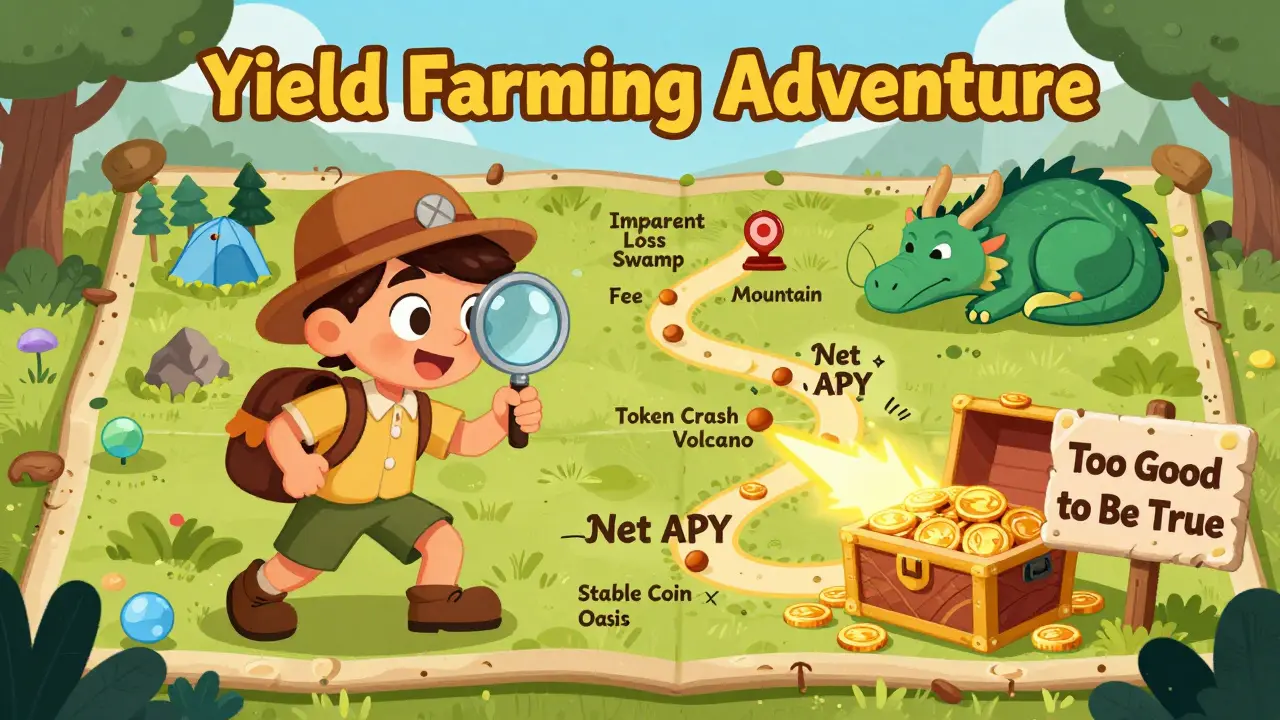
- Impermanent loss: If you provide liquidity in a token pair (like ETH/USDC) and one token’s price swings hard, you might lose value even if the APY looks great.
- Platform fees: Some protocols charge 0.5% to 2% in withdrawal or claim fees. That’s 10-40% of your monthly earnings gone.
- Token price drops: If your reward is in a governance token like CRV or SUSHI, and its price crashes, your APY in USD terms plummets-even if the token count stays the same.
- Gas costs: Claiming rewards on Ethereum can cost $5-$20 per transaction. If you’re earning $10 a week, that’s a huge cut.
- Lock-up periods: Some farms require you to lock your funds for 30, 60, or 90 days. If the market crashes during that time, you can’t exit.
That’s why smart yield farmers don’t just chase the highest APY. They look at the net APY: estimated rewards minus fees, minus impermanent loss risk, minus token volatility.
How to compare yield farming opportunities properly
Here’s a simple rule: Compare APY to APY. Compare APR to APR. Never mix them.
Let’s say you’re choosing between two pools:
- Pool A: 15% APY, daily compounding, no fees, rewards in stablecoin
- Pool B: 14.5% APR, monthly payouts, 1.5% withdrawal fee, rewards in volatile token
At first glance, Pool A looks better. But let’s convert Pool B’s APR to APY: 14.5% APR compounded monthly = ~15.5% APY. So technically, Pool B offers more compounding. But now you factor in the 1.5% fee. That’s $15 per $1,000 invested. And if the token drops 20% in a month? You’re down 5% overall.
Pool A wins-not because of the number, but because of the quality of the return: stable, fee-free, automatic.
Use tools like DeFiLlama or Zapper to compare net APY across dozens of pools at once. They factor in fees, token prices, and even impermanent loss estimates.
What to look for before you deposit
Before you lock up your crypto, ask these five questions:
- Is this APY or APR? (If it’s APR, does the platform auto-compound?)
- How often are rewards distributed? (Daily? Weekly? Monthly?)
- Are there any fees? (Claim, withdrawal, gas?)
- What token am I earning? Is it stable or volatile?
- Is there a lock-up? Can I exit anytime?
If you can’t find answers to these on the platform’s website, walk away. Legit protocols don’t hide this info.
Final tip: Don’t chase APY-chase sustainability
Some farms offer 50% APY. That sounds like free money. But high APY usually means high risk. It’s often a short-term incentive to attract liquidity, not a sustainable return. Once the rewards run out, the APY crashes. That’s called a “yield farm dump.”
Instead, look for pools with:
- Stable token pairs (like USDC/DAI)
- Low impermanent loss history
- Low fees
- High trading volume (more fees = more rewards)
- Reputation (is this a well-known protocol like Aave or Yearn?)
APY and APR are tools-not magic numbers. Used right, they help you make smarter decisions. Used wrong, they lead to losses disguised as gains.
Is APY always higher than APR?
Yes, when compounding occurs. APY includes interest earned on previous interest, while APR does not. So for the same rate, APY will always be higher if rewards are compounded more than once a year. If there’s no compounding (like monthly payouts you manually claim), then APY and APR are the same.
Should I only invest in high-APY yield farms?
No. High APY often signals high risk. Many projects offer 30-100% APY for a few weeks to attract users, then the rewards vanish. Focus on sustainable yields under 20% from reputable protocols with high liquidity and low fees. Stability beats short-term hype.
Do I pay taxes on APY earnings in the U.S.?
Yes. The IRS treats crypto rewards as taxable income at their fair market value when you receive them-even if you don’t sell. So if you earn 0.5 ETH in rewards and it’s worth $1,200 at the time, that’s $1,200 of taxable income. Keep records of every reward claim.
Can I lose money even with a 10% APY?
Absolutely. If you’re providing liquidity in a volatile pair like ETH/USDT and the price swings sharply, you could lose more than 10% due to impermanent loss. Also, if your reward token crashes in value, your USD earnings drop-even if your token count goes up.
What’s better: staking with APY or lending with APR?
It depends. Staking usually auto-compounds, so APY is more accurate. Lending often pays monthly without auto-reinvestment, so APR is standard. If both offer similar net returns after fees, staking tends to be more hands-off and potentially more profitable long-term. But lending often has lower risk and better liquidity.


Tatiana Rodriguez
December 5 2025Okay, I just spent three hours reading this and I’m emotionally drained-but in the best way. I thought I understood APY vs APR until I saw that 12% APY vs 12% APR breakdown. $7.49 on $1,000? That’s not just money-that’s a whole weekend of coffee runs. And then I realized: I’ve been manually claiming rewards on Curve for months, thinking I was getting the APY, but really? I was leaving hundreds on the table. I just set up auto-compound on Aave. I’m crying happy tears. This post didn’t just educate me-it changed my entire DeFi strategy. Thank you.
Also, the snowball analogy? Chef’s kiss. I’m framing that.
Now I just need to figure out how to explain this to my crypto-illiterate mom. She thinks ‘yield farming’ is a new type of yoga.
Also-gas fees. Oh god, the gas fees. I just lost $18 claiming $22 in rewards last week. I’m switching to Polygon now. Someone please send help.
And can we talk about how 50% APY farms are basically financial pyramids with better UIs? I’ve lost more money chasing those than I’ve made. I’m done. I’m a convert now. Sustainability over hype. I’m not even mad anymore. Just… enlightened.
Also-impermanent loss. I didn’t even know that was a thing until I lost 15% on a ETH/USDC pool last month. I thought I was being smart. Turns out I was just being reckless. This post is a gift. I’m sharing it with my entire Discord group. They’re going to hate me for it. Worth it.
Also-taxes. I’m going to hell. But at least I’ll go with accurate records. Thank you.
Also-why is this not a TED Talk? Someone get this man a microphone.
Also-why did I wait this long?
Also-also-also-
I’m done. I’m a new person.