
MiCA Compliance Deadline Calculator
Calculate Your MiCA Deadline
Enter your country of operation to see your specific deadline for applying for a MiCA license and operating in the EU.
Cross-Border Risk
Action Plan
On December 30, 2024, the MiCA regulation became fully active across the European Union. For crypto businesses operating in the EU, this wasn’t just another rule change-it was a hard reset. If you were running a crypto exchange, wallet service, or token issuer before that date, you didn’t automatically become compliant. You got a grace period. But that grace period isn’t the same everywhere. And if you ignore the differences, you could lose your ability to operate overnight.
What MiCA Actually Changes for Crypto Businesses
Before MiCA, every EU country had its own rules for crypto. Some had strict licensing. Others had almost none. That made it messy for businesses trying to serve customers across borders. MiCA fixes that. It’s a single rulebook for the whole EU and EEA. Now, if you’re a crypto-asset service provider (CASPs), you need a license. That includes exchanges, custodians, brokers, and even some wallet providers. Issuers of tokens like stablecoins or utility tokens also need approval.It’s not just about paperwork. MiCA demands real compliance: proof of management competence, enough capital to cover risks, strong cybersecurity, clear advertising, and rules to prevent conflicts of interest. Think of it like banking regulations-but for crypto. If you’re not ready, you can’t legally offer services after your transition period ends.
Your Transition Period Depends on Where You’re Based
The EU gave countries flexibility. They could set transition periods from 6 to 18 months after MiCA went live. That means the clock started ticking on December 30, 2024, but ended at different times depending on your country.- Czech Republic, Belgium, Poland: Deadline to apply for license is July 31, 2025. You can keep operating until July 1, 2026.
- Lithuania: Transition ends January 1, 2026.
- Finland: Must apply by October 31, 2024. Can operate until June 30, 2025. Only seven applications were received. If you didn’t apply, you’re already out of compliance.
- Netherlands, Slovenia, Hungary, Latvia, Finland: Deadlines in mid-2025, with operations allowed until late 2025.
- Norway (EEA): Transition ends December 30, 2025.
Some countries, like the Netherlands and Malta, moved fast. They issued the first MiCA licenses on day one. Others are still catching up. But here’s the catch: just because your country lets you operate longer doesn’t mean you’re safe if you serve customers elsewhere.
Cross-Border Operations Are a Minefield
If your crypto business serves clients in more than one EU country, you don’t get to pick the longest transition period. You’re bound by the shortest one.Let’s say you’re based in Belgium, where you have until July 1, 2026, to get licensed. But you also serve customers in Finland, whose transition ends June 30, 2025. As of July 1, 2025, you can no longer offer services to Finnish customers-even if you’re still legal in Belgium. Your license hasn’t been approved yet, so you don’t have MiCA passporting rights. And without those rights, you can’t legally serve anyone in a country where your transition period expired.
The European Securities and Markets Authority (ESMA) made this clear: National regulators must monitor cross-border activity. If you’re operating illegally in one country, even while compliant in another, you’re at risk of enforcement action. Clients could lose access to their funds. Your business could be blocked. And you won’t get a warning.
Grandfathering Isn’t a License-It’s a Temporary Stay
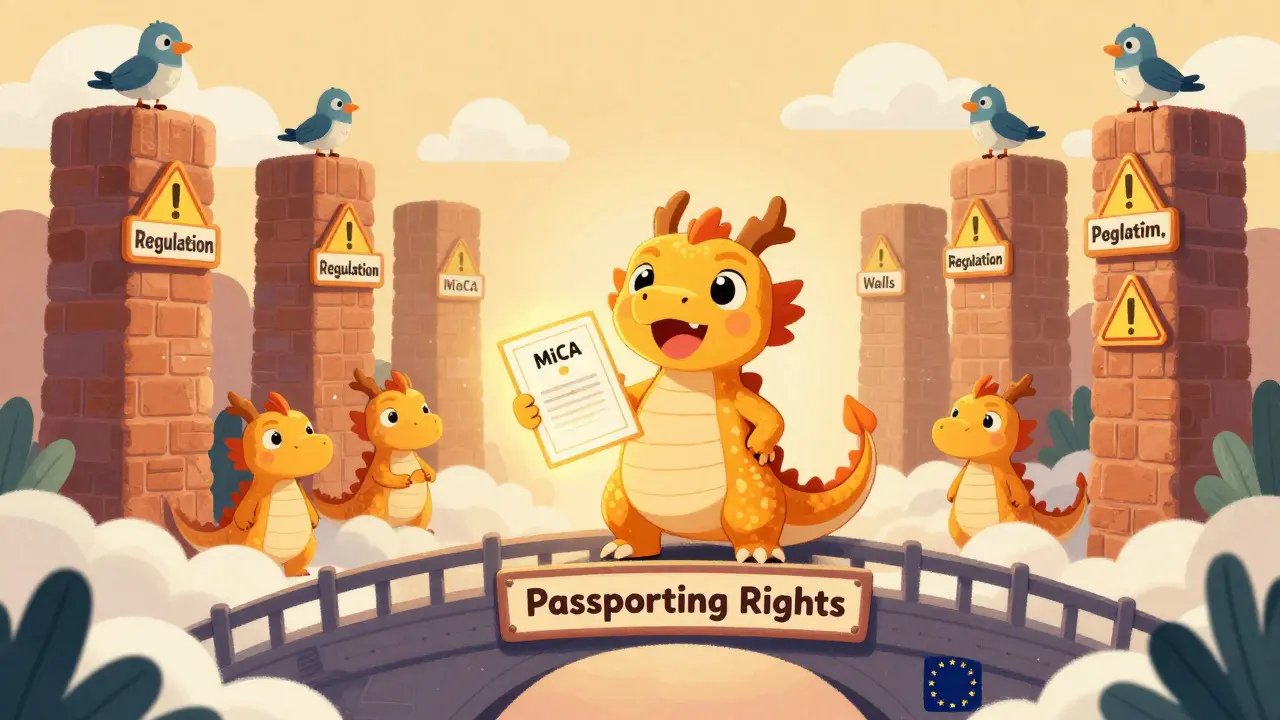
Many businesses thought being “grandfathered in” meant they could keep going like before. It doesn’t. Grandfathering lets you operate temporarily while you apply. But you’re not a MiCA-authorized CASP yet. That means no passporting.Passporting is the whole point of MiCA. Once you get licensed in one EU country, you can offer services across all 27 without applying again. But if you’re still under grandfathering, you’re stuck. You can’t expand into new markets. You can’t attract institutional investors who demand full compliance. You’re stuck in legal limbo.
By mid-2025, over 40 CASP licenses had been issued, mostly in the Netherlands and Germany. Those companies are already passporting. The ones still waiting? They’re losing ground.
What Happens If You Miss the Deadline?
If you don’t apply by your country’s deadline-or if your application is rejected-you lose the right to operate. No exceptions. No extensions. No appeals during the transition.Finland’s experience shows how fast this can happen. The Finnish Financial Supervisory Authority (FIN-FSA) received only seven applications from existing virtual currency providers. If you weren’t one of them, you’re already shut down. Even if you applied, you’re not guaranteed approval. The regulator can deny your license if you don’t meet capital, governance, or security standards.
Some businesses thought they could just keep going quietly. That’s a dangerous gamble. Regulators are watching. Clients are being warned. Banks are cutting off crypto-related accounts. If you’re not licensed, you’re not just at risk-you’re already in violation.

What Should You Do Now?
If you’re still operating under a transition period, here’s your action plan:- Confirm your country’s deadline. Don’t assume it’s the same as your neighbor’s. Check your national regulator’s website.
- Apply now. Even if your deadline is months away, applications take time. Delays happen. Processing backlogs are real.
- Review your compliance. Do you have documented management competence? Enough capital? Cybersecurity audits? Conflict of interest policies? If not, start fixing them now.
- Map your customer base. Are you serving clients in countries with shorter deadlines? If yes, prioritize compliance for those markets first.
- Prepare for shutdown. If you’re denied a license, have a plan to refund clients, freeze services, and wind down operations legally.
Waiting until the last month is a recipe for disaster. The regulators aren’t asking for favors. They’re enforcing a law that’s already in effect. The clock is ticking-and it doesn’t pause for excuses.
Why MiCA Matters Beyond the EU
MiCA isn’t just about Europe. It’s becoming the global benchmark. The U.S., UK, Singapore, and others are watching closely. If you want to expand outside the EU later, being MiCA-compliant gives you credibility. Investors, partners, and even other regulators will see you as serious.Companies that rushed to get licensed early are already winning contracts, attracting venture capital, and building trust. Those dragging their feet? They’re being left behind.
There’s no such thing as a "safe" delay anymore. The transition periods are ending. The licenses are being issued. The market is moving. If you’re not on the right side of this change, you’re not a crypto business-you’re a liability waiting to be shut down.
What happens if I don’t get a MiCA license by my country’s deadline?
You lose the legal right to offer any crypto-asset services in the EU. Your operations must stop immediately. You cannot serve clients, process transactions, or hold customer funds. Regulators may freeze assets, issue fines, or refer cases to law enforcement. There are no extensions or grace periods after the deadline.
Can I keep serving customers in countries with longer transition periods if I’m based in one with a short deadline?
No. If your business operates in multiple EU countries, you must comply with the shortest transition period among all jurisdictions where you serve clients. Even if your home country allows you to operate until July 2026, if you serve clients in Finland (deadline June 30, 2025), you must stop serving those clients after that date unless you’re fully licensed.
Is MiCA licensing the same as a national crypto license?
No. National licenses under pre-MiCA rules (like Finland’s old virtual currency provider registration) are not valid under MiCA. You must apply for a new MiCA-specific authorization as a Crypto-Asset Service Provider (CASP). The old registrations expire when the transition period ends.
How long does it take to get a MiCA license?
Processing times vary. The Netherlands and Malta issued licenses within weeks. Other countries, like Germany, took a few months. On average, applications take 3 to 6 months. But if your documentation is incomplete or you lack proper governance structures, it can take longer-or be denied outright.
Do I need a MiCA license if I only issue utility tokens?
Yes. MiCA covers all crypto-assets, including utility tokens. Issuers must provide a whitepaper detailing the token’s purpose, risks, and rights. You must also comply with disclosure rules and may need to register with your national regulator. Even if you don’t run an exchange, issuing tokens falls under MiCA’s scope.
Can I apply for a MiCA license in any EU country, even if I’m not based there?
Yes. You can choose any EU member state to apply for your MiCA license. Many businesses choose countries with faster processing, like the Netherlands or Malta. But you must establish a real, physical presence there-like an office or local team. You can’t just register remotely. The regulator will verify your operational base.
What’s the difference between an ART and an EMT under MiCA?
ART stands for Asset-Referenced Token. These are tokens pegged to a basket of assets like fiat currencies, commodities, or other crypto. EMT stands for E-Money Token. These are tokens pegged to a single fiat currency (like EUR or USD) and function like digital cash. Both are treated as stablecoins under MiCA and face stricter reserve, audit, and redemption rules than utility tokens.
Are non-EU crypto businesses affected by MiCA?
Yes. If your business serves EU customers-even from outside the EU-you must comply with MiCA. That means either setting up a legal entity within the EU to get licensed or stopping service to EU clients. Regulators are already monitoring foreign platforms. Non-compliant platforms may be blocked by EU payment providers or app stores.


Heather Hartman
December 3 2025Hey everyone, just wanted to say you’re not alone in feeling overwhelmed by MiCA-it’s a lot, but you’ve got this! Every step you take toward compliance is a win. Even if it feels slow, keep pushing. The crypto world needs responsible players like you.