SyncSwap v2 isn’t just another decentralized exchange. It’s the SyncSwap v2 that powers most trades on zkSync Era - the fastest-growing Ethereum Layer 2 network. If you’re trading crypto on Layer 2 to avoid insane Ethereum gas fees, you’ve probably used SyncSwap without even realizing it. With over $63 million locked in and $8 billion in total trades, it’s not a small player. It’s the biggest DEX on zkSync, holding nearly 38% of the entire market. But what does that actually mean for you as a trader?
Why SyncSwap v2 Exists
Most crypto exchanges are either centralized (like Binance) or slow, expensive DEXs on Ethereum mainnet. SyncSwap was built to fix both problems. It runs entirely on zkSync Era, a zero-knowledge rollup that batches hundreds of transactions into one single proof. This means trades settle in seconds, not minutes, and gas fees drop from $10+ to less than 10 cents. That’s not a tweak - it’s a revolution for everyday traders. SyncSwap didn’t just copy Uniswap’s interface. It redesigned the whole experience for zkSync’s speed. You swap tokens, add liquidity, or stake without waiting for confirmations. The platform feels smooth, almost like using a centralized app - but without handing over your keys. That’s the whole point: DeFi that doesn’t feel like DeFi.How SyncSwap v2 Works
At its core, SyncSwap v2 uses zkRollup technology. Every trade you make gets bundled with hundreds of others and verified on Ethereum using cryptographic proofs. This cuts costs and boosts speed dramatically. Unlike older DEXs that rely on order books or automated market makers (AMMs) on Ethereum, SyncSwap is built from the ground up for zkSync. That means it’s faster, cheaper, and more secure than trying to run a DEX on top of a slow network. It supports multiple networks now - zkSync Era, Scroll, Linea, Taiko, and Sophon. But here’s the catch: not all versions are equal. The main version on zkSync Era is where nearly all the action is. Trading volume, liquidity, and user activity are all concentrated there. The other versions? They’re either experimental or barely used.Fees That Actually Matter
Fees are where SyncSwap v2 shines. On zkSync Era, you pay typical Layer 2 gas fees - around $0.05 to $0.20 per trade. That’s it. No hidden charges. No maker/taker spreads. No platform fees. You pay only what the network charges. But the real surprise is on Scroll. SyncSwap’s deployment there has 0% fees for both makers and takers. That’s not a promotion. That’s the default. If you’re doing high-frequency trades or moving large amounts, this is one of the cheapest places in DeFi to trade. You could swap $10,000 worth of USDT for USDC and pay nothing beyond the network’s base fee - which is still pennies. Compare that to Uniswap on Ethereum, where a single swap can cost $5-$15. Or even to other Layer 2 DEXs that charge 0.05%-0.3% in platform fees. SyncSwap doesn’t take a cut. It just lets you trade.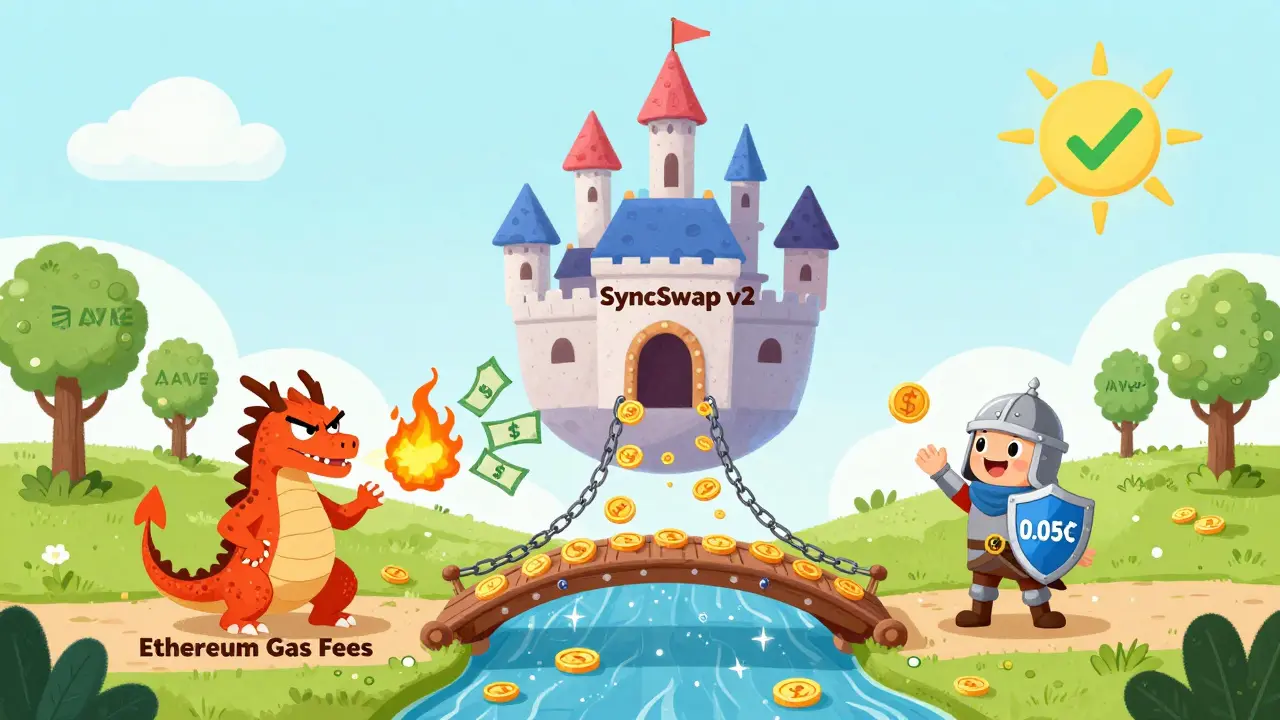
What You Can Trade
On zkSync Era, SyncSwap supports over 150 tokens. That includes the usual suspects: ETH, USDT, USDC, WBTC, WETH, and major DeFi tokens like AAVE, MKR, and SUSHI. It also supports zkSync-native tokens like ZK and early ecosystem tokens that aren’t listed elsewhere. But don’t get fooled by the Scroll version. It only lists three tokens: USDT, USDC, and ETH. And guess what? There were zero trades on Scroll’s SyncSwap in the last 30 days. That’s not a bug - it’s a sign. Liquidity and activity are tied to the main network. If you want to trade, go to zkSync Era. Everything else is noise.Is SyncSwap Safe?
Yes - but with caveats. SyncSwap is fully open-source. Its smart contracts have been audited by reputable firms like CertiK and PeckShield. The code is public. You can verify every transaction on zkSync’s block explorer. There’s no central server to hack. No team can freeze your funds. That’s the beauty of DeFi. But here’s the catch: you’re still responsible for your own keys. If you send funds to the wrong address, there’s no customer support to help you. If you connect your wallet to a fake SyncSwap site (there are phishing clones), you lose everything. Always double-check the URL:app.synswap.finance. Bookmark it. Don’t click links from Twitter or Telegram.
Also, SyncSwap isn’t regulated. No government agency oversees it. That means no FDIC insurance, no chargebacks, no legal recourse if something goes wrong. This is true for almost all DEXs. But if you’re comfortable with that, SyncSwap is one of the safest places to trade on Layer 2.
Who Should Use SyncSwap v2?
If you’re trading on Ethereum and paying $10+ in gas fees every time you swap, SyncSwap v2 is a no-brainer. It’s ideal for:- Regular traders who swap ETH for stablecoins daily
- Liquidity providers looking to earn yield with low fees
- Developers building apps on zkSync who need a reliable swap backend
- Anyone tired of waiting 20 minutes for a transaction to confirm
- You want to trade obscure altcoins not listed on zkSync
- You expect customer service to fix your mistakes
- You’re uncomfortable with self-custody
Tokenomics and SYNC Airdrop Speculation
There’s been a lot of buzz around SYNC, SyncSwap’s native token. The team confirmed there are 100 million SYNC tokens in existence. But here’s the thing: no token has been launched yet. No wallet has received any SYNC. No roadmap says when it will happen. Yet users are farming liquidity pools, staking, and swapping aggressively - hoping to qualify for a future airdrop. This is common in DeFi. Projects often reward early users with tokens later. SyncSwap’s team has said they’re monitoring activity, but they haven’t promised anything. Don’t trade or lock up funds just for a potential airdrop. You’re better off using SyncSwap because it’s fast and cheap - not because you’re chasing free tokens. If SYNC ever launches, it’ll be a bonus. If not, you still saved money on fees.How It Compares to Other DEXs
On zkSync Era, SyncSwap has no real competition. It has 38% market share. The next biggest DEX has less than 10%. That’s dominance. Compared to Uniswap on Ethereum? SyncSwap wins on speed and cost. Uniswap is more established and has more tokens, but you’re paying 100x more in fees. On other Layer 2s like Arbitrum or Optimism, DEXs like Aerodrome or Velodrome are popular. But they don’t have SyncSwap’s zero-fee model on Scroll. And they’re not as tightly integrated with their base network. SyncSwap’s edge isn’t just tech - it’s timing. It launched when zkSync was gaining traction. It was the first DEX built for it. That gave it a huge head start in liquidity and user trust.Final Verdict
SyncSwap v2 is the best DEX on zkSync Era. Period. It’s fast, cheap, secure, and simple. It’s the default choice for anyone trading on that network. The fact that it’s growing while other Layer 2 DEXs struggle shows it’s doing something right. The Scroll version is a curiosity - zero fees, but no users. The Sophon version is dead. That tells you where the real action is: zkSync Era. If you’re not trading on zkSync yet, start here. SyncSwap v2 removes the biggest pain point of DeFi: cost. And it does it without sacrificing security or control. Just remember: always use the official site. Never trust links. And never trade more than you’re willing to lose. That’s the rule for every DEX - even the best ones.Is SyncSwap v2 regulated?
No, SyncSwap v2 is not regulated by any government or financial authority. Like most decentralized exchanges, it operates without oversight. This means you have full control over your funds, but also no legal protection if something goes wrong. This is standard for DeFi platforms.
Does SyncSwap v2 have a token?
SyncSwap has confirmed the existence of 100 million SYNC tokens, but no token has been launched yet. There is no public release date, no wallet distribution, and no official roadmap. Any claims about SYNC airdrops are speculation. Don’t trade or stake based on the hope of receiving SYNC - use SyncSwap because it’s fast and cheap, not because you’re chasing free tokens.
Which network should I use for SyncSwap v2?
Use zkSync Era. That’s where 99% of the trading volume, liquidity, and user activity happens. Other versions like Scroll and Sophon have minimal or zero usage. Even though Scroll offers 0% fees, there were no trades there in the last 30 days. Stick with zkSync Era for real results.
How much do trades cost on SyncSwap v2?
On zkSync Era, trades cost between $0.05 and $0.20 in gas fees - far less than Ethereum mainnet. On Scroll, fees are 0% for both makers and takers. SyncSwap itself charges no platform fees. You only pay what the underlying blockchain charges.
Is SyncSwap v2 better than Uniswap?
On zkSync Era, yes - for most users. SyncSwap is faster, cheaper, and optimized for Layer 2. Uniswap has more tokens and is more established, but its fees on Ethereum are 10 to 100 times higher. If you’re on Ethereum, stick with Uniswap. If you’re on zkSync, SyncSwap is the clear winner.


Steven Dilla
February 1 2026SyncSwap v2 is literally the only reason I stopped using Uniswap on Ethereum. $0.10 per trade?? Bro, I used to pay $15 just to swap USDC for DAI. This isn’t a DEX, it’s a goddamn miracle. 🚀💸 And don’t even get me started on Scroll - zero fees? That’s either genius or a trap. Either way, I’m all in.