
If you’ve ever tried to buy Bitcoin in Seoul, you know it’s not like swiping a credit card at a coffee shop. It’s a structured, heavily monitored process that feels more like opening a brokerage account than tapping an app. The Financial Services Commission (FSC) is the gatekeeper here, and their rules are strict for a reason. As of late 2025 and heading into 2026, South Korea has moved from being a cautionary tale about crypto scams to a blueprint for institutional-grade regulation. If you’re looking to understand how this market works-or if you’re wondering why your foreign exchange won’t let you trade there-you need to grasp the specific mechanisms the FSC enforces.
| Requirement | Specific Rule | Impact on Users |
|---|---|---|
| Real-Name Verification | Bank account must match exchange name | No anonymous trading; high friction for new users |
| Travel Rule Threshold | KRW 1 million (~USD 750) | Sender/receiver info shared for transfers over limit |
| Security Certification | Mandatory ISMS certification | Exchanges must prove robust IT security standards |
| AML/KYC Compliance | Strict identity checks before deposit | Delays in onboarding; documents required upfront |
The Real-Name Bank Account Hurdle
Here’s the biggest barrier for anyone outside Korea trying to interact with these platforms: the real-name verification system. You can’t just sign up with an email. The FSC mandates that every user must have a bank account registered under their exact legal name at the same financial institution where the exchange holds its own operational accounts. This isn’t just a suggestion; it’s a hard technical constraint. If you use Upbit, for example, you likely need a Kookmin Bank account. If you don’t have one, you can’t deposit Won. Why does the FSC insist on this? It kills anonymity. In the early days of crypto, people loved the idea of peer-to-peer transactions without banks watching. South Korea flipped that script. By tying crypto wallets directly to verified banking identities, they made it nearly impossible to launder money through digital assets. For the average trader, this means higher trust but lower privacy. It also creates a closed loop. Foreign investors often struggle here because getting a Korean bank account as a non-resident is notoriously difficult. This effectively keeps the domestic market insulated, which helps the FSC control volatility, but it frustrates global arbitrage traders.
The Travel Rule and FATF Compliance
South Korea was one of the first countries to fully implement the Financial Action Task Force (FATF) Travel Rule. If you send more than KRW 1 million (roughly $750 USD depending on exchange rates) between two exchanges or wallets, the sender and receiver details must travel with the transaction. This applies to buying, selling, transferring, and even storing assets. Imagine you’re moving funds from Bithumb to a cold wallet. If the amount exceeds that threshold, Bithumb collects your personal data and passes it along. The receiving entity must verify it. This sounds tedious, but it’s crucial for stopping fraud. Before this rule, stolen funds could vanish into mixers or unregulated offshore exchanges within minutes. Now, the paper trail is digital and permanent. The FSC uses this data to monitor suspicious patterns. If you suddenly move large sums across multiple platforms in a short time, you might get flagged for review. It’s not automatic freezing, but it adds a layer of scrutiny that doesn’t exist in less regulated jurisdictions.

Institutional Shift: Spot ETFs and Corporate Holdings
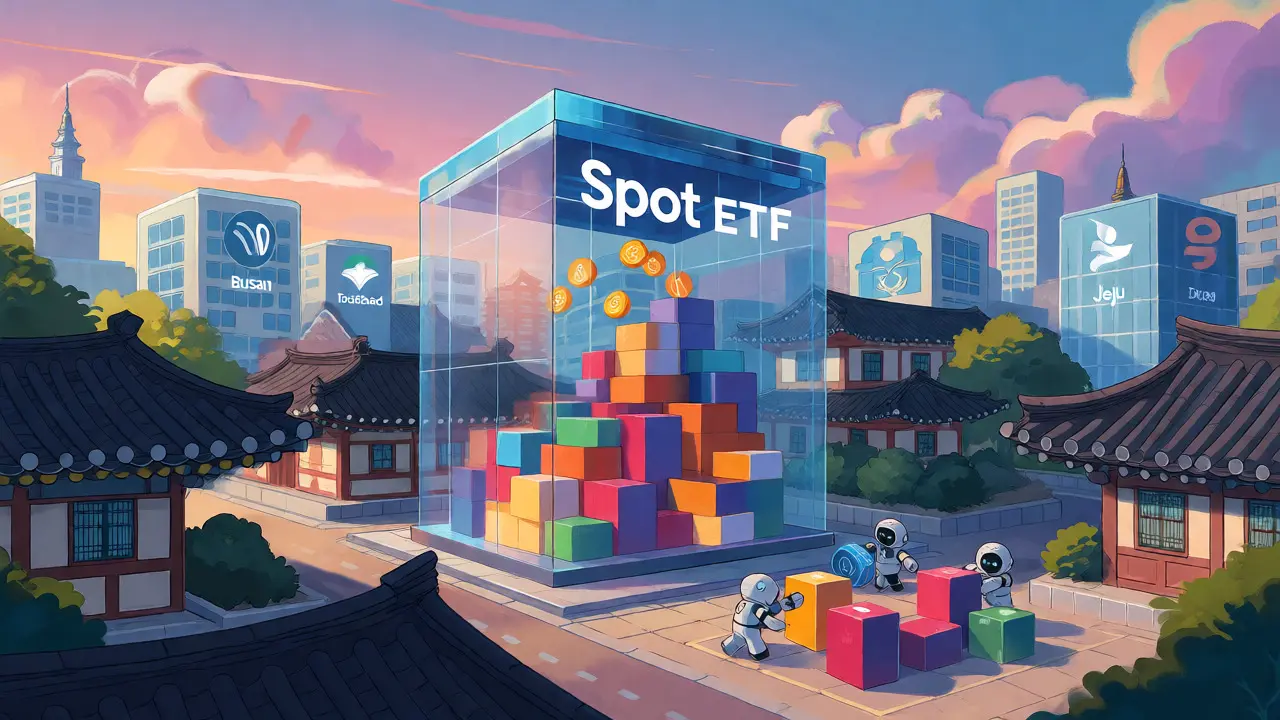
The narrative around South Korean crypto changed dramatically in 2025. For years, the stance was restrictive, banning Initial Coin Offerings (ICOs) since 2017. But the FSC realized that fighting the tide wasn’t working. Instead, they pivoted toward integration. The big news? The approval pathway for spot cryptocurrency Exchange-Traded Funds (ETFs). By late 2025 and early 2026, we saw diversified crypto indices starting to trade on the Korea Exchange. This is huge. It means pension funds and mutual funds can now buy Bitcoin exposure without holding the actual coins. They buy shares in an ETF, which is regulated like any other stock. The FSC imposed strict conditions on these ETF sponsors: transparent index methodologies, real-time net asset value reporting, and full auditability. This opens the door for billions in institutional capital that previously sat on the sidelines due to custody risks. Simultaneously, the ban on corporate crypto holdings began to loosen. Previously, companies couldn’t easily hold Bitcoin on their balance sheets. The Virtual Asset Task Force proposed a phased relaxation, allowing corporations to open KYC-verified accounts and transact within defined limits. Think of companies like Samsung or Hyundai potentially allocating a tiny fraction of treasury reserves to digital assets. This isn’t a free-for-all, but it legitimizes crypto as a financial instrument rather than just a speculative toy.
Taxation Delays and Investor Protection
You might be wondering about taxes. The South Korean government originally planned to tax crypto gains in 2025. Then, they postponed it. As of now, profits from trading are largely exempt from capital gains tax, though this is a temporary reprieve. The delay was political-retail investors cried foul, arguing it was unfair compared to stock markets. The FSC and Ministry of Economy and Finance are still hammering out the details. When the tax finally hits, expect provisions for offsetting losses against gains within the same tax year. This mimics traditional stock market rules. It reduces the sting of volatility. Right now, if you lose money on Ethereum and make it back on Solana, you keep the profit. Later, you’ll pay tax on the net gain. This shift signals that regulators view crypto as mature enough to handle standard financial taxation. It removes the "wild west" label, but it also means your after-tax returns will shrink. Plan accordingly.
Regional Testbeds: Busan and Jeju
Not all regulations apply uniformly across geography. The FSC allows regional innovation zones. Busan, for instance, launched the Digital Asset Nexus. It’s a regulatory sandbox specifically designed for Security Token Offerings (STOs). While the national ICO ban remains, Busan offers a controlled environment where foreign institutions can test tokenized securities. Jeju and Incheon are watching closely, hoping to replicate the model. This approach lets the FSC experiment with new technologies like NFTs and DeFi without risking the entire national economy. If an STO project fails in Busan, the fallout is contained. If it succeeds, the rules can scale nationally. It’s a smart way to balance innovation with stability. For developers and entrepreneurs, this means opportunities exist, but you must navigate local municipal laws alongside federal FSC guidelines.
What This Means for You
If you’re a retail trader in South Korea, life is stable but restricted. You have four main players-Upbit, Bithumb, Coinone, and Korbit-and they all play by the same strict rules. Your money is safe, your identity is known, and your options are limited to compliant assets. If you’re an international investor, access is harder. You can’t just download an app and start trading. You need a Korean bank account, or you need to work through institutional channels like the new ETFs. The FSC prioritizes domestic stability over global accessibility. That’s changing slowly, but don’t expect seamless cross-border trading anytime soon. For businesses, the door is cracking open. Treasury allocations are becoming feasible, but compliance costs are high. You need dedicated legal teams to track the evolving AML rules and reporting requirements. The era of ignoring crypto regulation is over; now, you must budget for it.
Is cryptocurrency trading legal in South Korea?
Yes, trading is legal. However, it operates under a strict regulatory framework managed by the Financial Services Commission (FSC). Unlike some countries where crypto exists in a legal gray area, South Korea grants explicit legal status to cryptocurrencies traded on registered Virtual Asset Service Providers (VASPs).
Why do I need a real-name bank account for Korean exchanges?
The FSC requires real-name verification to prevent money laundering and ensure accountability. Your bank account name must exactly match your exchange account name, and both must be held at the same financial institution linked to the exchange. This eliminates anonymous trading and ties every transaction to a verified identity.
Are there taxes on crypto profits in South Korea right now?
As of late 2025/early 2026, the implementation of capital gains tax on virtual assets has been postponed. Currently, most individual traders do not pay capital gains tax on crypto profits, though future legislation is expected to introduce taxation with provisions for offsetting losses.
Can foreigners trade on South Korean crypto exchanges?
It is difficult. Most major Korean exchanges require a domestic Korean bank account for deposits and withdrawals. Since obtaining a Korean bank account as a non-resident is challenging, many foreigners rely on institutional products like ETFs or global exchanges that accept Korean users, though those may have different liquidity profiles.
What is the Travel Rule threshold in South Korea?
The threshold is KRW 1 million (approximately $750 USD). Any transfer exceeding this amount requires the exchange to collect and share originator and beneficiary information with the receiving party, in compliance with FATF standards.