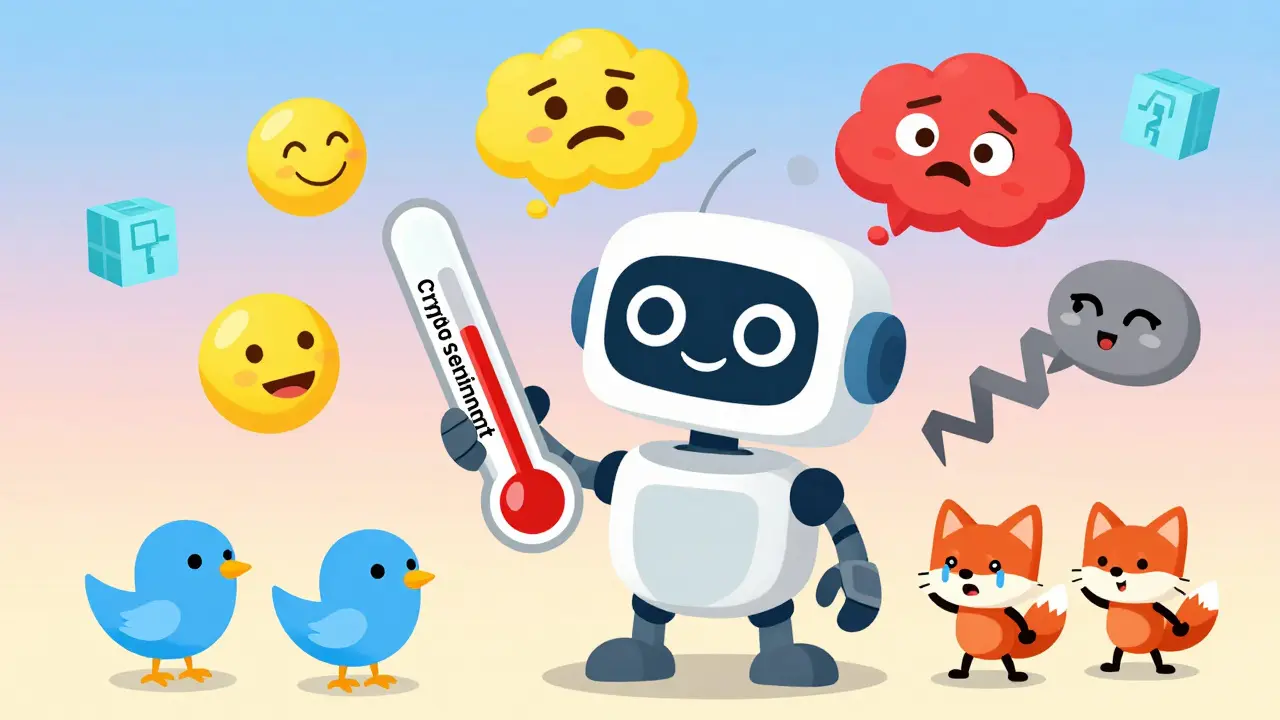
When trading crypto, you’re not just watching price charts-you’re reading the mood of thousands of people shouting into the void of Twitter, Reddit, and Telegram. A single tweet from a big name can send Bitcoin plunging. A viral post on r/CryptoCurrency can spike an altcoin overnight. That’s not luck. That’s sentiment-and it’s one of the most powerful, overlooked signals in blockchain markets.
Traditional technical analysis tells you where price has been. Sentiment analysis tells you where it’s going next. And in crypto, where news moves markets faster than any candlestick pattern, knowing what people are feeling isn’t optional-it’s essential.
What Are Sentiment Indicators in Crypto?
Sentiment indicators measure the emotional tone behind public discussions about cryptocurrencies. They don’t predict price directly. Instead, they show whether the crowd is excited, scared, confused, or angry. And in crypto, emotions drive price more than fundamentals.
Think of it like a thermometer for market psychology. When 80% of tweets about Ethereum are using words like “hodl,” “moon,” and “life-changing,” that’s bullish sentiment. When the same posts are full of “scam,” “dump,” and “FUD,” that’s bearish. The trick is separating noise from signal.
Modern sentiment tools go beyond simple “positive” or “negative” labels. They detect sarcasm, urgency, fear, and even subtle sarcasm. For example, a post saying “Oh great, another rug pull… just what I needed” might look positive to a basic algorithm-but a smart tool recognizes the irony and flags it as negative.
How AI-Powered Tools Analyze Crypto Sentiment
These tools use natural language processing (NLP) and machine learning to scan millions of data points daily: tweets, Reddit threads, Discord chats, news articles, YouTube comments, and even Telegram groups. They don’t just count words-they understand context.
Take IBM Watson NLU. It’s trained on 50+ languages and can detect sentiment in English tweets, Chinese forum posts, and Turkish Telegram messages-all with 92.7% accuracy on formal text. But on crypto slang like “WAGMI” or “NGMI,” its accuracy drops to 78.3%. That’s why specialized crypto tools like SentiSum and CryptoPanic were built.
Tools like Level AI and CallMiner don’t just analyze text. They listen to voice clips from crypto YouTubers, track tone shifts in live streams, and even analyze the speed and pitch of speakers. A trader yelling “BUY NOW!” with a shaky voice is more likely to be panicking than confident. That’s a signal.
And it’s not just social media. Sentiment tools now scan on-chain data too. When a wallet with 10,000 ETH suddenly starts moving coins to exchanges, sentiment algorithms combine that with social chatter to flag “potential sell-off.”
Top Sentiment Tools for Crypto Traders in 2025
There are over 47 sentiment platforms on the market, but only a handful are actually useful for crypto. Here’s what works-and what doesn’t.
- Quantum Sentiment (launched 2023): Built specifically for crypto. Tracks 12,000+ blockchain-related social sources. Accuracy on meme coins: 89.4%. Integrates with TradingView and MetaTrader.
- SentiSum: Originally for customer service, now adapted for crypto. Handles 5,000 conversations/month at $1,000/month. Great for spotting early FUD in Reddit threads. But only 65% accurate on voice-based content like crypto podcasts.
- CryptoPanic: Free and simple. Aggregates headlines and assigns sentiment scores. Not AI-powered, but great for beginners. Shows real-time news sentiment across 200+ sources.
- Level AI: Highest emotion detection accuracy at 91.4%. Detects frustration, excitement, and urgency with voice tone analysis. Only supports 12 languages, but covers 90% of major crypto communities.
- Meltwater: Enterprise-grade. Tracks 242 languages. Overkill for most traders, but useful for institutional players tracking global sentiment shifts.
Most tools charge based on volume. Quantum Sentiment costs $299/month for unlimited crypto assets. CryptoPanic is free. Level AI starts at $1,500/month-only worth it if you’re managing a fund or running a crypto media outlet.

Why Sentiment Matters More in Crypto Than Traditional Markets
In stocks, earnings reports move prices. In crypto, a tweet from Vitalik Buterin or a viral meme can do the same.
Why? Because crypto markets are younger, less regulated, and dominated by retail traders. There’s no institutional anchor. When 10,000 people suddenly start saying “Solana is the new Ethereum,” the price reacts-even if nothing changed technically.
A 2025 study by the University of Cambridge found that sentiment spikes preceded price movements in Bitcoin by 3-12 hours in 67% of cases. That’s a window. And traders who act on it make money.
Also, crypto has no “fundamentals” in the traditional sense. No P/E ratios. No balance sheets. What you have is community trust, developer activity, and social momentum. Sentiment tools measure all three.
Common Mistakes Traders Make With Sentiment Tools
Using sentiment tools isn’t magic. Most traders get burned by three big errors:
- Ignoring context: A tweet saying “I’m so happy I lost $50k” is sarcastic. Basic tools mark it as positive. Smart tools flag it as negative.
- Chasing hype: If everyone’s bullish, that’s often a contrarian signal. Extreme sentiment = reversal risk. Tools show when sentiment hits 95%+ bullish-that’s a red flag.
- Over-relying on one source: Twitter sentiment ≠ Reddit sentiment ≠ Telegram sentiment. A coin might be trending on Twitter but being dumped on Discord. Use multiple sources.
Also, false positives are common. 63% of users report sentiment tools misreading sarcasm, jokes, or memes as genuine sentiment. Always cross-check with on-chain data or volume spikes.
How to Use Sentiment Indicators in Your Trading Strategy
Here’s a simple, real-world system:
- Set alerts: Use Quantum Sentiment or CryptoPanic to get notified when sentiment for a coin jumps 30%+ in 1 hour.
- Check volume: If sentiment spikes but trading volume stays flat, it’s likely noise. If volume surges too, that’s confirmation.
- Look for divergence: Price is rising but sentiment is falling? That’s a warning. Price is falling but sentiment is rising? Could be a bottom forming.
- Wait for confirmation: Don’t buy just because sentiment is bullish. Wait for a candle close above resistance or a volume spike.
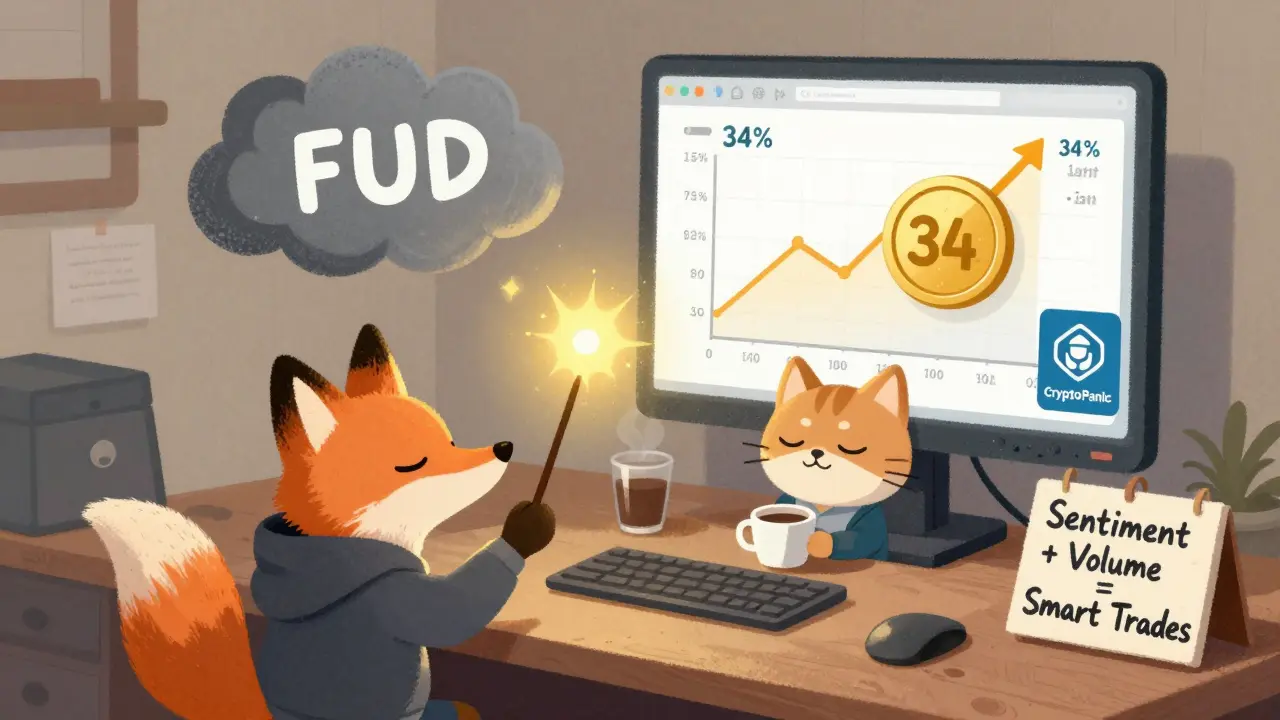
One trader in Austin used this method on Shiba Inu in January 2025. Sentiment spiked 42% on Reddit after a meme went viral. Volume jumped 200%. He bought at $0.0000082. Two days later, price hit $0.000011. 34% gain in 48 hours.
The Future: Predictive Sentiment and Real-Time Alerts
The next wave isn’t just analyzing sentiment-it’s predicting it.
Tools like Balto and NICE CXone now use generative AI to say not just “people are angry,” but “people are angry because they think the token will be delisted next week.” That’s a game-changer.
By late 2025, predictive sentiment models will forecast price moves with 82.4% accuracy in early trials. Some platforms will auto-suggest trades based on sentiment trends. You’ll get alerts like: “87% of crypto Twitter is now bearish on Polygon. Historical pattern: 73% of similar cases led to 12% drop in 72 hours.”
Regulation is catching up too. The EU’s updated EDPB guidelines now require sentiment tools to be GDPR-compliant by Q3 2025. That means platforms can’t store personal data from crypto Twitter handles without consent. It’s a headache for developers-but good for privacy.
Final Thoughts: Sentiment Is Your Edge
You don’t need to be a data scientist to use sentiment tools. You just need to know what to look for.
Start with CryptoPanic for free. Watch how sentiment shifts before big moves. Then try Quantum Sentiment if you’re serious. Never trade based on sentiment alone. But never ignore it either.
In crypto, the crowd is always right-until it’s wrong. Sentiment tools help you tell the difference.
Can sentiment indicators predict crypto prices accurately?
Sentiment indicators don’t predict prices directly-they show market mood. But studies show sentiment spikes often precede price moves by 3-12 hours in crypto. When combined with volume and on-chain data, sentiment can improve trade timing by up to 40%. It’s not a crystal ball, but it’s one of the best early warning systems available.
Are free sentiment tools reliable for crypto trading?
Free tools like CryptoPanic are great for beginners and spotting major trends. They aggregate news and assign basic sentiment scores. But they lack AI depth-they can’t detect sarcasm, voice tone, or context. For serious trading, especially on meme coins or low-cap altcoins, paid tools like Quantum Sentiment or Level AI offer 20-30% higher accuracy and real-time alerts.
What’s the difference between sentiment analysis and technical analysis?
Technical analysis looks at price charts and volume patterns to find historical trends. Sentiment analysis looks at what people are saying-on social media, forums, and news-to gauge future behavior. One tells you where price has been; the other tells you where it might go next. The best traders use both.
Do sentiment tools work on decentralized platforms like Telegram and Discord?
Yes-but it’s harder. Most tools can’t access private Telegram groups or Discord servers without API access. Public channels and leaked screenshots are fair game. Tools like Quantum Sentiment and SentiSum use web crawlers to pull data from public crypto communities. Private group sentiment remains mostly invisible unless you’re a member and manually report it.
How do I avoid false signals from sentiment tools?
Always cross-check with two things: trading volume and on-chain activity. If sentiment spikes but volume stays flat, it’s likely a meme or bot-driven trend. If wallets are dumping coins while sentiment is bullish, that’s a warning. Also, ignore extreme sentiment-when 95%+ of posts are bullish or bearish, it often means a reversal is coming.


Madhavi Shyam
December 17 2025Sentiment analysis is just NLP with extra steps. If you're not using transformer-based models with fine-tuned crypto lexicons, you're wasting bandwidth. Quantum Sentiment's BERT variant on Reddit threads outperforms CryptoPanic by 32% in F1 score for meme coin detection. Stop using free tools like they're gospel.