
Blockchains are isolated islands. They cannot look outside their own walls to see the price of Bitcoin, Ethereum, or even a simple stock index. If they could, smart contracts would be useless for anything involving real-world value. This is where price oracles come in. They are the bridges that carry external data into the blockchain world.
Without these mechanisms, decentralized finance (DeFi) would not exist. You couldn’t borrow against your crypto collateral because the protocol wouldn’t know if its value dropped below the loan amount. Stablecoins wouldn’t stay pegged to the dollar. Automated market makers would fail. As of 2023, price oracles secured over $30 billion in DeFi protocols alone. That number only grows. Understanding how they work, their risks, and which ones to trust is no longer just for developers-it’s essential for anyone holding assets in DeFi.
The Core Problem: The Oracle Dilemma
To understand why oracles matter, you have to understand the limitation they solve. Blockchains are designed to be deterministic and secure. Every node in the network agrees on the state of the ledger. But this security comes at a cost: isolation. A blockchain cannot make an API call to Coinbase or Binance to fetch the current price of ETH. It simply can’t.
This creates what experts call the "Oracle Problem." If you rely on a single source of truth outside the chain, you reintroduce centralization and potential points of failure. If that source lies, gets hacked, or goes offline, the smart contract executing based on that data will execute incorrectly. In finance, incorrect execution means lost money.
Chainlink, launched in May 2017, emerged as the first major solution to this problem. It didn’t just build a bridge; it built a network of bridges. By aggregating data from multiple independent sources and using a decentralized network of node operators, Chainlink aimed to eliminate single points of failure. Today, it dominates the space, securing roughly 70% of the decentralized oracle market share according to 2023 Dune Analytics data.
How Price Oracles Actually Work
Not all oracles are built the same. The two most common architectures you’ll encounter in DeFi are off-chain decentralized networks and on-chain liquidity-based oracles. Each has distinct mechanics, strengths, and weaknesses.
Off-Chain Decentralized Networks (e.g., Chainlink)
These systems operate largely outside the blockchain until the final data point is submitted. Here is the typical flow:
- Data Collection: Multiple independent node operators query various data sources (like centralized exchanges, other blockchains, or traditional financial APIs).
- Aggregation: These nodes submit their findings to a smart contract on-chain. The contract aggregates these values, often taking the median, to filter out outliers or malicious data.
- Submission: The final, verified price is stored on-chain for smart contracts to read.
This approach offers high reliability and resistance to manipulation because an attacker would need to compromise a majority of both the data sources and the node operators simultaneously. Chainlink reports sub-1 minute update intervals for major pairs with median accuracy within 0.5% of centralized exchange prices.
On-Chain Liquidity Oracles (e.g., Uniswap)
Instead of fetching data from outside, these oracles calculate price based on trading activity within the protocol itself. Uniswap introduced its on-chain oracle mechanism with V2 in May 2020. It works by measuring market prices at the beginning of each block before any trades take place. It uses Time-Weighted Average Prices (TWAPs), calculated based on the geometric mean of price observations over time.
The key advantage here is capital efficiency. You don’t need to pay gas fees for external data submissions; the price is derived from existing liquidity pools. However, this method carries higher risk. If a pool has low liquidity, a large trade can drastically skew the price. Uniswap’s oracle updates prices at the end of a block, after the last trade, which removes some in-block manipulation possibilities, but flash loan attacks remain a threat.
Comparison: Chainlink vs. Uniswap Oracles
Choosing between these two approaches depends entirely on your use case. Are you building a lending platform where precision and security are paramount? Or are you building a yield farming strategy where capital efficiency matters more?
| Feature | Chainlink (Decentralized Network) | Uniswap (On-Chain TWAP) |
|---|---|---|
| Data Source | Multiple off-chain APIs and exchanges | Internal liquidity pool trades |
| Manipulation Resistance | High (requires attacking multiple nodes/sources) | Low to Medium (vulnerable to flash loans in low liquidity) |
| Update Frequency | Sub-1 minute for major pairs | Per block (can be frequent but sparse) |
| Cost | Higher (gas for submissions + node fees) | Lower (no extra submission costs) |
| Best For | Lending, derivatives, stablecoins | Yield strategies, AMM operations |
| Market Share | ~70% of decentralized oracle market | Dominant in DEX liquidity |

The Dark Side: Oracle Manipulation Attacks
If oracles are critical infrastructure, they are also prime targets. Security researchers estimate that 37% of all DeFi hacks between 2020 and 2023 involved some form of oracle manipulation. When an oracle’s price feed is artificially altered, it triggers unintended behaviors in smart contracts-usually to the detriment of users.
The most famous example is the Harvest Finance hack of October 2020. Attackers used flash loans to manipulate the price of assets on Uniswap. Because Harvest relied on Uniswap’s short-term price feeds, the manipulated prices allowed attackers to borrow far more than they should have been able to, stealing $24 million. The post-mortem confirmed that the attacker exploited the short observation window in the oracle mechanism.
Another incident occurred during the "Black Thursday" event in March 2020. MakerDAO's oracle failed to update ETH prices during extreme network congestion. This led to $4 million in undercollateralized liquidations. While not a malicious attack, it highlighted a different risk: stale data. During extreme volatility, if an oracle doesn’t update frequently enough, prices become obsolete, leading to unfair liquidations.
Nicolas Macco, founder of Cyfrin, recommends using decentralized oracles over centralized ones and constantly checking the oracle’s performance. He notes that "price oracle manipulation attacks can dramatically affect behavior within DeFi protocols that rely on that oracle for their internal logic." The lesson is clear: never trust a single data source blindly.
Emerging Solutions and Future Trends
The oracle landscape is evolving rapidly. Developers are looking for ways to combine the best of both worlds: the security of decentralized networks and the efficiency of on-chain data.
Cross-Chain Interoperability
As multi-chain ecosystems grow, getting accurate prices across different blockchains is crucial. Chainlink CCIP (Cross-Chain Interoperability Protocol), launched in October 2023, enables secure cross-chain price data transfers between 12 blockchain networks. This reduces the complexity of managing separate oracles for each chain.
Hybrid Models
Newer players like Pyth Network and API3 are introducing hybrid models. Pyth, for instance, brings institutional-grade market data directly on-chain from top-tier financial institutions, offering faster update speeds than traditional decentralized networks. Delphi Digital predicts that hybrid models combining on-chain liquidity data with traditional market feeds will become standard by 2026, potentially reducing manipulation vectors by 70%.
Regulatory Pressure
Regulation is also shaping the future. The EU’s MiCA legislation, effective December 2024, requires "reliable and verifiable price sources" for stablecoin issuers. This forces projects to choose oracles that not only work technically but also meet compliance standards, likely favoring established, audited networks like Chainlink.
Best Practices for Users and Developers
Whether you are a developer building a new protocol or a user interacting with DeFi, understanding oracle risks is vital. Here is how to protect yourself.
For Developers:
- Use Multiple Sources: Never rely on a single oracle for critical functions. Combine Chainlink with another provider or use a fallback mechanism.
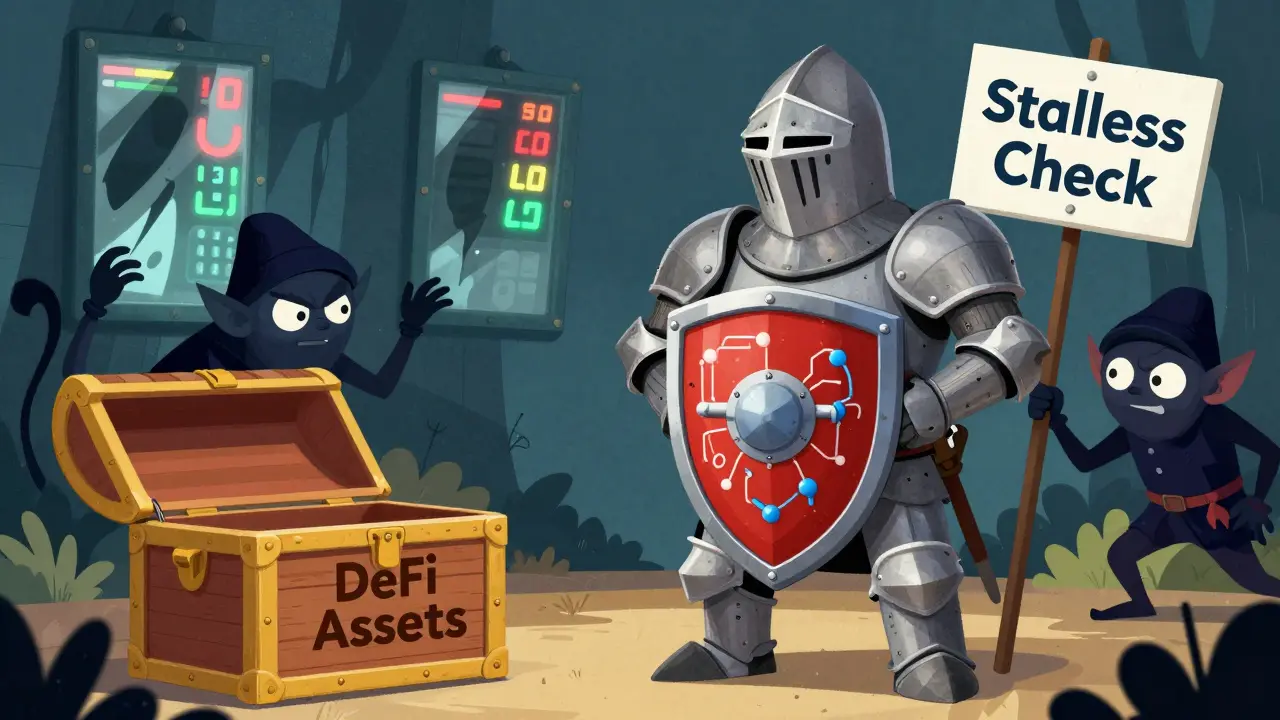
- Implement Circuit Breakers: Code your smart contracts to halt operations if price changes exceed a certain threshold within a short period. This prevents catastrophic losses during manipulation attempts.
- Set Staleness Thresholds: Ensure your contracts reject data that is too old. A ConsenSys advisory found that 17% of audited DeFi protocols had incorrect staleness configurations.
- Audit Your Integrations: Integration takes 2-3 weeks for complex systems. Don’t rush. Use comprehensive documentation and community support.
For Users:
- Check Oracle Providers: Before depositing funds into a lending protocol, check which oracles it uses. Protocols using only Uniswap V2/V3 oracles for large loans are riskier than those using Chainlink.
- Beware of Low-Liquidity Pools: If you are providing liquidity, remember that thin pools are easier to manipulate. This affects the accuracy of the price data derived from them.
- Monitor Market Volatility: During extreme crashes, oracle updates may lag. Be cautious about interacting with leverage positions during these times.
Conclusion: The Backbone of Trustless Finance
Price oracles are unsung heroes of the crypto ecosystem. They allow blockchains to interact with the real world, enabling everything from simple swaps to complex financial derivatives. While they introduce new risks, particularly around manipulation and stale data, the industry is maturing. With better architectures, cross-chain solutions, and stricter security practices, oracles are becoming more robust every year.
As DeFi continues to grow, securing over $80 billion in total value locked by late 2023, the reliability of these data feeds will only become more important. For now, the golden rule remains: diversify your data sources, verify your integrations, and never assume that on-chain data is inherently immune to error.
What is a price oracle in cryptocurrency?
A price oracle is a service or mechanism that provides external data, such as asset prices, to smart contracts on a blockchain. Since blockchains cannot access off-chain data directly, oracles act as bridges, ensuring that decentralized applications (dApps) can react to real-world events like price changes.
Why are price oracles important for DeFi?
Price oracles are critical for DeFi because they enable core functionalities like loan liquidations, stablecoin peg maintenance, and automated market maker operations. Without accurate price data, smart contracts cannot determine the value of collateral, leading to insolvency or unfair user outcomes.
What is the difference between Chainlink and Uniswap oracles?
Chainlink is a decentralized oracle network that aggregates data from multiple off-chain sources, offering high security and resistance to manipulation. Uniswap oracles, on the other hand, derive prices from on-chain liquidity pool trades using Time-Weighted Average Prices (TWAP). Uniswap oracles are more capital-efficient but are more vulnerable to manipulation in low-liquidity scenarios.
Can price oracles be hacked?
Yes, price oracles can be compromised through manipulation attacks. Hackers can exploit vulnerabilities in oracle designs, such as short observation windows or reliance on low-liquidity pools, to artificially alter price feeds. This was seen in the Harvest Finance hack, where attackers stole $24 million by manipulating Uniswap prices.
How do I choose the right oracle for my project?
Choose an oracle based on your specific needs. For high-security applications like lending and derivatives, use decentralized networks like Chainlink. For capital-efficient strategies within DEXs, on-chain oracles like Uniswap’s TWAP may suffice. Always implement circuit breakers and use multiple data sources to mitigate risks.
What is a TWAP oracle?
TWAP stands for Time-Weighted Average Price. It is a method used by on-chain oracles like Uniswap to calculate the average price of an asset over a specific period. This helps smooth out short-term price fluctuations and reduces the impact of single large trades on the reported price.
Are there regulatory requirements for price oracles?
Yes, regulations like the EU’s MiCA legislation require stablecoin issuers to use "reliable and verifiable price sources." This pushes projects toward established, audited oracle providers that can demonstrate transparency and security in their data collection methods.