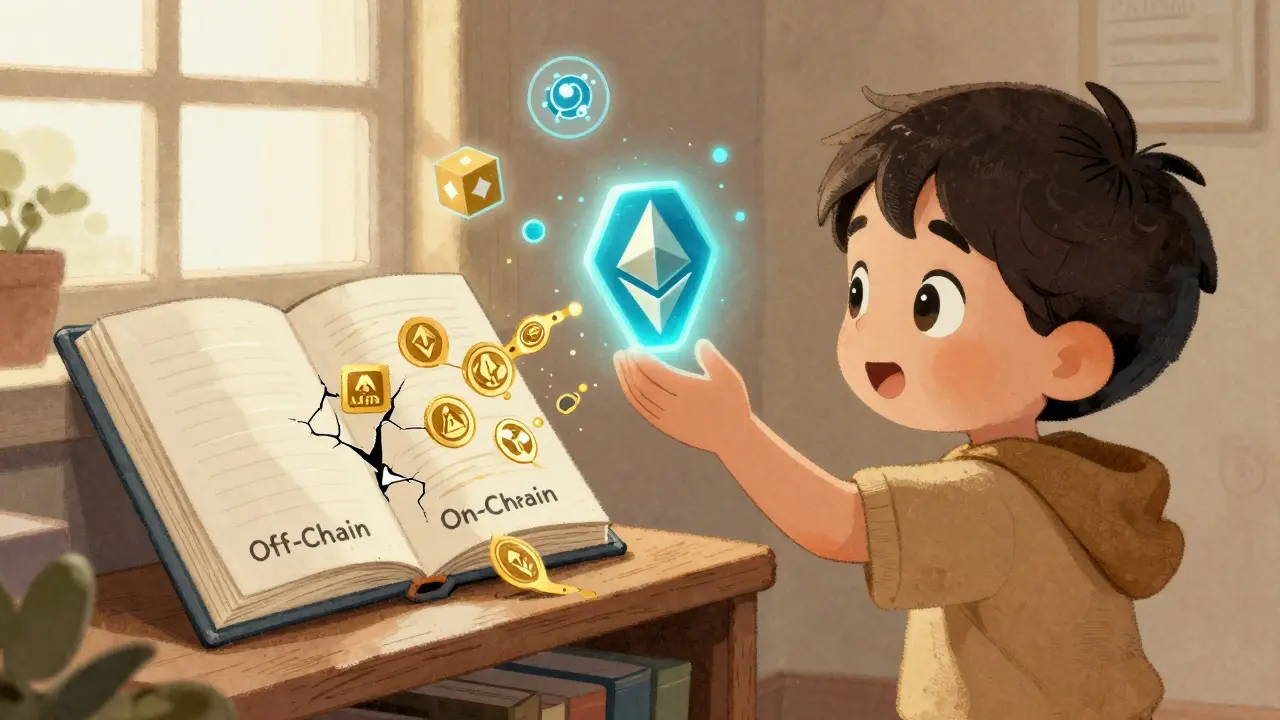
Imagine buying an NFT that shows a beautiful digital artwork today-only to wake up next month and see a blank space where your art used to be. This isn’t science fiction. It’s happened to thousands of NFT owners because their metadata was stored off-chain. Meanwhile, others who paid more upfront to store everything on-chain still see their art perfectly intact, even after their project’s website shut down. The difference? Where the data lives.
What Exactly Is NFT Metadata?
NFT metadata is the behind-the-scenes information that makes your NFT meaningful. It’s not the token itself-that’s just a digital certificate on the blockchain. The metadata is what tells your wallet: ‘This NFT is a pixelated punk with a bandana, 1980s sunglasses, and a 7% chance of being a zombie.’ It includes the image, name, description, traits, and any other attributes that give your NFT its identity.
Without metadata, an NFT is just a string of numbers. Think of it like a book with no pages-just a cover with a barcode. The barcode (the token) proves you own it. But the story (the metadata) is what makes it valuable.
On-Chain Metadata: The Ironclad Guarantee
On-chain metadata means the entire thing-image, traits, name-is written directly into the smart contract on the blockchain. No external servers. No third parties. No middlemen. Just raw data baked into Ethereum (or another chain) forever.
This is the gold standard for permanence. If Ethereum exists, your NFT’s metadata exists. Even if the artist disappears, the website crashes, or the company goes bankrupt, your NFT still works. Art Blocks, one of the earliest and most respected generative art platforms, has used fully on-chain metadata since 2020. Every single one of their 100,000+ NFTs still renders correctly today.
How does it work? Instead of linking to a JPG file, the smart contract generates the image using SVG code-text-based graphics that can be stored as strings inside the contract. Attributes like rarity, color, or accessories are stored as JSON-like data directly in the contract. It’s like writing your entire book inside the binding of the cover.
But there’s a cost. Storing 1KB of data on Ethereum can cost between $50 and $500 in gas fees, depending on network congestion. A simple NFT with basic traits might use 5KB-that’s $250 to $2,500 just to mint one. For complex art or animations, the cost becomes prohibitive. Ethereum’s transaction limit of 128KB per block also caps how much you can store in one go.
Still, for high-value art, collectors demand this level of security. A 2023 study found that 87% of NFTs with a floor price over 10 ETH used on-chain or hybrid metadata. If you’re selling a $10,000 NFT, paying $500 to ensure it lasts 100 years makes sense.
Off-Chain Metadata: The Flexible but Risky Option
Off-chain metadata means the NFT token stores only a link-usually a URL-to where the real data lives. That link could point to a server like AWS, a decentralized network like IPFS, or a permanent storage solution like Arweave.
This approach is cheap. Storing metadata on AWS S3 costs about $0.023 per GB per month. For a collection of 10,000 NFTs, that’s less than $10 a month. Minting takes seconds, not minutes. Developers love it because it’s easy to update. Need to fix a typo? Just change the file on the server.
But here’s the catch: if the server goes down, your NFT breaks.
In 2022, LooksRare’s metadata servers went offline during a market surge. Over 47,000 NFTs showed blank images. CryptoPunks had the same problem before they moved to on-chain storage in 2022. Even IPFS, often praised as decentralized, isn’t foolproof. A 2023 analysis found that 68% of Ethereum NFTs using IPFS relied on just one company-Pinata-to keep their data alive. If Pinata shuts down or changes its API, those links break.
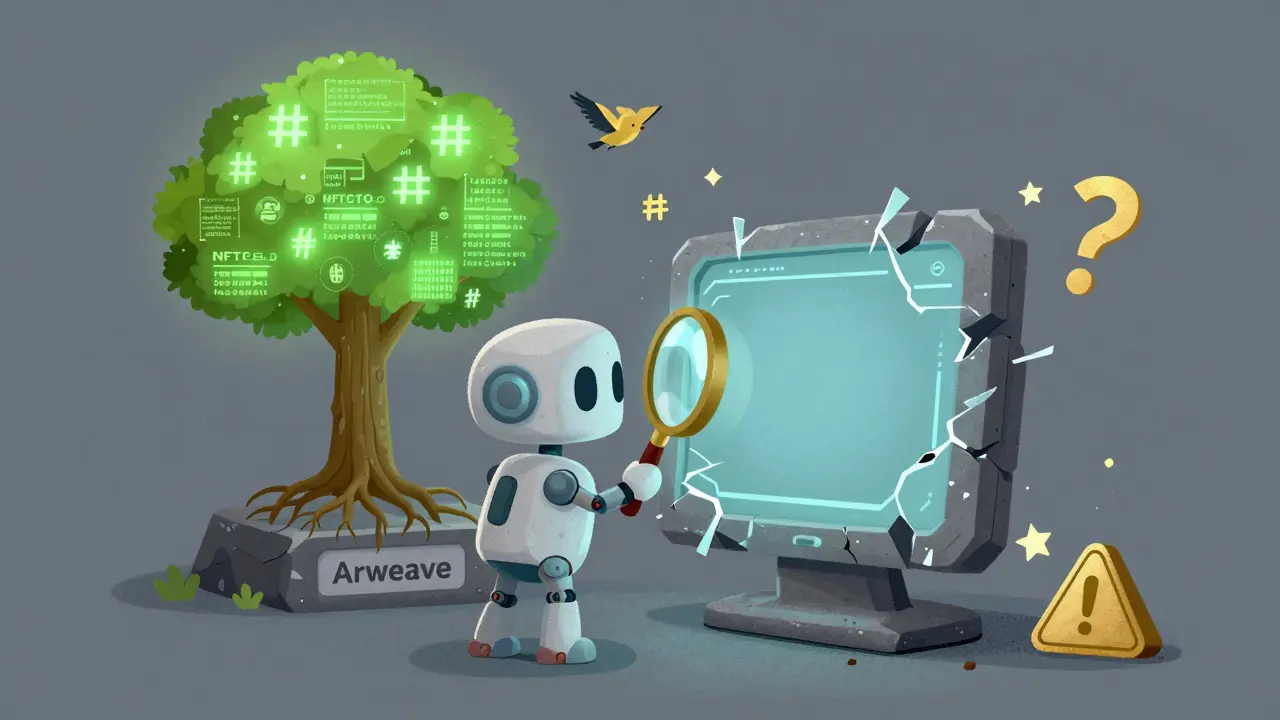
Arweave is different. It charges $0.015 per MB for permanent storage with a 200-year guarantee. It’s used by 90% of Solana NFTs and is growing fast. But even Arweave has limits: you can’t easily edit metadata after upload, and querying it is slower than a regular server.
And then there’s centralized storage-like Google Drive or Dropbox links. These are the riskiest. One lawsuit, one server shutdown, one forgotten bill, and your NFT turns into a digital ghost. Polygon’s top NFT projects showed 61% reliance on private servers in 2023-a ticking time bomb.
Hybrid: The Smart Middle Ground
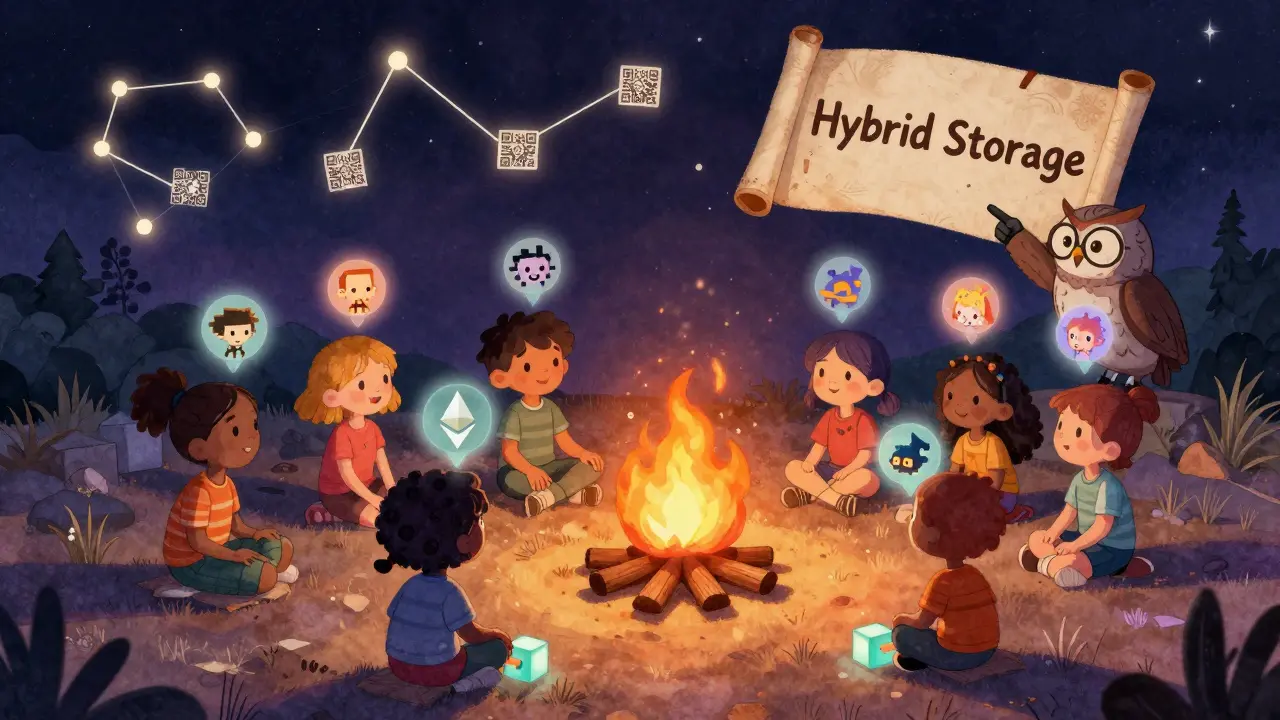
Most serious NFT projects today don’t choose one or the other. They use hybrid storage: store a cryptographic hash of the metadata on-chain, and the actual data off-chain.
Here’s how it works:
- The smart contract holds a unique hash (like a digital fingerprint) of your NFT’s metadata.
- The real image and traits are stored on IPFS or Arweave.
- When you view your NFT, your wallet checks the hash on-chain to confirm authenticity, then pulls the data from the off-chain source.
This gives you the best of both worlds: you get proof that the data hasn’t been tampered with, and you avoid the insane gas costs of storing full images on-chain.
Projects like OpenSea, Coinbase, and Rarible are pushing for this to become the industry standard by late 2024. The NFT Metadata Alliance, formed in September 2023, is working to make hash-on-chain the minimum requirement for all major marketplaces.
It’s not perfect. If the off-chain data disappears, your NFT still breaks-but at least you can prove it was once real. And if you’re using Arweave, you’re covered for the long haul.
Which Should You Use?
It depends on what you’re building-and what you’re willing to pay for.
Use on-chain if:
- You’re creating high-value art (floor price > 5 ETH)
- You want to guarantee your NFT survives 10, 20, or 50 years
- You’re okay with higher minting costs and slower transactions
- You’re an artist who doesn’t want anyone to ever alter your work
Use off-chain (IPFS or Arweave) if:
- You’re minting a large collection (1,000+ NFTs)
- You need to update traits or fix bugs after minting
- You’re on a budget and can’t afford $500 per NFT in gas
- You’re building utility NFTs (gaming, access passes, memberships)
Use hybrid if:
- You want maximum security without the cost
- You’re launching on Ethereum or a chain with high gas fees
- You’re unsure whether your project will last
- You’re working with a marketplace that requires it
For most people-artists, collectors, builders-the hybrid model is the smartest choice. It’s the most common today and the most likely to become the standard.
What’s Changing in 2026?
The landscape is shifting fast. Ethereum’s Prague upgrade, scheduled for Q2 2024, will reduce on-chain storage costs by up to 90% thanks to EIP-4844. That means in 2026, storing full metadata on-chain could cost as little as $5 per NFT.
Tools like Thirdweb’s On-Chain Metadata SDK are already cutting gas use by 47%. Compression techniques are improving too-some NFTs now fit entire animated art pieces under 2KB using advanced SVG tricks.
Regulations are catching up. The EU’s MiCA framework, effective June 2024, requires financialized NFTs to have immutable metadata. That will force more projects to move toward on-chain or hybrid solutions.
And the market is responding. In 2021, 61% of NFTs used centralized metadata. By 2023, that dropped to 38%. In 2026, it’s likely under 20%. The era of broken NFTs is ending-not because people are being nice, but because the tech and economics finally make permanence affordable.
What Happens If Your NFT Metadata Breaks?
If you’re a collector and your NFT shows a blank image, here’s what to do:
- Check the NFT’s contract on Etherscan or Solscan. Look for the metadata URI.
- Copy the link and paste it into your browser. If you get a 404 error, the server is down.
- Search for the NFT on NFTScan or OpenSea. Sometimes they cache metadata.
- If it’s on IPFS, try accessing it via https://ipfs.io/ipfs/ + your hash.
- If it’s on Arweave, check https://arweave.net/ + your transaction ID.
- If nothing works, and the project is dead-you likely lost access. That’s why on-chain matters.
There’s no magic fix. Once the link dies and the data isn’t archived, it’s gone. That’s why storing your own NFTs on a permanent network like Arweave is becoming a best practice for serious collectors.
Final Thoughts
On-chain metadata is the future-but it’s not the only future. Off-chain is still practical, affordable, and widely used. But if you care about legacy-if you want your NFT to be readable in 2050-you need to think beyond the mint.
The most successful NFTs aren’t the ones with the flashiest art. They’re the ones that still work after the hype dies. That’s the real test. And right now, the only way to pass it is to store your data where no one can delete it.
Choose wisely. Your NFT’s life depends on it.


Surendra Chopde
January 10 2026Just minted my first on-chain piece last week. Paid $320 in gas but worth every cent. Saw a project from 2021 die and all their NFTs turned into blank squares. My art still renders even if the site vanishes tomorrow. No regrets.