OFAC Cryptocurrency Sanctions Are Not Optional
If you run a crypto exchange, wallet service, DeFi platform, or even a business that accepts Bitcoin, you’re already under OFAC’s radar. The Office of Foreign Assets Control doesn’t care if your platform is decentralized, anonymous, or built on a new blockchain. If U.S. persons are involved - even indirectly - you’re subject to U.S. sanctions law. And in 2026, enforcement is sharper, faster, and more technical than ever.
It’s not about intent. It’s about control. OFAC operates under strict liability. That means if a user from Iran sends you 0.5 ETH, and you didn’t block it, you’re in violation - even if you had no idea who they were. The 2025 ShapeShift settlement proves it: $750,000 in penalties for letting users from sanctioned countries trade over $12.5 million in crypto. No fraud. No conspiracy. Just missing geolocation checks.
How OFAC Targets Crypto: The SDN List and Digital Wallets
OFAC doesn’t just block names anymore. It blocks addresses. As of October 2025, the Specially Designated Nationals (SDN) List includes 1,247 cryptocurrency wallet addresses tied to sanctioned individuals and entities. These aren’t random. They’re linked to hackers, ransomware operators, Iranian oil traders, Russian military suppliers, and North Korean laundering networks.
When a wallet appears on the SDN list, every transaction going to or from it must be blocked. That includes incoming deposits, outgoing withdrawals, and even smart contract interactions. You can’t just freeze the account. You have to freeze the specific digital asset. OFAC gives you two options: either lock each individual wallet that holds sanctioned funds, or consolidate all blocked assets into one designated ‘Blocked SDN Digital Currency’ wallet. Either way, those funds stay frozen until OFAC says otherwise.
And here’s the catch: you don’t have to convert them to dollars. You can keep them as Bitcoin, Ethereum, or USDT - but you can’t move them. Not even to your own cold storage. Not even to pay miners. Not even to cover gas fees. The asset is legally blocked. Period.
Compliance Isn’t Just a Tool - It’s a System
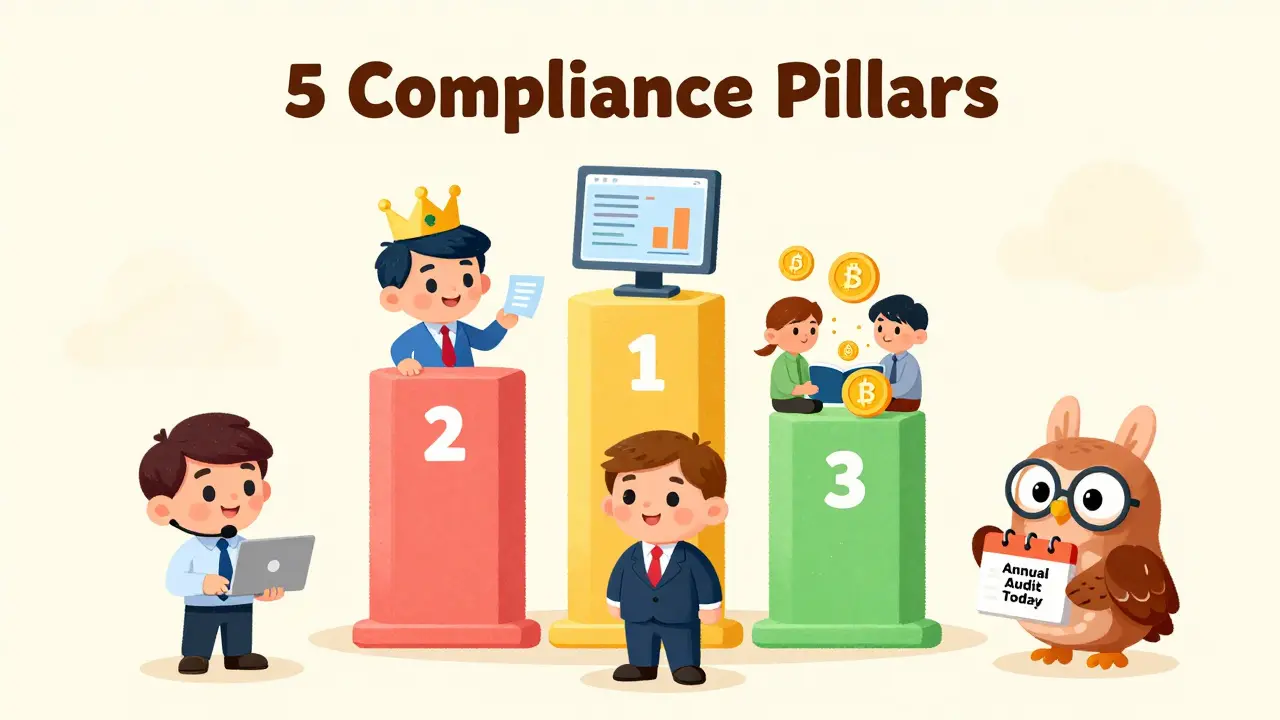
OFAC’s 2021 Virtual Currency Compliance Guidance laid out five non-negotiable pillars for any crypto business:
- Management Commitment - Your CEO or board must sign off on compliance. Not your legal team. Not your CTO. The top leadership. No exceptions.
- Risk Assessment - You must document your exposure quarterly. Are you serving users in Venezuela? Do you support privacy coins? Are you integrated with cross-chain bridges? Each adds risk.
- Internal Controls - Automated screening tools are mandatory. Manual checks won’t cut it. You need real-time screening of every transaction against the latest SDN list.
- Testing and Auditing - An independent third party must audit your system at least once a year. Internal reviews don’t count.
- Training - Every employee who touches transactions, KYC, or customer support must complete training. 92% completion rate is the baseline. OFAC checks.
Companies that skip even one of these get fined. Not warned. Not given a grace period. Fined. The 2025 Garantex case shows how deep it goes: not only was the exchange sanctioned, but six related companies and its successor entity, Grinex, were also designated. OFAC is now going after entire networks.
Tools You Can’t Afford to Ignore
You can’t screen crypto wallets with Excel. You need blockchain analytics platforms. The market leaders are Chainalysis, Elliptic, and TRM Labs. These tools connect directly to OFAC’s SDN list and scan every transaction in real time.
Chainalysis Reactor, for example, lets you build custom risk rules: flag any transaction over $100 from a wallet that’s ever interacted with a mixer, or block all activity from IPs in sanctioned countries. Kraken reduced false positives from 18% to 4.3% after implementing it. But it costs $450,000 to set up - and that’s just for one platform.
Smaller firms often try to cut corners with free tools or manual lists. That’s dangerous. OFAC added 37 new crypto addresses in Q2 2025 alone. If your system isn’t updating daily, you’re already behind. A Coinbase compliance officer confirmed: false positives hit 12-15% with basic tools. That means you’re blocking legitimate users - and missing bad actors.
Privacy coins like Monero and Zcash are the biggest blind spot. 68% of crypto firms say they can’t effectively screen them. OFAC’s October 2025 update clarified: you still need ‘reasonable measures.’ That means you can’t ignore them. You must document your efforts - even if you can’t fully block them.
DeFi Is the New Wild West - And OFAC Is Coming
DeFi protocols are the hardest to regulate. No company. No CEO. No KYC. Just code. But OFAC doesn’t care. If a U.S. person interacts with a DeFi pool that’s been used by a sanctioned wallet, you’re still liable if you’re facilitating access.
73% of firms surveyed in 2025 said they struggle to apply sanctions rules to automated market makers and liquidity pools. Some try to block IP addresses. Others use wallet screening on entry points like centralized bridges. But there’s no perfect solution yet.
That’s why Ethereum’s proposed EIP-7594 - a protocol-level sanctions filter - is so controversial. It would force smart contracts to reject transactions from blocked addresses. But the Ethereum community pushed back hard. 1,247 comments on the AllCoreDevs call called it a violation of decentralization. OFAC knows this. That’s why they’re focusing on the entry points: exchanges, wallets, and on-ramps.
How Much Does This Cost?
Compliance isn’t cheap. A 2025 Deloitte survey of 78 crypto firms found annual compliance costs range from $150,000 to $2 million, depending on transaction volume. For a small exchange processing $10 million a month, expect to spend $300,000-$500,000. For a major platform like Binance, it’s $2 million - and they still get flagged for false positives.
Setup takes time too. A 2025 Steptoe & Johnson study found full implementation takes 22-36 weeks:
- Sanctions risk assessment: 4-8 weeks
- Selecting and integrating blockchain tools: 8-12 weeks
- Connecting to transaction systems: 6-10 weeks
- Staff training and testing: 4-6 weeks
And it doesn’t stop there. You need at least one full-time compliance officer for every $100 million in daily volume. Most firms hire contractors or outsource to specialized firms. But even then, training is non-negotiable. ACAMS found compliance officers need 147 hours of specialized crypto sanctions training before they’re effective.
U.S. vs. The World: Why OFAC Is Different
Other countries have crypto sanctions too - but none are as aggressive as OFAC.
The EU’s 6AMLD uses a ‘reasonable measures’ defense. If you tried, you’re not liable. OFAC doesn’t care. The UK’s OFSI has issued just three crypto enforcement actions since 2018. OFAC has issued 17 - totaling $48.7 million in penalties.
Even Singapore, which has strict financial rules, has only fined $3.8 million in crypto sanctions cases. OFAC’s 2026 budget request includes $28 million - a 40% increase - just for crypto enforcement. They’re building a 35-person Digital Asset Sanctions Task Force. This isn’t a warning. It’s a war room.
If you’re a U.S.-based company, you have no choice. If you’re a foreign company serving U.S. users - even one - you’re still in scope. OFAC doesn’t need you to be in the U.S. It just needs your transaction to touch the U.S. financial system. That includes USD stablecoins, U.S. banks, or even U.S.-based developers.
What Happens If You Don’t Comply?
Penalties aren’t just fines. They’re existential.
ShapeShift paid $750,000 - but they also had to overhaul their entire compliance team, fire executives, and submit to a 3-year monitoring agreement. Garantex didn’t just get fined. They got erased from the financial system. Their bank accounts were frozen. Their payment processors cut them off. Their reputation died.
For a small exchange, that’s death. For a startup, it’s the end. And it’s not just about money. OFAC can block your domain. Freeze your assets. Prevent you from accessing U.S. markets. That’s the real power.
Where Do You Start in 2026?
Here’s your action plan:
- Assess your exposure - Who are your users? What chains do you support? Do you handle stablecoins? Privacy coins? Cross-chain swaps?
- Choose a blockchain analytics tool - Chainalysis, Elliptic, or TRM Labs. Don’t go cheap. Your liability is too high.
- Integrate screening at every touchpoint - Onboarding, deposits, withdrawals, swaps. Not just the front end.
- Train everyone - Not just compliance. Support, engineering, marketing. Everyone who touches users.
- Document everything - Risk assessments, audit reports, training logs. OFAC will ask for them. If you don’t have them, you’re guilty by default.
There’s no shortcut. No loophole. No ‘we didn’t know.’ The technology exists. The rules are clear. The penalties are real. If you’re in crypto, compliance isn’t a cost center. It’s your license to operate.
What’s Next?
By 2027, 65% of all crypto transactions will be screened in real time. That’s up from 38% today. The trend is unstoppable. Regulators are getting smarter. Tools are improving. The cost of non-compliance is rising faster than the cost of compliance.
Some say OFAC is overreaching. That it’s killing innovation. But the most successful crypto firms - Coinbase, Kraken, Binance - aren’t fighting it. They’re investing in it. Because they know: in crypto, trust isn’t built on anonymity. It’s built on reliability. And reliability means you know who you’re dealing with.
OFAC isn’t the enemy. Ignoring OFAC is.
Does OFAC only target U.S. companies?
No. OFAC applies to anyone who engages in transactions involving U.S. persons, the U.S. financial system, or U.S.-based technology. That includes foreign exchanges that accept U.S. dollars, use U.S. stablecoins like USDT or USDC, or have developers in the U.S. Even if your company is based in Singapore or Dubai, if a U.S. user sends you crypto - you’re in scope.
Can I use free blockchain explorers to check addresses?
No. Free tools like Etherscan or Blockchain.com don’t update in real time against OFAC’s SDN list. They don’t flag newly added addresses. They don’t screen smart contracts or cross-chain transactions. OFAC expects automated, real-time screening through licensed tools like Chainalysis or Elliptic. Relying on manual checks is a violation waiting to happen.
What if I don’t know who the user is - like in a DeFi protocol?
OFAC requires ‘reasonable measures’ even in DeFi. That means you must screen wallet addresses before allowing interaction with your platform. If you’re a DEX aggregator, you must block transactions going to known sanctioned wallets. If you’re a bridge, you must screen both origin and destination addresses. You can’t claim ignorance. The technology exists to detect and block. If you don’t use it, you’re not taking reasonable measures.
Do I need to report blocked assets to OFAC?
Yes. You must file a report with OFAC within 10 business days of blocking an asset. The report must include the wallet address, asset type, amount, date of blocking, and how you identified the sanction. Failure to report is a separate violation. OFAC’s FAQ 646 outlines exact reporting formats. Don’t guess - follow the template.
Can I still accept cryptocurrency if I’m not a financial institution?
Yes - but you still need compliance. OFAC’s guidance says ‘all companies - even those not primarily engaged in financial services - should implement risk-based sanctions compliance programs.’ That means if you’re a SaaS company accepting Bitcoin for subscriptions, you still need to screen incoming payments. You don’t need a full KYC system, but you need basic wallet screening. Ignoring it exposes you to liability.
How often does OFAC update the SDN list with new crypto addresses?
OFAC adds new cryptocurrency addresses weekly. In Q2 2025 alone, they added 37 new crypto addresses. Tools like Chainalysis update their databases daily, but manual checks are useless. Your system must be automated and connected to OFAC’s official feed. Delayed updates = compliance failure.
Are NFTs subject to OFAC sanctions?
Yes. NFTs are digital assets, just like Bitcoin or Ethereum. If an NFT is owned by a sanctioned person, or if it’s traded through a wallet on the SDN list, the transaction must be blocked. OFAC has already sanctioned NFT marketplaces that facilitated trades with blocked addresses. The same rules apply.
What if my software is open source and used by others?
Developers of open-source software are generally not liable - unless they actively assist sanctioned entities. But if you’re running a node, hosting a wallet service, or offering a dApp that interacts with blocked addresses, you’re responsible. OFAC targets operators, not code. If you’re not in control of the service, you’re likely not liable. But if you’re running it - you’re on the hook.


Caitlin Colwell
January 13 2026I just lost a client because their wallet got flagged. They were a small artist selling NFTs. No ties to sanctions, just bad luck with an old address. It breaks my heart. We had to refund and shut it down. This system doesn't distinguish between criminals and creators.