
Imagine a government so isolated by international sanctions that it turns to the dark web not for propaganda, but for payroll. Between 2017 and 2025, North Korean state-sponsored hacking groups stole approximately $3 billion in cryptocurrency. This isn’t the work of rogue criminals acting on their own; it is a systematic, state-directed campaign designed to fund weapons programs while bypassing global financial restrictions. For anyone holding digital assets or working in fintech, understanding these operations is no longer optional-it is a survival skill.
The scale of this theft has escalated dramatically. In 2024 alone, North Korean actors stole $1.34 billion across 47 incidents, more than doubling the previous year’s total. Then came February 2025, when a single attack on the Dubai-based exchange Bybit resulted in the loss of nearly $1.5 billion worth of Ether. That one heist exceeded the combined value of every other crypto robbery in 2024. The question is no longer if these hackers are targeting your platform, but how they are doing it and what you can do to stop them.
The Architects of Theft: Who Are the North Korean Hackers?
When we talk about North Korean cybercrime, we aren’t talking about a faceless shadow. We are talking about specific, tracked entities with distinct operational styles. The primary group behind most major breaches is known as Lazarus Group, which is a North Korean state-sponsored hacking collective responsible for some of the largest financial cyberattacks in history. But Lazarus doesn’t work alone. They operate alongside specialized units like TraderTraitor, Jade Sleet, UNC4899, and Slow Pisces. Each group has its own niche, from social engineering to malware deployment, creating a diversified arsenal that keeps defenders guessing.
These groups are not just random script kiddies. They are highly trained operatives who understand blockchain technology deeply. According to assessments by the United Nations Security Council and firms like Chainalysis, these actors account for over 60% of all cryptocurrency stolen globally in recent years, despite representing only a fraction of total hacking incidents. Their success rate is terrifyingly high because they combine technical sophistication with relentless patience. They don’t rush. They plan months in advance, often compromising a target long before they execute the final theft.
How the Heists Work: Social Engineering Over Code
You might expect a $300 million hack to involve complex zero-day exploits or brute-force attacks on encryption keys. Surprisingly, the most effective weapon in the North Korean arsenal is human error. The majority of these breaches start with social engineering-specifically, fake job offers on professional networking sites like LinkedIn.
Consider the May 2024 attack on the Japanese cryptocurrency platform DMM, which resulted in a $308 million loss. The hackers didn’t break into DMM directly. Instead, they targeted employees at Ginco, a company that provided wallet software for DMM. On LinkedIn, attackers posed as recruiters, sending out legitimate-looking job postings. Interested candidates were directed to a GitHub repository containing a "pre-employment test"-which was actually a malicious Python script. Once an employee ran this script, the hackers gained access to their session cookies. With those cookies, they could impersonate the employee inside Ginco’s internal systems, eventually manipulating a transaction request to divert funds to their own wallets.
This pattern repeats itself. TraderTraitor, another key player, used similar tactics to steal $100 million from Atomic Wallet and tens of millions from Alphapo and CoinsPaid in 2023. The lesson here is clear: securing your servers is useless if your employees click on a link from a "recruiter." The vulnerability is human, not just technical.

The Great Laundering: Moving Billions Across Chains
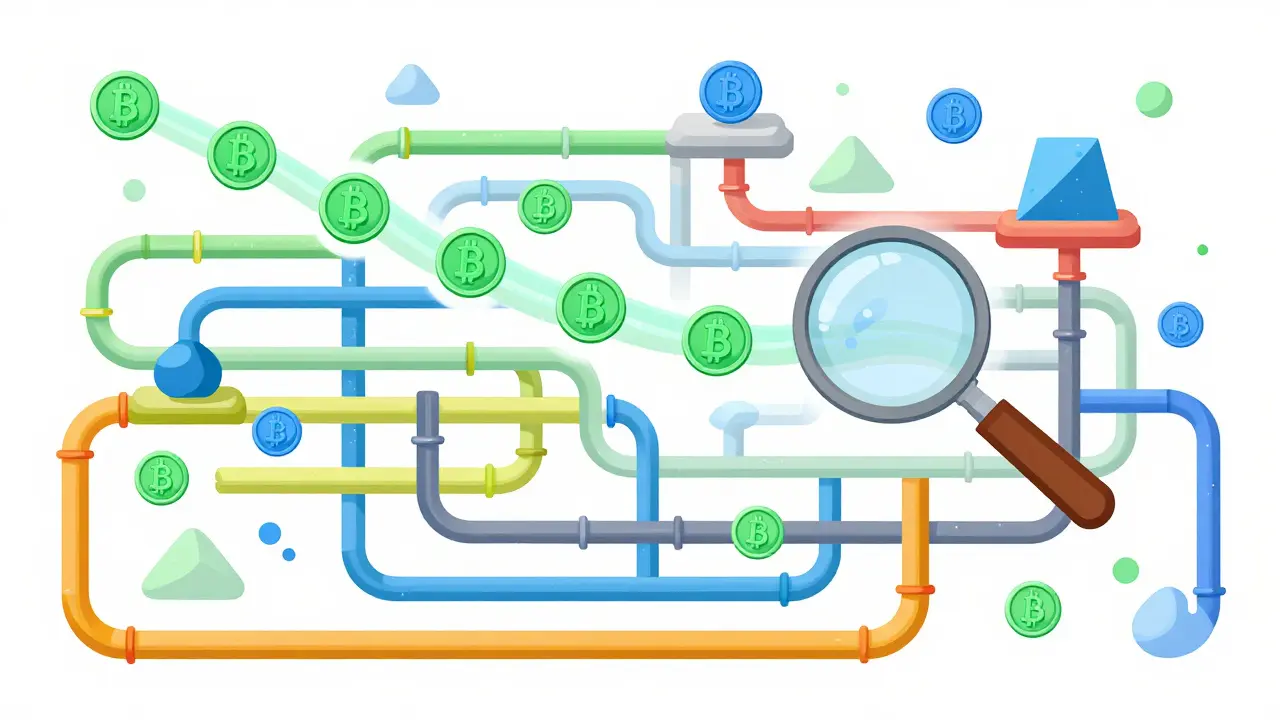
Stealing the money is only half the battle. The real challenge for any criminal is cashing out without getting caught. North Korean hackers have mastered the art of crypto laundering, turning transparent blockchain transactions into untraceable messes. After the massive Bybit hack in February 2025, where nearly $1.5 billion in Ether was stolen, investigators watched as the funds moved rapidly through decentralized exchanges (DEXs) and cross-chain bridges.
Here is how the laundering process typically works:
- Initial Conversion: Stolen assets, often stablecoins or Ethereum, are quickly converted into Bitcoin or other major cryptocurrencies to obscure their origin.
- Fragmentation: Large sums are split into thousands of smaller transactions sent to different virtual wallets. This makes it harder for analysts to track the total volume.
- Cross-Chain Movement: Funds are moved across different blockchains using bridges. If you lose the trail on Ethereum, it reappears on Solana or Binance Smart Chain.
- Mixing Services: Advanced mixing protocols shuffle the coins with others, breaking the direct link between the sender and receiver.
TRM Labs and other blockchain analysis firms note that these techniques have become increasingly sophisticated. The goal is to create enough noise that law enforcement gives up tracing the funds. However, this also means that the stolen money remains in the crypto ecosystem, circulating in dark markets or being used to purchase goods and services that support the North Korean regime.
Why It Matters: Sanctions Evasion and National Security
This isn’t just about lost investment capital. The United States Department of Defense and the FBI have explicitly linked these cyberthefts to North Korea’s nuclear and ballistic missile programs. Every dollar stolen is a dollar that doesn’t need to come from traditional trade, allowing the Democratic People’s Republic of Korea (DPRK) to evade international sanctions that are supposed to cripple its economy.
In 2024, North Korean hackers accounted for 61% of all global crypto thefts. This dominance highlights a critical failure in the current cybersecurity landscape. Traditional banks have robust anti-money laundering (AML) checks. Crypto platforms, especially newer ones, often lack the same level of scrutiny. North Korea exploits this gap. By targeting exchanges, wallets, and even the service providers that support them, they create a revenue stream that is both lucrative and difficult to shut down.
The implications extend beyond finance. If a nation-state can generate billions in foreign currency through cybercrime, it undermines the entire concept of economic sanctions. It also sets a dangerous precedent, encouraging other authoritarian regimes to view cyber warfare as a viable economic strategy.
Defending Against the Unstoppable Force
So, what can you do? Whether you are a small investor or a CEO of a crypto startup, the threat is real. Here are practical steps to mitigate risk based on how these attacks actually unfold.
| Threat Vector | Common Vulnerability | Recommended Defense |
|---|---|---|
| Social Engineering | Employees clicking malicious links in fake job offers | Mandatory security training focusing on phishing and pre-employment scams |
| Session Hijacking | Stolen cookies allowing unauthorized access | Implement multi-factor authentication (MFA) and short-lived session tokens |
| Internal Compromise | Access to wallet management systems via compromised staff | Use multi-signature wallets requiring multiple approvals for large transactions |
| Blockchain Tracking | Lack of visibility into fund movements | Integrate blockchain monitoring tools like Chainalysis or TRM Labs |
For individual investors, the advice is simple: use hardware wallets. Never leave significant amounts of crypto on an exchange, especially those that have been targeted before. For businesses, the focus must be on people. Hire security-conscious employees, verify identities rigorously, and assume that any external communication could be malicious. Assume breach mentality is essential.
Furthermore, regulatory compliance is becoming a shield. Platforms that adhere to strict Know Your Customer (KYC) and Anti-Money Laundering (AML) regulations are less attractive targets because they make laundering harder. North Korean hackers prefer platforms with weak oversight. By strengthening your compliance framework, you raise the cost of attacking you.
The Future of Cyber Warfare in Crypto
The trend line is alarming. From $660 million in 2023 to $1.34 billion in 2024, and then the massive $1.5 billion Bybit heist in 2025, the stakes are rising. As traditional revenue sources for North Korea dry up due to tighter sanctions, cybercrime will likely become even more central to their economy. Experts predict that these groups will continue to evolve, targeting larger platforms and developing more advanced laundering techniques.
We are witnessing the birth of a new form of geopolitical conflict-one fought not with missiles, but with code. The $3 billion already stolen is just the beginning. Unless the crypto industry unites to share threat intelligence and improve security standards, the next billion-dollar heist won’t be a surprise. It will be inevitable.
Who is primarily responsible for the $3 billion in crypto thefts?
The thefts are primarily attributed to North Korean state-sponsored hacking groups, most notably the Lazarus Group, along with associated units like TraderTraitor, Jade Sleet, UNC4899, and Slow Pisces. These groups operate under the direction of the North Korean government to circumvent international sanctions.
What was the largest single cryptocurrency hack involving North Korea?
The largest single incident was the February 2025 attack on the Dubai-based exchange Bybit, where hackers stole nearly $1.5 billion worth of Ether. This single heist exceeded the total amount stolen in all 47 incidents combined throughout 2024.
How do North Korean hackers typically gain access to crypto platforms?
They frequently use social engineering tactics, such as posing as recruiters on LinkedIn to send malicious scripts disguised as pre-employment tests. Once an employee runs the script, hackers can steal session cookies and impersonate the user to access internal systems and manipulate transactions.
Why does North Korea steal cryptocurrency instead of using traditional banking?
International sanctions severely restrict North Korea's ability to participate in the global financial system. Cryptocurrency provides a way to generate hard currency (like US Dollars or Euros) and fund weapons programs without triggering traditional banking alerts or AML checks.
Can stolen cryptocurrency be recovered?
Recovery is extremely difficult. While blockchain analysis firms like Chainalysis and TRM Labs can trace the movement of funds, the hackers use complex laundering techniques like cross-chain bridges and mixing services. Law enforcement agencies like the FBI actively pursue these cases, but successful recovery rates remain low due to the speed and complexity of the laundering process.


Melissa Beckwith
July 3 2026It is genuinely fascinating, and frankly quite terrifying, to observe the sheer industrial scale at which state-sponsored cybercrime has evolved into a primary economic pillar for isolated regimes like North Korea. One might assume that traditional financial sanctions would cripple such an economy, yet here we are witnessing a sophisticated pivot toward decentralized finance as a means of circumvention. The Lazarus Group and its affiliates have essentially turned blockchain technology against itself, exploiting the very transparency that was supposed to make digital assets secure. It is not merely about stealing money; it is about weaponizing the global financial infrastructure to fund nuclear proliferation without leaving a paper trail in the traditional banking sector. The social engineering aspect is particularly insidious because it highlights that the weakest link in any security chain remains the human element, regardless of how robust the cryptographic protocols may be. When you consider that these actors are patient, well-funded by the state, and willing to spend months compromising a single target through fake job offers on LinkedIn, it becomes clear that this is not random criminal activity but a calculated geopolitical strategy. The laundering techniques described, involving cross-chain bridges and mixing services, demonstrate a level of technical sophistication that rivals, if not exceeds, many legitimate fintech firms. This creates a paradox where the more we adopt crypto for freedom and decentralization, the more we inadvertently empower authoritarian regimes to evade accountability. We must stop treating these incidents as isolated IT failures and start recognizing them for what they truly are: acts of economic warfare that undermine international law and security frameworks. Until regulatory bodies and private sector entities collaborate more effectively on threat intelligence sharing, the cycle will undoubtedly continue, with each subsequent heist becoming larger and more complex than the last.