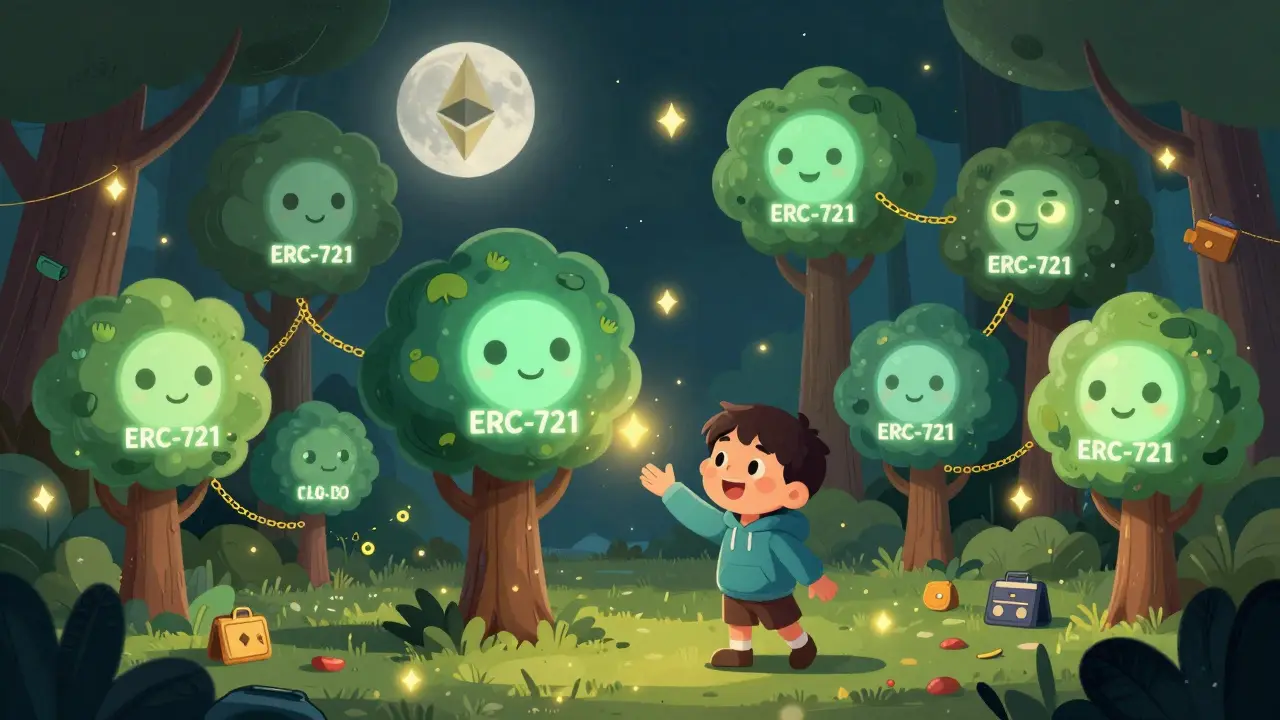
When you buy an NFT, you’re not just buying a JPEG. You’re buying a digital asset that’s tied to a specific set of rules - rules written into the blockchain itself. These rules are called NFT standards. They decide how your NFT is created, who can own it, how it moves between wallets, and even if it can hold other NFTs inside it. Not all blockchains use the same rules. Ethereum, Solana, Tezos, and Polygon each have their own standards, and choosing the wrong one can cost you money, time, or even your entire collection.
Why NFT Standards Matter More Than You Think
NFT standards aren’t optional upgrades. They’re the foundation. Without them, your NFT wouldn’t show up in OpenSea, MetaMask, or any wallet. It wouldn’t be transferable. It wouldn’t be verifiable. You’d just have a file with a weird link.
The first real standard, ERC-721, was born out of chaos. In late 2017, CryptoKitties - a game where people bred digital cats - flooded Ethereum with so many NFT transactions that the whole network slowed to a crawl. Gas fees spiked. Transactions took hours. Developers realized they needed a better way to handle unique digital items. ERC-721 was the answer. It made each token truly one-of-a-kind, with its own ID and ownership record.
Today, that same logic applies across blockchains. If you’re minting an NFT, you’re picking a standard. And that choice affects everything: how much you pay, how fast it sells, who can buy it, and whether your asset can evolve over time.
Ethereum’s Dominance and Its Three Key Standards
Ethereum still handles about 80% of all NFT transactions as of mid-2025. That’s not because it’s the fastest or cheapest - it’s because it’s the most trusted. Most marketplaces, wallets, and collectors still operate on Ethereum. And on Ethereum, you’ve got three main standards to choose from.
ERC-721 is the original. Every NFT is unique. Each one requires its own smart contract call to move. That means if you want to sell five NFTs at once, you pay five separate gas fees. In peak times, that could cost you $15-$50 just to list them. But it’s simple. Reliable. Widely supported. If you’re selling digital art or collectibles where uniqueness matters more than volume, ERC-721 is still the gold standard.
ERC-1155 changed the game. Created by Enjin, this standard lets you bundle multiple NFTs - even fungible tokens - into one transaction. You can mint 10,000 NFTs in a single call. Transfer 20 in one go. Cut gas costs by up to 90%. That’s why gaming companies and big brands like Starbucks use it. Their Odyssey program mints thousands of loyalty NFTs at once. But there’s a catch: ERC-1155’s efficiency comes at the cost of flexibility. Metadata handling is trickier. Developers report 32% more bugs when coding ERC-1155 compared to ERC-721. If you need fine-grained control over each NFT’s properties, this might not be the right fit.
ERC-998 is the wild card. It lets NFTs own other NFTs. Imagine a rare sword NFT that contains three enchanted gem NFTs inside it. You don’t sell the sword and the gems separately - you sell the whole package as one unit. It’s powerful. But it’s also dangerous. A 2025 audit of 147 smart contracts found that 22% of ERC-998 implementations had critical security flaws. Recursive ownership can be exploited. Only experienced devs should touch this.
And now there’s ERC-6551, the next evolution. Proposed in 2023 and expected to launch fully on Ethereum mainnet by late 2025, this standard gives each NFT its own wallet address. That means your NFT can interact with DeFi protocols, hold ETH, pay gas fees, or even rent itself out. A digital sneaker NFT could earn royalties every time someone wears it in a game. This isn’t just an upgrade - it’s a whole new layer of utility.
Solana: Speed Over Security
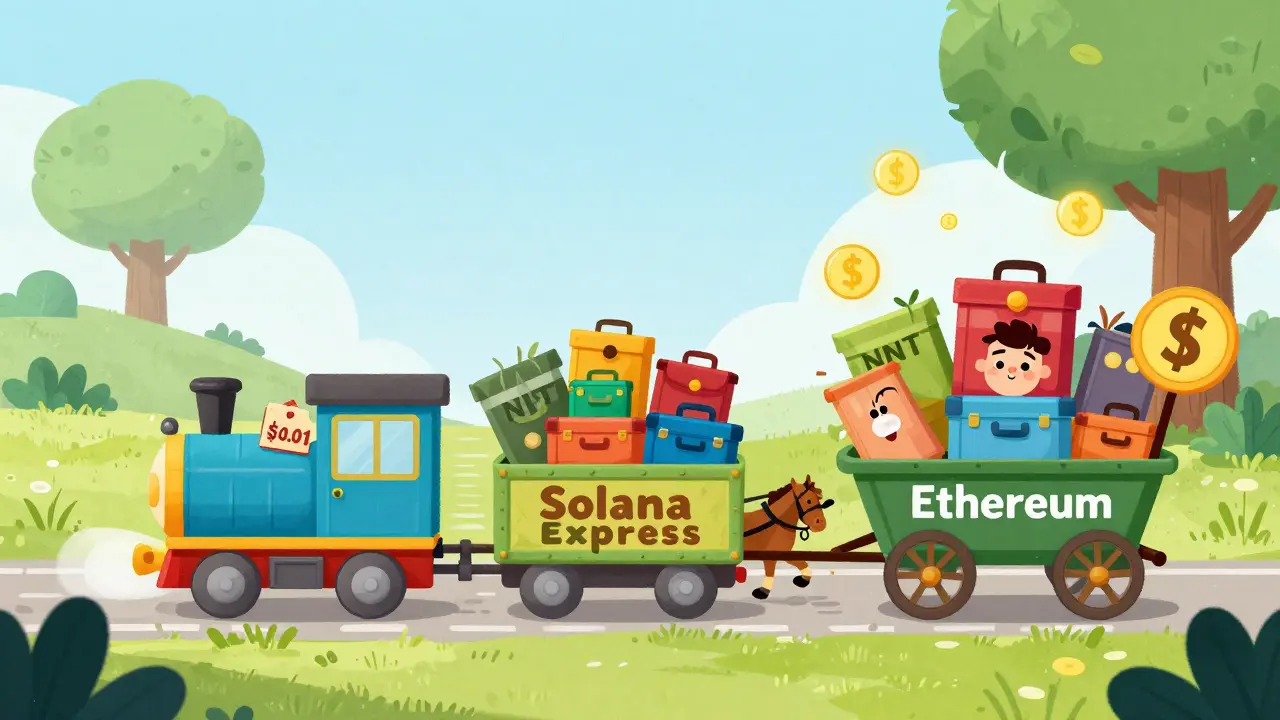
If Ethereum is the old-school bank, Solana is the high-speed train. It processes 65,000 transactions per second. Minting an NFT costs around $0.01. A transfer takes 0.4 seconds. That’s why PFP projects like Degens and Mad Lads exploded here.
Solana uses the SPL (Solana Program Library) standard. It’s not as complex as Ethereum’s standards. There’s no ERC-721 or ERC-1155 equivalent - SPL handles both fungible and non-fungible tokens in one system. It’s simple, fast, and cheap. But it’s also fragile.
In 2024, Solana had six major outages totaling nearly 20 hours of downtime. One of them happened during the mint of a rare Genesis NFT. A trader lost $200 because the network went down mid-purchase. That’s not a glitch - it’s a design trade-off. Speed comes at the cost of stability. Developers are working on Firedancer, a new validator client expected to push throughput to 100,000 TPS and fix reliability issues by late 2025. But for now, if you’re building a long-term collection, Solana’s volatility is a real risk.
Tezos: The Green Choice
Tezos doesn’t compete on speed or volume. It competes on ethics. Its FA2 standard is built on a proof-of-stake blockchain that uses 2 million times less energy than Ethereum did before its Merge. Minting costs $0.10. Transactions settle in 30 seconds. And creators like Björk and environmental artists flock here.
FA2 is a multi-asset standard, meaning you can bundle tokens, NFTs, and even royalties into one contract. It’s flexible, secure, and designed for long-term use. But the ecosystem is small. Fewer marketplaces. Fewer wallets. Fewer buyers. If you’re an eco-conscious artist who doesn’t need mass exposure, Tezos is perfect. If you’re trying to sell to a broad audience, you’ll struggle to find buyers.
Polygon: The Practical Middle Ground
Polygon isn’t trying to replace Ethereum. It’s trying to make it better. It’s EVM-compatible, meaning it runs the same code as Ethereum - including ERC-721 and ERC-1155. But gas fees? Averaging $0.001. Transaction finality? 2.1 seconds.
That’s why big brands use Polygon. Starbucks, Nike, and even Red Bull have launched NFT loyalty programs here. You get Ethereum’s ecosystem, security, and tooling - but without the $15 gas fees. Developers love it. You can build on Polygon like you would on Ethereum, then bridge to mainnet later if you need the prestige.
Polygon’s zkEVM upgrade, launched in March 2024, cut costs by 92% compared to Ethereum mainnet. It’s not just cheaper - it’s more secure than other Layer 2s. If you’re building an NFT project for everyday users, Polygon is the smartest choice right now.
Flow: Built for the Masses
Flow was created by Dapper Labs - the same team behind NBA Top Shot. It’s not an afterthought. It was designed from the ground up for NFTs. It uses the Cadence programming language, which is easier to audit and less prone to bugs than Solidity.
Transactions finalize in 3-5 seconds. Minting costs $0.05. And it’s incredibly stable - no outages in 2025. But here’s the problem: outside of NBA Top Shot, Dapper’s own projects, and a few partnerships, adoption is thin. Developers don’t flock here. Tools are limited. Documentation is sparse. If you’re building for sports, entertainment, or licensed content, Flow is ideal. For anything else? You’re going it alone.
Specialized Chains: NFTs for Real-World Use
Not every NFT is for art or collectibles. Some are for diplomas, supply chain records, or medical IDs. That’s where chains like CREST Chain come in. Built specifically for educational credentials, CREST processes verification 40% faster than Ethereum-based systems. Operational costs are 97% lower.
But here’s the catch: you can’t trade a CREST NFT on OpenSea. It doesn’t exist on public marketplaces. It’s a closed system. That’s the trade-off. Specialized chains are perfect for enterprise use - but useless if you want to flip your asset.
Gartner predicts that by 2027, 60% of enterprise NFTs will run on purpose-built chains like this, not Ethereum or Solana. Real-world asset tokenization - think real estate, art ownership, or carbon credits - is growing fast. And those use cases don’t need hype. They need reliability, compliance, and low cost.

What You Should Pick - And Why
Here’s the short version:
- If you’re an artist selling high-value digital art - go with ERC-721 on Ethereum. Buyers expect it. Wallets support it. Provenance matters.
- If you’re a game studio or brand minting thousands of NFTs - use ERC-1155 on Polygon. Low cost. Fast. Scalable.
- If you’re an eco-conscious creator - Tezos with FA2 is your home. Your carbon footprint matters more than your audience size.
- If you’re building for sports, entertainment, or licensed IP - Flow is the only real option.
- If you’re building for real-world assets (certificates, deeds, IDs) - consider a specialized chain like CREST. Don’t force it onto Ethereum.
- If you’re experimenting and want maximum future-proofing - start with ERC-6551 on Ethereum. It’s the future of NFT utility.
Don’t pick a blockchain because it’s trendy. Pick it because it matches your goal.
What’s Coming Next
By 2026, cross-chain interoperability will be standard. Chainlink’s CCIP protocol will let you send an NFT from Ethereum to Solana in one click. No bridges. No waiting. No risk of lost assets.
Regulation is catching up too. The SEC now says NFTs with investment features - like profit-sharing or promised returns - are securities. About 18% of NFT projects are already being adjusted to comply. The EU’s MiCA framework requires full transparency. You can’t just mint and disappear anymore.
And the market? It’s cooling. Speculative trading is down 63% since 2022. But utility is rising. Real-world asset NFTs will make up 37% of total volume by 2027. The era of selling JPEGs for $100,000 is over. The era of NFTs that unlock real services, access, and ownership is just beginning.
Frequently Asked Questions
What’s the difference between ERC-721 and ERC-1155?
ERC-721 creates one unique token per NFT. Each transfer costs a separate gas fee. ERC-1155 bundles multiple NFTs - even fungible tokens - into one smart contract. You can transfer 10 NFTs in one transaction, cutting gas costs by up to 90%. ERC-721 is simpler and more widely supported. ERC-1155 is more efficient but harder to code correctly.
Is Solana safer than Ethereum for NFTs?
No. Solana is faster and cheaper, but less stable. It had six major outages in 2024, totaling nearly 20 hours of downtime. Ethereum, even with high fees, has been battle-tested for years. If you’re holding valuable NFTs long-term, Ethereum’s reliability is worth the cost. Solana is better for short-term, high-volume projects where speed matters more than uptime.
Why do some NFTs cost $50 to mint while others cost $0.01?
It’s all about the blockchain. Ethereum mainnet charges gas fees based on network demand - during busy times, minting can cost $15-$50. Polygon, Solana, and Tezos have much lower fees because they’re either Layer 2s or designed for efficiency. Polygon uses Ethereum’s security but with near-zero fees. Solana uses speed and parallel processing. Tezos uses a low-energy consensus. The cost difference isn’t random - it’s built into the protocol.
Can I move my NFT from Ethereum to Solana?
Not directly. You need a bridge - a third-party service that locks your NFT on one chain and mints a copy on another. But bridges are risky. They’ve been hacked before. Assets have been lost. In 2025, most serious NFT holders avoid bridges. The future is cross-chain protocols like Chainlink’s CCIP, which will let you transfer NFTs natively without bridges - expected to launch in 2026.
Are NFTs legal?
Yes - but not all NFTs are legal. If your NFT promises returns, profit-sharing, or investment-like benefits, it may be classified as a security. In the U.S., the SEC has already targeted 18% of NFT projects for this reason. In the EU, MiCA requires full disclosure. Always consult a legal expert if your NFT has financial features. Just owning a JPEG is fine. Selling it as an investment? That’s regulated.
What to Do Next
If you’re building an NFT project, start by asking: What’s the goal? Is it art? A game item? A loyalty reward? A real-world deed? Then pick the blockchain that matches.
Don’t chase hype. Don’t pick Ethereum just because it’s popular. Don’t pick Solana because it’s cheap. Pick the one that solves your problem.
And if you’re just collecting? Stick to ERC-721 on Ethereum or Polygon. They’re the safest bets for long-term value. Avoid unknown chains. Avoid bridges. And always check if the NFT’s standard supports future upgrades - like token-bound accounts (ERC-6551) - so your asset doesn’t become obsolete.


Craig Fraser
December 21 2025Let’s be real - most people buying NFTs don’t care about standards. They just want to flip a JPEG before the next tweet drops. ERC-721? ERC-1155? Sounds like corporate jargon to fund another crypto bro’s Lamborghini. I’ve seen 10k PFP projects die in a week because someone picked the ‘wrong’ chain. The only standard that matters is FOMO.
And don’t get me started on ‘utility.’ My NFT sneaker doesn’t walk. My digital sword doesn’t slash. It’s a JPEG with a blockchain receipt. We’re all just playing pretend while the real money’s in AI training data.
But hey, if you need to feel like a tech wizard, go ahead. I’ll be over here watching the market crash like it’s a Netflix documentary.