
You might have seen the headlines screaming about network hash rate hitting new all-time highs. It sounds technical, dry even. But here is the thing: this number isn't just a geeky metric for engineers. It is the heartbeat of the entire Bitcoin economy. If you are holding Bitcoin, running a node, or thinking about buying an ASIC miner, ignoring these trends is like driving with your eyes closed. The hash rate tells you how secure the network is, how hard it is to mine, and frankly, whether your electricity bill is going to eat your profits alive.
As of late 2025, we are seeing numbers that would have sounded like science fiction five years ago. We aren't talking about gigahashes anymore; we are deep into the exahash territory. Understanding where this power is coming from, where it is going, and why it matters is crucial for anyone who wants to stay ahead of the curve in the blockchain space. Let's break down what is actually happening behind the scenes.
What Exactly Is Network Hash Rate?
Before we look at the charts, let's clear up the jargon. Hash rate is the total computational power being used by miners to process transactions and keep the network secure. It measures how many times per second the network can attempt to solve the cryptographic puzzle required to add a new block. Think of it as the collective muscle power of every computer on the network trying to guess the right password simultaneously.
The unit of measurement scales rapidly because computers get faster. You start with hashes per second (H/s), but modern networks operate in terahashes (TH/s) or even exahashes (EH/s). One exahash is one quintillion calculations per second. To put that in perspective, if you had a supercomputer doing one trillion calculations per second, it would take it over a year to match what the Bitcoin network does in a single second. This massive scale is what makes Proof-of-Work a robust consensus mechanism that requires immense energy to alter the ledger.
Why do we care? Because security scales with this number. The more hash rate there is, the more expensive it becomes for an attacker to rewrite history. A 51% attack-where someone controls more than half the network's power-becomes financially impossible when the cost to rent that much hardware spikes into the billions. So, when you see the hash rate climb, you are essentially watching the fortress walls get thicker.
The Explosive Growth Trajectory
If you look back to January 2021, the network was operating around 40 EH/s. Fast forward to October 2025, and we are hovering near 600 EH/s. That is a 1,200% increase in less than five years. This isn't just organic growth; it reflects a fundamental shift in who is mining and how they are doing it.
In the early days, you could mine Bitcoin with a laptop. Then came GPUs. Then FPGAs. Now, it is all about specialized Application-Specific Integrated Circuits (ASICs). These chips are designed to do one thing only: calculate SHA-256 hashes. They are incredibly efficient compared to general-purpose processors, which allows the network to absorb more power without needing exponentially more electricity. However, this efficiency race also drives the hash rate up relentlessly. As soon as a more efficient chip hits the market, older machines become unprofitable, get turned off, and are replaced by newer, faster ones. This cycle ensures the hash rate almost always trends upward during bull markets.
But it is not just hardware. Institutional money has flooded into mining. Publicly traded companies like Marathon Digital and Riot Platforms now control significant portions of the network. Their ability to raise capital means they can deploy thousands of miners overnight, causing sudden jumps in the global hash rate. This institutionalization brings stability but also centralizes decision-making power among fewer, larger entities.
Geographic Shifts and Energy Realities
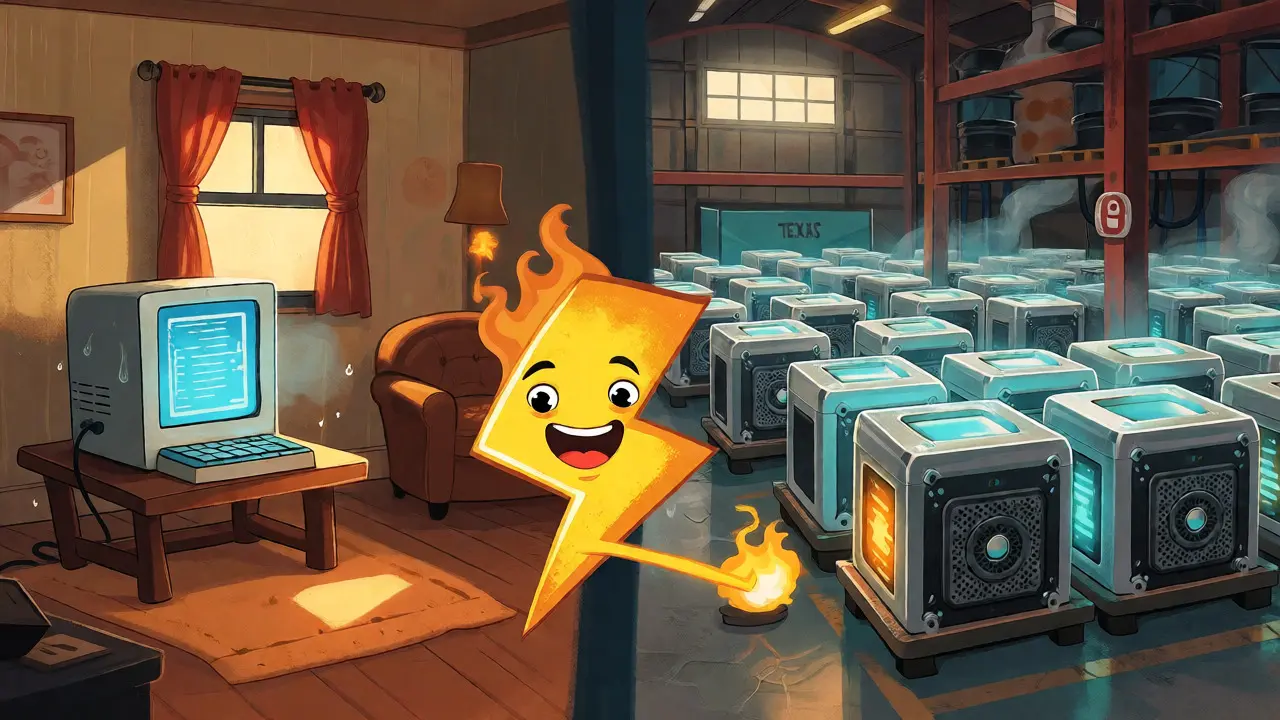
Where is all this power coming from? The map has changed dramatically since China banned mining in 2021. Back then, China dominated the scene. Today, the United States hosts nearly 49% of the global hash rate. Why Texas? Cheap electricity, friendly regulations, and access to stranded natural gas. Miners set up shop next to gas flares, using energy that would otherwise be wasted to generate revenue. This trend toward "stranded energy" mining is reshaping the environmental narrative around Bitcoin.
Kazakhstan, Russia, and Canada make up most of the remaining share. Each region offers different advantages. Kazakhstan offers low costs but faces grid instability. Canada offers renewable hydroelectric power but colder climates require different cooling solutions. The geographic distribution matters because it affects decentralization. If 90% of the hash rate moved to one country with strict government control, the network's resilience would drop. Currently, the spread across North America and Central Asia keeps the network reasonably decentralized, though concentration risks remain.
Energy consumption is the elephant in the room. The Cambridge Bitcoin Electricity Consumption Index estimates annual usage at over 120 terawatt-hours. Critics call this wasteful. Proponents point out that 58% of this energy comes from renewables, and miners often act as flexible loads that help stabilize grids by turning off during peak demand periods. The debate continues, but the data shows that while absolute consumption rises, efficiency per transaction improves as chip technology advances.
Security Implications of High Hash Rates
High hash rates are great for security but tough for small players. The difficulty adjustment algorithm, which tweaks every two weeks, ensures blocks are found roughly every ten minutes. When hash rate surges, difficulty rises proportionally. For a home miner with one Antminer S19, this means their slice of the pie shrinks unless they upgrade hardware or find cheaper power.
Let's look at the cost of attacking Bitcoin today. Estimates suggest you would need $14.8 billion in hardware and pay $38.7 million daily in electricity to sustain a 51% attack. Compare that to smaller Proof-of-Work chains like Ravencoin, where a temporary dip in hash rate led to a double-spend incident costing just $1,250. The correlation is direct: higher hash rate equals higher barrier to entry for attackers. This battle-tested security model remains Bitcoin's strongest selling point against competitors claiming superior speed or lower fees.
| Network | Approx. Hash Rate | Primary Hardware | Security Cost Estimate* |
|---|---|---|---|
| Bitcoin | 600 EH/s | ASIC (e.g., Antminer S21) | $14.8B Hardware + $38M/day |
| Bitcoin Cash | 4.2 EH/s | ASIC (SHA-256 compatible) | ~$100M Hardware |
| Litecoin | 650 TH/s | ASIC (Scrypt) | ~$50M Hardware |
| Dogecoin | 450 TH/s | ASIC (merged with Litecoin) | ~$40M Hardware |
Mining Profitability and the Halving Effect
Here is the practical side: if you are mining, hash rate trends dictate your profit margins. As hash rate climbs, difficulty rises. Unless Bitcoin's price rises faster than difficulty, your earnings per TH/s drop. Many miners reported decreased profitability in 2025 despite high prices because difficulty increased so sharply.
Electricity costs are the biggest operational expense, averaging 73.5% of total costs for average miners. If you are paying residential rates ($0.15/kWh), you are likely losing money compared to industrial miners paying $0.025/kWh. This disparity forces small miners to either join pools, sell their hardware, or move to regions with subsidized energy.
Looking ahead, the next halving in April 2026 will cut block rewards in half. Historically, this event triggers a shakeout. Less efficient miners turn off their machines, causing a temporary dip in hash rate. Analysts predict a 15-20% decline post-halving before the network stabilizes. If you are planning to buy equipment now, consider this cycle. Buying at peak hash rate might mean waiting longer for ROI. Conversely, buying after a post-halving dip could offer better entry points.

Future Outlook: Where Are We Heading?
Experts project the hash rate could hit 1,000 EH/s by mid-2026. Drivers include new 5nm ASIC chips promising 300 TH/s at lower power consumption and institutional ETFs dedicated specifically to mining stocks. BlackRock’s upcoming MINR ETF is expected to bring billions in fresh capital directly into mining operations.
However, sustainability concerns persist. Dr. Alex de Vries predicts Bitcoin could consume 1.5% of global electricity by 2027. While advocates argue this is manageable given grid investments, regulators may impose stricter caps. Texas already offers tax incentives, but New York has moratoriums. Jurisdiction shopping will continue as miners chase the best regulatory environment.
Ultimately, the hash rate is a lagging indicator of confidence. When miners invest billions in hardware, they bet on Bitcoin’s long-term value. A rising hash rate signals strong conviction. A falling rate signals fear or economic stress. Watching this metric gives you a window into the collective psychology of the industry. It is not just about math; it is about trust, economics, and engineering pushing the limits of what is possible.
Frequently Asked Questions
Why does the network hash rate matter for my wallet security?
It doesn't directly protect your private keys, but it protects the ledger. A higher hash rate makes it exponentially harder and more expensive for bad actors to reverse transactions or double-spend coins. If the hash rate dropped significantly, the risk of network reorganizations or attacks would increase, potentially affecting the reliability of confirmations.
Can I still mine Bitcoin at home with a GPU?
Not effectively. Bitcoin uses the SHA-256 algorithm, which is optimized for ASICs. GPUs are far less efficient and consume too much electricity relative to their output. Home GPU mining is now mostly profitable for other coins like Ethereum Classic or Ravencoin, but for Bitcoin, you need an ASIC miner to compete.
How does the halving affect hash rate trends?
The halving reduces miner revenue by 50%. This squeezes profit margins, forcing inefficient miners to shut down. Consequently, the hash rate often dips temporarily after a halving event until the price adjusts upward or hardware efficiency improves enough to restore profitability for the remaining miners.
Is a high hash rate bad for the environment?
It depends on the energy source. While total consumption is high, a growing percentage comes from renewable or stranded energy sources. Miners often use excess renewable energy that would otherwise be curtailed. Additionally, competition drives chip efficiency improvements, reducing the energy cost per hash over time.
What happens if the hash rate drops suddenly?
A sudden drop usually indicates miners turning off due to low prices or high energy costs. The network difficulty adjusts downward every two weeks to compensate, allowing remaining miners to find blocks at the normal 10-minute interval. This self-correcting mechanism ensures network stability despite fluctuations in participant count.