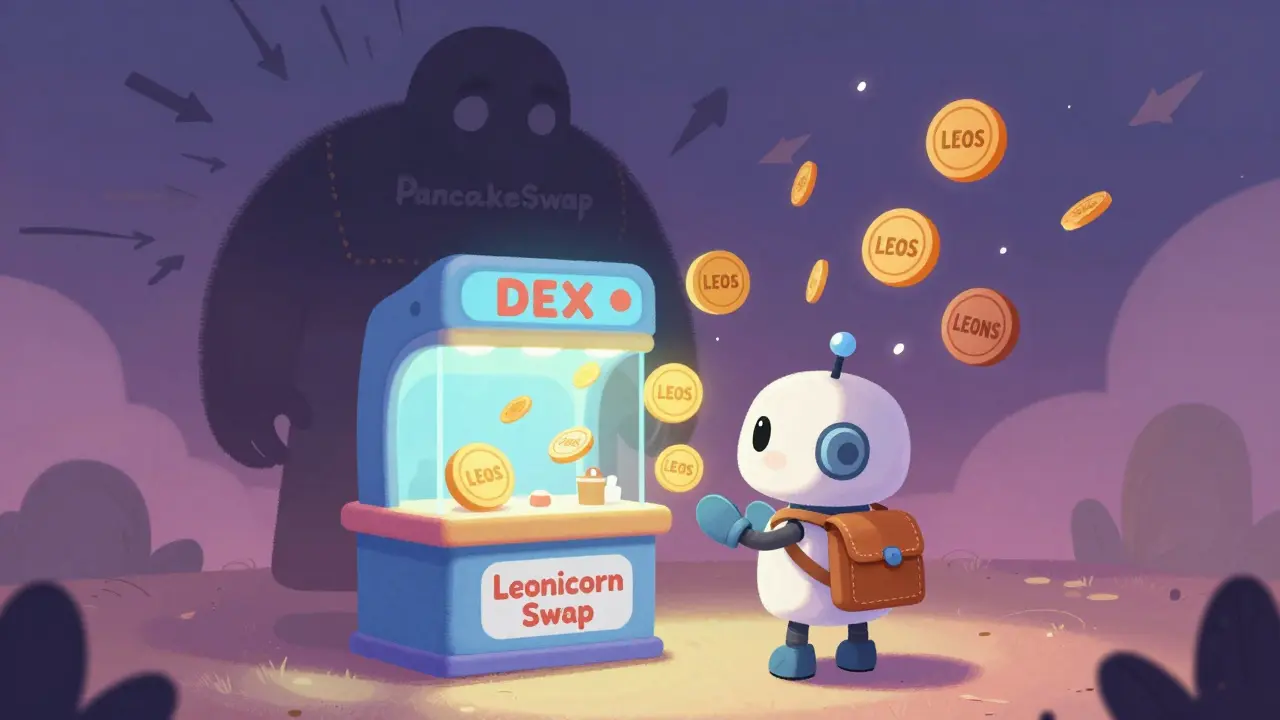
Leonicorn Swap is a decentralized exchange (DEX) built on Binance Smart Chain (BSC). It promises users full control over their funds, ultra-low trading fees, and multiple ways to earn tokens - all without needing a middleman. But does it deliver? Or is it just another forgotten project buried under the weight of bigger players like PancakeSwap?
First, the basics: Leonicorn Swap lets you trade crypto directly from your wallet. No sign-up. No KYC. Just connect MetaMask or Trust Wallet, pick a pair, and swap. It uses an Automated Market Maker (AMM) model, which means trades happen through liquidity pools instead of order books. This is standard for DEXs, but Leonicorn Swap adds a twist: it also has an NFT marketplace built into the platform. That’s unusual for a small DEX. Most stick to trading. Leonicorn Swap tries to be everything at once - exchange, NFT hub, and reward engine.
How Does Leonicorn Swap Work?
At its core, Leonicorn Swap operates like most BSC-based DEXs. You deposit two tokens into a liquidity pool - say, BNB and LEOS - and the system uses a mathematical formula to set prices. When someone trades, they pay a small fee, and that fee gets distributed to liquidity providers. Simple. Efficient. But here’s where things get messy.
The native token is called LEOS. Or is it LEONS? That’s not a typo. Some exchanges list it as LEOS. Others - like Kriptomat - list it as LEONS. This inconsistency isn’t just confusing. It’s a red flag. A well-run project picks one symbol and sticks to it. Mixing them makes it harder for users to track price, find the right contract, or even know if they’re trading the real thing. CoinMarketCap says LEOS. CryptoRank says “Price N/A.” Kriptomat says LEONS. If you can’t even agree on the name, how can you trust the platform?
Transactions on Leonicorn Swap cost around $0.01 per trade. That’s thanks to BSC’s low gas fees. On Ethereum, swapping tokens can cost $2-$5. On BSC, it’s usually under $0.10. Leonicorn Swap rides that advantage. But low fees alone don’t make a good DEX. You need volume. You need liquidity. And that’s where Leonicorn Swap falls apart.
Why Leonicorn Swap Struggles to Compete
As of 2023, PancakeSwap handled over 60% of all trading volume on BSC. Leonicorn Swap? No clear data exists. No market share numbers. No daily volume reports. Just silence. Compare that to Leonicorn Swap’s token: LEOS/LEONS. It’s listed on only two exchanges - KuCoin and possibly Binance. PancakeSwap’s CAKE token trades on over 40 exchanges. That’s not a small difference. That’s a chasm.
Why does this matter? Because liquidity determines price stability. Low liquidity means big price swings. Kriptomat shows LEOS/LEONS dropped 4.6% in 24 hours. That’s not normal. That’s a sign of thin trading. When only a few people are buying or selling, one large trade can crash the price. That’s dangerous for anyone holding the token or trying to provide liquidity.
And then there’s the lack of audits. Leonicorn Swap’s smart contracts have never been publicly reviewed by firms like CertiK or PeckShield. That’s a huge risk. In 2022, 78% of DeFi hacks happened because of untested code. If you’re putting money into a pool with no audit, you’re gambling. Not investing.
What’s the Real Value? Earning and NFTs
Leonicorn Swap claims to offer “new and advanced features” that let users earn and win tokens. But what exactly are those features? The website doesn’t say. No clear breakdown. No tutorials. No examples. Is it yield farming? Staking? NFT staking? Liquidity mining? No details. That’s not transparency - it’s vagueness.
The NFT marketplace is another mystery. You can buy and sell NFTs on the platform? Cool. But how many are listed? What collections exist? Are they popular? Are they even tradable? Again - nothing. No marketplace activity. No sales data. Just a placeholder.
Compare this to PancakeSwap. It has a clear lottery system, a vibrant NFT marketplace with thousands of items, and multiple staking pools with real APYs. Leonicorn Swap offers buzzwords. PancakeSwap offers results.
Who Is This For?
Leonicorn Swap might seem tempting if you’re new to crypto and looking for low-cost swaps. But it’s not beginner-friendly. There’s no educational content. No help center. No active Discord or Telegram. You’re on your own.
It’s also not for serious traders. If you need deep liquidity, tight spreads, or fast order execution - look elsewhere. Leonicorn Swap doesn’t have the volume to support it.
And it’s definitely not for long-term investors. With no roadmap, no recent updates, and conflicting token names, this project feels stagnant. The fact that CryptoRank lists its price as “N/A” while Kriptomat still shows a price suggests the platform is in limbo - maybe barely alive, maybe already dead.

Security and Trust
The founder, Mofassair Hossain, has a marketing background. He’s been called one of the top blockchain marketing advisers and claims to have raised $600 million for over 60 projects. That sounds impressive - until you realize marketing ≠ technical expertise. A great promoter doesn’t mean a secure blockchain. You need audited code, active developers, and a transparent team. Leonicorn Swap has none of that.
No security audits. No public GitHub. No developer updates. No community engagement. These aren’t small oversights. They’re dealbreakers in DeFi.
Final Verdict
Leonicorn Swap isn’t evil. It’s just irrelevant. It has the potential to be useful - low fees, NFT integration, AMM model - but it’s missing everything that makes a DEX last: liquidity, transparency, community, and trust.
If you’re curious, you can connect your wallet and try a tiny swap. But don’t deposit more than you’re willing to lose. Don’t stake your tokens. Don’t add liquidity. And definitely don’t buy LEOS/LEONS expecting it to grow.
There are better options on BSC. PancakeSwap, Biswap, Autofarm - they all have volume, audits, and active users. Leonicorn Swap? It’s a ghost town with a website.
Is Leonicorn Swap safe to use?
No, not reliably. Leonicorn Swap’s smart contracts have never been audited by a reputable firm like CertiK or PeckShield. Without an audit, there’s no guarantee the code is secure. Additionally, the platform shows signs of neglect - inconsistent token naming (LEOS vs LEONS), no community activity, and no recent updates. These are major red flags in DeFi. Only use it with funds you’re prepared to lose entirely.
What is the LEOS token used for?
Leonicorn Swap claims LEOS is its native token, used for trading fees, liquidity mining, and NFT marketplace transactions. But there’s no official documentation explaining how it works. No staking rewards are clearly listed. No governance features. The token’s value is tied to speculation, not utility. With minimal trading volume and only two exchange listings, LEOS lacks the ecosystem support needed to be meaningful.
Why is the token called both LEOS and LEONS?
This inconsistency suggests poor project management. LEOS is listed on CoinMarketCap and CryptoRank. LEONS appears on Kriptomat. This kind of confusion makes it hard for users to find the right contract, track price movements, or avoid scams. Legitimate projects standardize their token symbols. Leonicorn Swap hasn’t - which raises serious questions about its operational stability.
Can I earn rewards on Leonicorn Swap?
The platform claims users can “earn and win tokens,” but no clear mechanism exists. There are no staking pools, no yield farms, and no public dashboards showing rewards. Unlike PancakeSwap, which openly lists APYs and reward schedules, Leonicorn Swap offers vague promises without proof. Without verifiable data, any earnings claim is speculative at best.
Is Leonicorn Swap still active?
It’s unclear. KuCoin and Binance still have guides for buying LEOS, suggesting some level of ongoing support. But CryptoRank lists the price as “N/A,” and there are no recent updates, blog posts, or developer announcements. Community channels are silent. The NFT marketplace has no listings. The token price is volatile and thin. All signs point to a project that’s either on life support or already abandoned.


Mansoor ahamed
March 24 2026LEOS vs LEONS? Bro, that’s not a typo-it’s a red flag waving in a hurricane. I’ve seen sketchy projects, but this one doesn’t even know what its own token is called. Skip it. Use PancakeSwap. You’ll thank me later.