
Concentrated Liquidity Yield Calculator
Estimate Your Returns
Calculate potential earnings from concentrated liquidity positions compared to standard liquidity pools. Based on real data from the KyberSwap Elastic incident and industry benchmarks.
When KyberSwap Elastic launched on Ethereum in 2022, it promised something new: a decentralized exchange where liquidity providers could earn more by locking their funds in precise price ranges - and then letting the system automatically reinvest their fees. No manual compounding. No constant monitoring. Just better capital efficiency than Uniswap v3. For experienced traders and DeFi power users, it looked like the next evolution of AMMs. But today, that promise is in ruins.
What KyberSwap Elastic Actually Did
KyberSwap Elastic wasn’t just another DEX. It was built on the idea of concentrated liquidity, a concept popularized by Uniswap v3. Instead of spreading your ETH and USDT across every possible price, you picked a narrow range - say, $1,800 to $2,000 for ETH - and put all your capital there. If the price stayed in that zone, you earned way more fees than on a traditional AMM.
But KyberSwap Elastic added one critical twist: automatic fee compounding. Every time you earned trading fees, the protocol didn’t just let them sit. It used them to buy more liquidity positions, reinvesting your earnings without you lifting a finger. That’s powerful. For someone providing liquidity to ETH/USDT, it meant your position could grow over time - even if you never logged back in.
It was designed for users who understood price ranges, impermanent loss, and gas costs. Not beginners. Not casual traders. People who spent hours tweaking their positions, watching charts, and optimizing returns. And for a while, it worked.
The Security Incident That Changed Everything
On November 20, 2025, KyberSwap’s team issued an urgent warning: “Withdraw your funds immediately.”
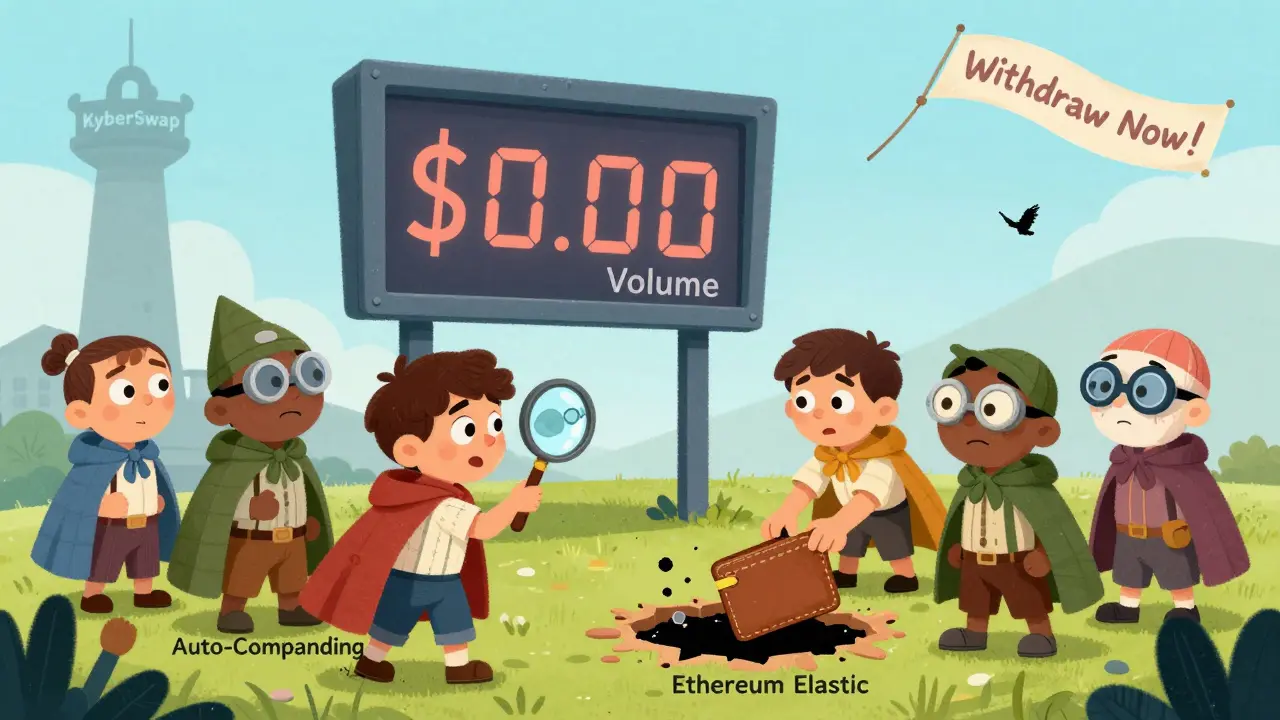
There was no public exploit report. No detailed breakdown of the vulnerability. Just a blunt advisory - and then silence. Within hours, trading volume on KyberSwap Elastic dropped to $0.00. It’s stayed there.
Today, the protocol lists only one trading pair: C98/USDT. The price? $0.06766. The spread? 0.75%. The last trade? Six days ago. The status? “Inactive - No trades in the last 3 hours.”
And here’s the kicker: the price is flagged as an “anomaly.” It’s not just dead. It’s behaving erratically. That’s not normal market volatility. That’s a broken system.
Users who left funds in KyberSwap Elastic are now stuck. The protocol still technically exists - you can still connect your wallet - but withdrawing isn’t guaranteed. The team hasn’t released a patch, a timeline, or even a clear explanation. In DeFi, that’s a death sentence.
Why This Matters More Than You Think
KyberSwap Elastic wasn’t just a niche tool. It was one of the few protocols trying to solve a real problem: capital inefficiency in DeFi. Most liquidity providers lose money because their funds sit idle outside the active price range. KyberSwap Elastic’s automatic compounding was a smart fix.
But it also made the system more complex - and more dangerous. Automated compounding means more code. More code means more attack surfaces. A single flaw in the reinvestment logic could have allowed someone to drain fees, manipulate pricing, or freeze withdrawals. We don’t know exactly what went wrong. But we know the result: trust vanished.
Compare that to Uniswap v3. It’s older. It doesn’t auto-compound. But it’s been audited, tested, and used by billions in volume. No emergency withdrawals. No price anomalies. Just steady, predictable performance. KyberSwap Elastic tried to out-innovate - and failed.
How It Compared to the Competition
Here’s how KyberSwap Elastic stacked up before the crash:
| Feature | KyberSwap Elastic | Uniswap v3 | Curve |
|---|---|---|---|
| Concentrated Liquidity | Yes | Yes | No |
| Auto-Compounding Fees | Yes | No | No |
| Trading Volume (Before Incident) | $12M/day (peak) | $1.2B/day | $800M/day |
| Current Volume | $0.00 | $1.1B/day | $750M/day |
| Impermanent Loss Protection | Yes | No | Yes (for stablecoins) |
| Dynamic Fees | Yes | Yes | No |
| Current Status | Inactive, funds at risk | Stable, high volume | Stable, high volume |
Uniswap v3 doesn’t auto-compound, but it’s rock solid. Curve doesn’t do concentrated liquidity, but it dominates stablecoin trading. KyberSwap Elastic tried to do both - and broke.
Who Was This For? (And Who Should Avoid It)
KyberSwap Elastic was never meant for people who just want to swap ETH for USDT. It was for liquidity providers who:
- Understood how price ranges affect fee earnings
- Had the time to monitor and adjust positions
- Trusted automated systems to handle compounding
- Wanted to maximize yield on Ethereum without staking
If you’re a beginner, you should have stayed away. If you’re a professional, you should’ve seen the red flags: low liquidity, thin trading, and a team that didn’t communicate clearly during the crisis.
Now, the only people still connected to the protocol are those hoping for a rescue - or those who can’t withdraw. And that’s not a healthy ecosystem.

The Bigger Picture: KyberSwap Still Exists - But Not Elastic
The KyberSwap brand isn’t dead. The broader platform - the aggregator that finds the best rates across 7 blockchains - still pulls in over 200,000 monthly visits. It supports Polygon, Arbitrum, BSC, and more. It still offers non-custodial swaps. No KYC. No middlemen.
But KyberSwap Elastic? That’s a separate product. And it’s gone.
The fact that the parent company still operates elsewhere doesn’t help users who locked funds into the Ethereum Elastic protocol. You can’t trade on Polygon if your money is stuck on Ethereum. And the team hasn’t offered a migration path.
What Should You Do Now?
If you still have funds in KyberSwap Elastic:
- Connect your wallet immediately - don’t wait.
- Try to withdraw everything, even if the interface looks broken.
- Don’t trust any “helpful” links from Twitter or Discord - scammers are already active.
- Check the official KyberSwap Twitter or blog for updates - not third-party sites.
- If you can’t withdraw, assume your funds are at risk and treat them as lost.
If you’re looking for a concentrated liquidity DEX today:
- Use Uniswap v3 on Ethereum - it’s safe, well-audited, and liquid.
- Try Balancer v2 - it has dynamic weights and decent volume.
- For stablecoins, Curve is still the gold standard.
And avoid any new protocol that promises “auto-compounding” without a public audit, a long track record, or active community oversight.
Final Verdict: Don’t Use KyberSwap Elastic
KyberSwap Elastic had a brilliant idea. It executed poorly. The auto-compounding feature was innovative, but the security practices were clearly inadequate. The team’s response - silence, then a withdrawal notice - showed a lack of preparedness.
This isn’t a case of “DeFi is risky.” This is a case of a team building something complex and then failing to protect it. And now, users are paying the price.
If you’re looking for yield on Ethereum, there are dozens of safer options. Don’t gamble on a dead protocol hoping for a miracle. KyberSwap Elastic is no longer a tool. It’s a cautionary tale.
Is KyberSwap Elastic still operational?
No. KyberSwap Elastic on Ethereum has been inactive since November 20, 2025. Trading volume is $0.00, no trades have occurred in over 6 days, and the platform has issued an urgent advisory for users to withdraw funds. The protocol is effectively shut down.
Can I still withdraw my funds from KyberSwap Elastic?
Technically, you may still be able to connect your wallet and attempt a withdrawal. But there’s no guarantee your funds will be released. The protocol is non-functional, and the team has not confirmed any recovery plan. Treat any remaining funds as potentially lost.
Why did KyberSwap Elastic fail when Uniswap v3 didn’t?
KyberSwap Elastic added complex auto-compounding logic on top of concentrated liquidity, which increased the attack surface. Uniswap v3 is simpler, more battle-tested, and has been audited and used by billions in volume. Complexity without robust security is dangerous - and that’s what killed KyberSwap Elastic.
Is the broader KyberSwap platform safe to use?
The KyberSwap aggregator (which finds the best rates across chains like Polygon and Arbitrum) is still active and appears unaffected. But KyberSwap Elastic (Ethereum) was a separate protocol. Do not assume safety across all parts of the platform. Use only the aggregator, not the Elastic product.
Are there any alternatives to KyberSwap Elastic for auto-compounding liquidity?
Not yet. No major DEX currently offers automatic fee compounding for concentrated liquidity. Some yield optimizers like Yearn or Beefy may help, but they’re not direct replacements. Until a secure, audited solution emerges, manual compounding on Uniswap v3 remains the safest option.
Should I trust any new DeFi protocol that promises high yields?
No. High yields often come with hidden risks - especially when paired with automation. Always check for audits, community trust, and real trading volume. If the team is silent during a crisis, walk away. KyberSwap Elastic was a $0.00 volume project before it collapsed - and it still had users.


Stanley Wong
December 8 2025KyberSwap Elastic was one of those ideas that sounded like magic until you realized the magic was just a glitch in the code
People got sucked in by the promise of hands-off compounding like it was some kind of DeFi fairy tale
But you don’t get free lunch in crypto, especially when the kitchen is run by devs who think ‘audit’ is a suggestion
I watched this unfold in real time-volume dropping, prices glitching, silence from the team
It wasn’t even a hack, it was just incompetence dressed up as innovation
And now we’re left with this ghost protocol haunting wallets like a bad debt
And the worst part? People still check it daily like it’s gonna wake up and fix itself
It won’t. It’s dead. And the longer you wait, the more you’re just feeding the illusion
Trust isn’t built on whitepapers. It’s built on transparency. And transparency? Gone.