
Back in late 2021, JF was one of the hottest names in DeFi. The Jswap.Finance platform promised a one-stop shop for decentralized finance: swap tokens, earn yield, stake single assets, and even get paid in DAO dividends-all on OKExchain. And to kick things off, they ran a massive airdrop tied to MEXC’s Kickstarter program. Users voted with MX tokens to get JF listed, and in return, thousands received free JF tokens. At the time, the hype was real. TVL hit $60 million. APYs on some pools soared past 1,400%. People were making quick gains. But what happened after? And is there anything left to grab today?
How the JF Airdrop Actually Worked
The main JF airdrop wasn’t handed out randomly. It was tied to a voting campaign on MEXC. Users had to contribute MX tokens to vote for JF to be listed on the exchange. The more MX you voted with, the higher your chance of getting JF tokens. In total, users contributed over 23.6 million MX tokens. That’s not a small number. It shows real community interest. Those who qualified received 35,200 JF tokens each. That might sound like a lot, but here’s the catch: the total supply of JF is capped at 100 million tokens. So this single airdrop alone distributed about 35% of the entire supply. That’s massive. And it’s why so many wallets ended up with large balances early on. Bitget also ran its own airdrop promotions, letting users earn JF by completing challenges. The platform claimed you could convert any crypto reward into JF tokens, which made it flexible. But these were short-term campaigns. There’s no evidence they’re still running today.What’s the JF Token Worth Today?
If you check Binance, CoinMarketCap, or any major price tracker, you’ll see the same thing: JF trades at $0.00. Not $0.01. Not $0.0001. Zero. And it’s been like this for months. The 24-hour trading volume? $0. The circulating supply? Also listed as $0. Even the market cap is $0. The All-Time High? It shows as "NaN"-Not a Number. That’s not a glitch. That’s a signal. Something’s broken here. Either the price feeds are completely offline, or no one is trading JF anymore. The numbers don’t lie. If you had 35,200 JF tokens from the MEXC airdrop, you can’t sell them. There’s no market. No buyers. No liquidity. The DEX trading volume on Jswap.Finance itself is $40.24 in 24 hours. That’s less than what you’d spend on coffee in Austin.Why Did the JF Token Crash?
There are a few reasons. First, the high APYs weren’t sustainable. A 1,476% yield sounds amazing, but it’s a classic DeFi trap. It attracts short-term speculators, not long-term users. When the yield drops-which it always does-the users leave. And when they leave, the liquidity drains. That’s what happened. Second, the tokenomics were flawed. Jswap.Finance planned to use platform profits to buy back and burn JF tokens, making them scarcer over time. Sounds smart, right? But if no one is trading, there are no profits. No profits means no buybacks. No buybacks means no deflation. The whole system stalled because the engine stopped running. Third, the team never built out the cross-chain bridge, the IDO launchpad, or the DAO dividend system they promised. The website still lists those features, but there’s no proof they ever launched. Without real utility, the token became a speculative asset with no backing.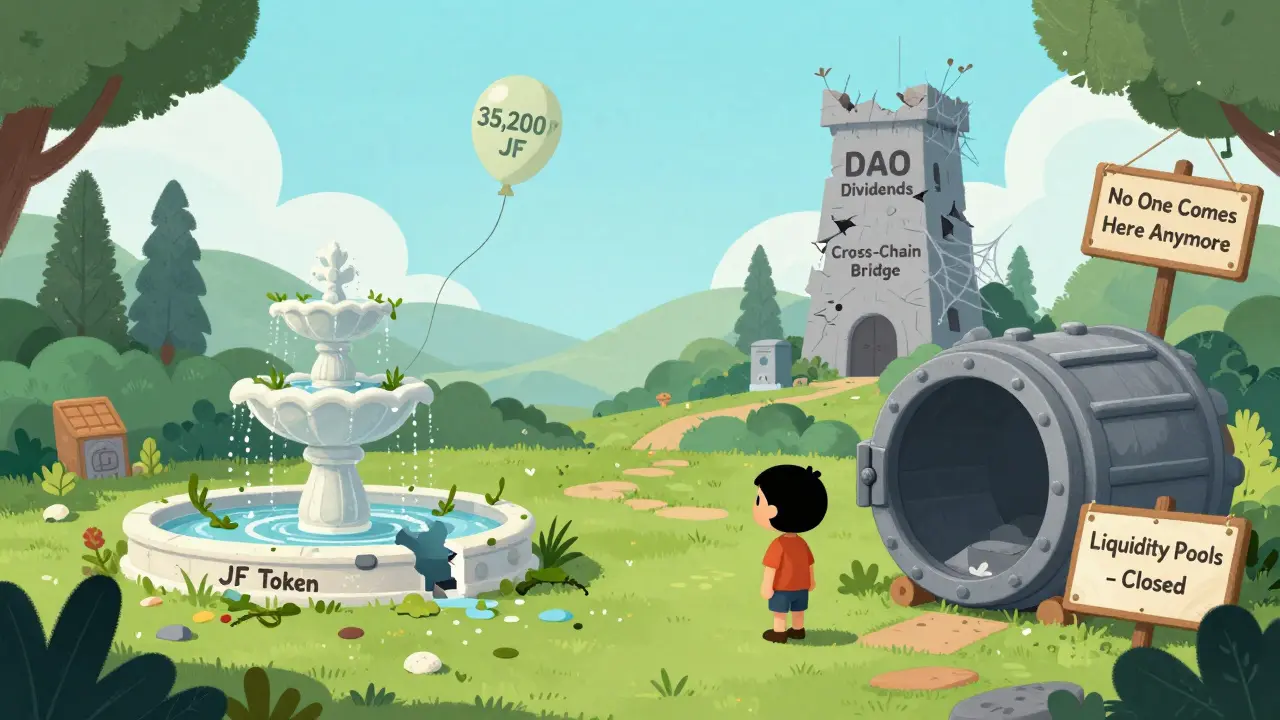
Is There Still an Active Airdrop?
No. Not anymore. The MEXC Kickstarter campaign ended in November 2021. The Bitget promotions stopped shortly after. There are no active airdrops listed on Jswap.Finance’s official channels. Their Telegram, Twitter, and Discord accounts haven’t posted meaningful updates in over a year. The last major announcement was a price update in early 2022-and even that was just a static image. If someone tells you they’re running a "new JF airdrop" today, it’s a scam. The project is dead. Any claim of free JF tokens being distributed now is either a phishing link or a pump-and-dump scheme trying to trick people into connecting wallets.What’s in Your Wallet?
If you participated in the original airdrop and still hold JF tokens, here’s the cold truth: they’re worth nothing. You can’t trade them. You can’t stake them. You can’t swap them. The smart contract address (0x5fAc...C85b0A) still exists on OKExchain, but no one is using it. The liquidity pools are empty. The vaults are inactive. Some people still check their balances on blockchain explorers, hoping the price will come back. It won’t. The market has moved on. Jswap.Finance didn’t fail because of bad code. It failed because it was built on hype, not utility.
What You Should Do Now
If you still have JF tokens in your wallet:- Don’t send more crypto to any "claim" site. It’s a trap.
- Don’t connect your wallet to any new Jswap.Finance website. The official domain may have been taken over.
- If you want to remove them, you can try sending them to a burn address-but you’ll lose them forever. No refund.
- Consider it a learning experience. High APYs are a red flag, not a green light.
- Stick to projects with real trading volume and active teams.
- Check CoinGecko or CoinMarketCap for verified listings-not just announcements.
- Airdrops tied to established exchanges (like Binance, OKX, Coinbase) are safer than random DeFi protocols.
Final Thoughts
The JF airdrop wasn’t a scam. It was a classic case of a project that burned bright, then vanished. The initial community effort was real. The MEXC campaign worked. People got paid. But the platform never evolved. No new features. No marketing. No liquidity. Just silence. Today, Jswap.Finance is a ghost. The token is dead. The airdrop is over. And if you’re reading this in 2026, you’re not late-you’re just late enough to know better.DeFi isn’t about chasing the highest yield. It’s about building something that lasts. Jswap.Finance didn’t build anything that lasted. And that’s why JF is worth $0.
Was the JF airdrop a scam?
No, the original JF airdrop through MEXC wasn’t a scam. Users received real tokens for participating in a legitimate voting campaign. But the project behind the token failed. The platform stopped updating, trading volume collapsed, and the token became worthless. So while the airdrop itself was real, the project it was tied to is now defunct.
Can I still claim JF tokens today?
No. All official airdrop campaigns ended in 2021. Any website or social media post claiming to distribute free JF tokens now is attempting to steal your private keys or trick you into paying fees. Do not interact with them. The JF token has no active distribution channels.
Why is JF trading at $0 on all exchanges?
Because no one is buying or selling it. There’s zero trading volume. The liquidity pools are empty. The smart contracts still exist, but no one is using them. Exchanges like Binance and CoinMarketCap show $0 because the market has completely disappeared. It’s not a technical error-it’s a market death.
Did Jswap.Finance ever launch its cross-chain bridge?
There’s no evidence it did. The project promised a cross-chain bridge to connect with Ethereum, BSC, and other chains, but no transaction data, no contract deployments, and no user reports confirm it was ever built. The feature remains listed on their website, but it’s clearly just a placeholder.
Are there any active Jswap.Finance community channels?
The official Telegram, Twitter, and Discord channels have been inactive since early 2022. The last posts were either automated price updates or replies to spam. The project has no active developers, moderators, or community managers. Any group claiming to be the "official" Jswap.Finance community is not connected to the original team.
What happened to the $60 million in TVL?
It vanished. As users pulled their liquidity out and the APYs dropped, the funds drained from the pools. Without ongoing incentives or new users, the protocol couldn’t sustain itself. The smart contracts still hold some leftover assets, but they’re inaccessible because no one maintains the front-end interface or governance system.
Can I use JF tokens on other DeFi platforms?
No. JF is not listed on any major DeFi protocols like Uniswap, Curve, or Aave. Even if you have the tokens, you can’t stake them, lend them, or use them as collateral. The token has no interoperability. It’s locked in isolation.
Is there any chance JF will recover?
Extremely unlikely. For a token to recover, it needs either a strong team reviving it, a major exchange relisting it, or a new utility being added. None of these are happening. With zero trading volume, no updates, and no community, JF has no path to recovery. It’s effectively dead.
What should I learn from the JF airdrop experience?
High yields are a warning sign, not a reward. Projects that promise 1,000%+ APYs are usually designed to attract short-term money, not build long-term value. Always research the team, check for active development, and verify real trading volume-not just hype. And never assume an airdrop means a project is sustainable. Many are just marketing tools that vanish after the initial rush.
Where can I find legitimate airdrops now?
Look for airdrops tied to established platforms like Binance, OKX, or Coinbase. These exchanges have verification processes and track real user activity. Avoid random DeFi protocols with no history, no team, and no liquidity. The safest airdrops are those that require you to use a service you already trust-not ones that ask you to deposit funds or connect your wallet to unknown contracts.


Santosh kumar
February 10 2026I still remember when I got my 35k JF tokens. Thought I hit the lottery. Turned out it was just a digital receipt for a dead bank. But hey, at least I didn't lose any ETH to fees. Learned the hard way: if the APY looks too good to be true, it probably is. DeFi isn't Vegas. No one pays you to gamble with your assets.