
Imagine you’re running a decentralized network where anyone can join. Now imagine one person sneaks in with ten thousand fake accounts to rig the vote. That’s a Sybil attack, named after the 2002 paper by Brian Neil Levine and Clay Shields. It’s not just a theory; it’s a real threat that has toppled networks and drained millions from DeFi protocols. If you’re building or securing a blockchain, understanding how to spot these fake identities is no longer optional-it’s survival.
What Makes a Node a "Sybil"?
A Sybil node is a malicious entity that creates multiple fake identities within a peer-to-peer network to gain disproportionate influence over consensus, voting, or resources. In traditional centralized systems, we use phone numbers or email addresses to verify who someone is. In blockchain, anonymity is a feature, not a bug. This makes detection tricky. You can’t just ask for an ID card without killing the privacy that makes crypto appealing. The core problem is distinguishing between a legitimate user who runs multiple nodes (for redundancy) and an attacker trying to dominate the network.
The Five Main Detection Strategies
There isn’t one silver bullet. Effective networks layer several methods together. Here are the five most common approaches used today:
- Economic Barriers: This is the foundation. Proof-of-Work (PoW) requires expensive hardware. Proof-of-Stake (PoS) requires locking up capital. Ethereum’s switch to PoS meant attackers had to stake 32 ETH per validator. At current prices, that’s a significant financial risk if they get slashed. This makes creating thousands of cheap fake nodes economically unfeasible.
- Social Trust Graphs: Algorithms analyze how nodes connect. Legitimate nodes usually have diverse connections. Sybil clusters often form tight, isolated groups that only talk to each other. Research from IEEE shows these patterns can be spotted with over 86% accuracy.
- Reputation Systems: New nodes start with low trust. Over time, consistent good behavior raises their score. Chainlink, for example, takes 90-180 days for a node to reach maximum trust. An attacker can’t fake this timeline quickly without burning resources.
- Identity Verification: Some projects use KYC (Know Your Customer) or biometrics. Worldcoin uses eye-scanning technology to ensure "one person, one token." While effective, it raises privacy concerns and excludes people without access to specific tech.
- Behavioral Analysis: AI models watch for anomalies. Do these 50 wallets always send funds at the exact same millisecond? Do they always vote the same way? These synchronized behaviors are red flags.
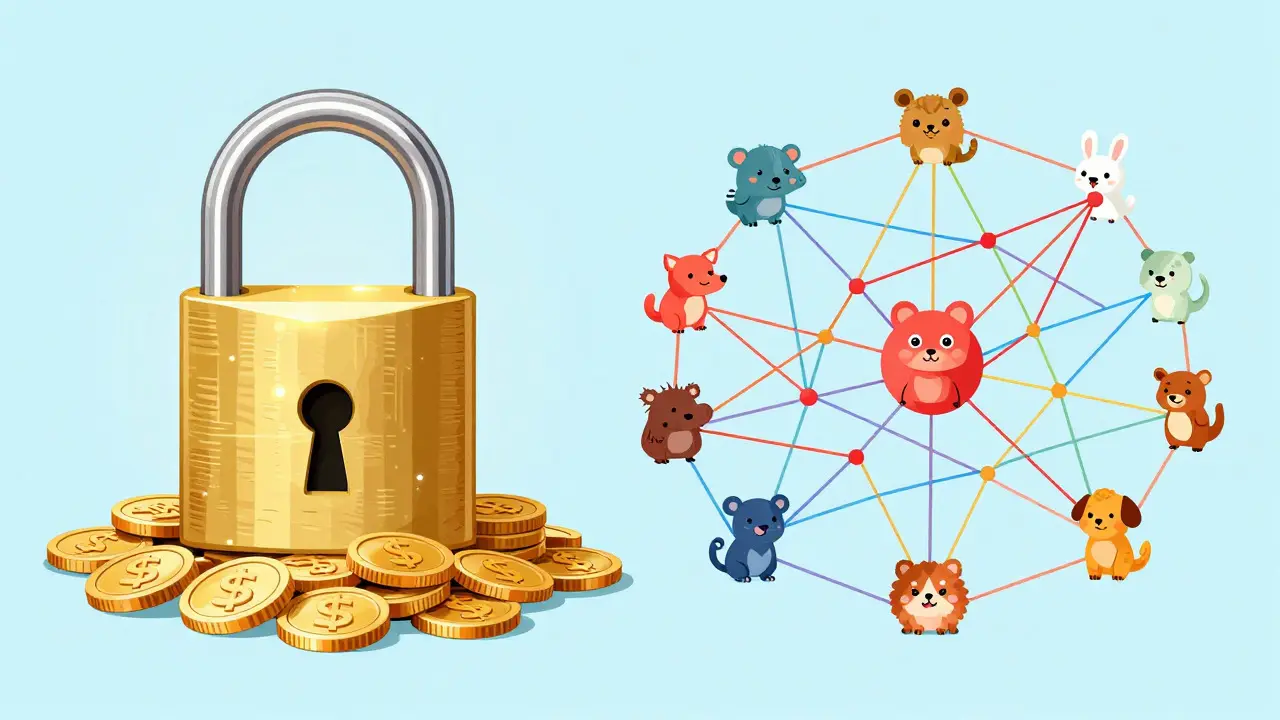
Comparing Consensus Mechanisms for Sybil Resistance
Not all blockchains are equally vulnerable. The consensus mechanism dictates how hard it is to pull off a Sybil attack.
| Consensus Type | Primary Barrier | Estimated Cost/Risk | Sybil Vulnerability |
|---|---|---|---|
| Proof-of-Work (Bitcoin) | Computational Power | ~$1.4M/hour for 51% control | Low (Economic) |
| Proof-of-Stake (Ethereum) | Staked Capital | 32 ETH per validator (~$89k+) | Very Low (Post-Merge) |
| Delegated PoS (EOS) | Reputation/Voting | High social cost to lose delegate status | Moderate (Centralization risk) |
| Privacy Chains (Monero) | Anonymity | Harder to track, but node count matters | Higher (Historical attacks) |
Note that while Bitcoin is secure due to cost, it’s slow. Ethereum’s PoS model is faster and more energy-efficient, but it relies heavily on the economic weight of stakers. Privacy chains like Monero face unique challenges because hiding identity also hides malicious behavior, making graph analysis harder.
Real-World Cases: When Detection Failed
History offers painful lessons. In January 2019, Ethereum Classic suffered a 51% attack partly driven by Sybil-like manipulation of its mining pool structure. More recently, DeFi protocols have been hit repeatedly. In 2022, there were 37 documented Sybil attacks in DeFi, costing an average of $2.8 million per incident. Airdrops are prime targets. Optimism’s retroactive airdrop initially faced fraud claims estimated at 68%. By implementing 14 different Sybil filters, they reduced fraudulent claims to 8.3%, saving roughly $142 million in token value. This proves that layered detection works, but it’s complex to implement.

The Trade-Off: Security vs. Accessibility
Here’s the catch: every layer of security adds friction. If you require biometric scans or long reputation periods, you exclude users. The MIT Digital Currency Initiative found that strict identity verification excludes 1.7 billion unbanked adults globally. Developer surveys show that 74.2% cite "maintaining user privacy" as the biggest challenge. There’s a delicate balance. Too loose, and bots take over. Too tight, and you lose the open, permissionless spirit of blockchain. Most successful projects aim for a "progressive trust" model, where basic participation is easy, but high-influence actions (like governance voting) require higher verification levels.
Future Trends: Zero-Knowledge Proofs and AI
Where is this going? Two technologies are leading the charge. First, Zero-Knowledge Proofs (ZKPs). zkSync reported 99.2% accuracy in identifying Sybil wallets while keeping user data private. This allows a node to prove it’s a unique human without revealing *who* they are. Second, AI-driven behavioral analysis. Early tests suggest combining decentralized identity with AI can spot Sybil clusters with 96.8% accuracy. Regulatory pressure is also accelerating adoption. The EU’s MiCA regulations and upcoming SEC frameworks will likely mandate "industry-standard" Sybil detection by 2026. For developers, this means Sybil resistance is moving from a nice-to-have feature to a compliance requirement.


Jennifer Ulmer
August 21 2026It is really interesting to see how we try to keep the network open but also safe. It feels like a constant balancing act that never really ends. We want everyone to join in, but we also need to make sure no one cheats the system. The idea of using money as a barrier makes sense to me. If it costs too much to fake an identity, people will stop doing it. But what about the people who do not have much money? Do they get left behind? I think we need to find a way that works for everyone. Maybe technology can help us sort out the fakes without hurting the real users. It is a hard problem, but it is important to solve. I hope we get there soon.