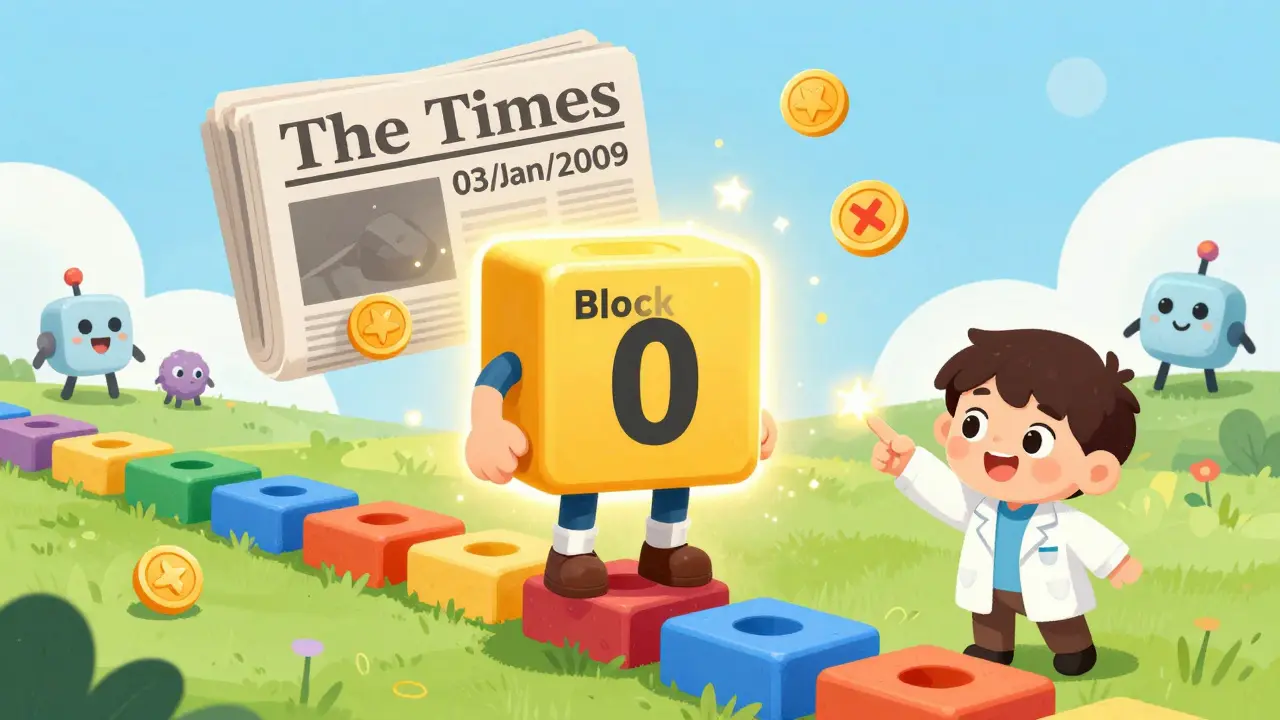
The first block ever created on the Bitcoin blockchain isn't just another entry in a ledger. It's the genesis block-the foundation everything else is built on. If you've ever wondered how blockchain networks prove they're real, where Bitcoin started, or why that first transaction can't be spent, you're looking at the right place. Analyzing the genesis block on a block explorer isn't just for experts. It's the simplest way to understand how trust works in a decentralized system.
What Makes the Genesis Block Different?
Most blocks in a blockchain have a predecessor. They link back to the one before them, forming a chain. The genesis block doesn't. It's the start. No block came before it. That's why its "previous block hash" is filled with 32 zeros:0000000000000000000000000000000000000000000000000000000000000000. This isn't a mistake. It's intentional. It tells every node in the network: "This is where it begins."
When you look at the genesis block on a block explorer, you'll see it has one transaction. That transaction created 50 BTC. But here's the twist: those coins can't be spent. Ever. The script that locks them is non-standard. No miner, no wallet, no algorithm can unlock them. That’s not a bug. It was designed that way by Satoshi Nakamoto. Why? To make a statement. The reward was symbolic. It marked the birth of the network, not an incentive to mine.
The Hidden Message in the Genesis Block
If you dig into the coinbase parameter of the genesis block, you'll find a string of hex characters. Decode it, and you get:"The Times 03/Jan/2009 Chancellor on brink of second bailout for banks"
That’s not random. That’s a headline from the UK’s The Times, published on January 3, 2009-the same day the block was mined. Why include it? To timestamp the block. To say: "This system was created because the old one failed." It’s a protest written in code. Block explorers don’t always explain this. But if you see it, you’re looking at the moment Bitcoin was born-not as a currency, but as a response to a financial crisis.How to Find the Genesis Block on a Block Explorer
You don’t need special tools. Just pick any major block explorer and search for one of two things:- Block height:
0 - Block hash:
000000000019d6689c085ae165831e934ff763ae46a2a6c172b3f1b60a8ce26f
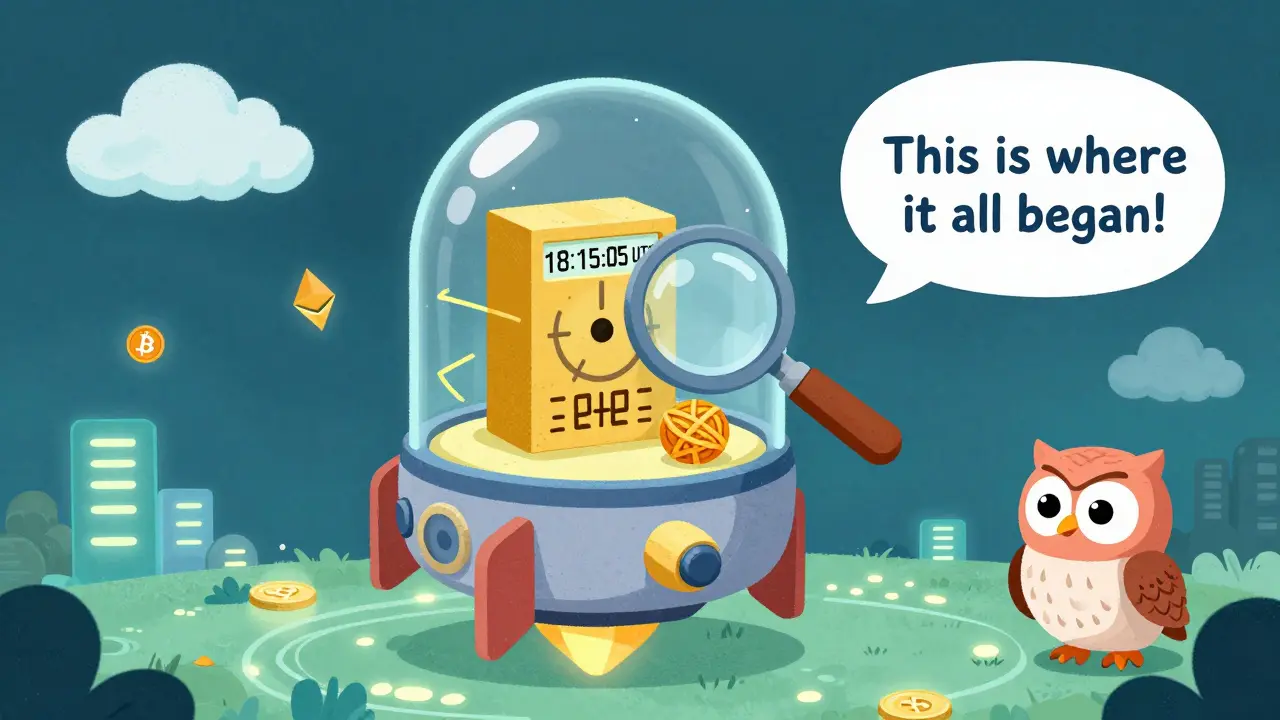
Most explorers will take you straight to it. Blockchain.com, Blockstream, and Blockchair all have dedicated pages for Bitcoin’s genesis block. Once you land there, you’ll see:
- Version: 1
- Timestamp: January 3, 2009, 18:15:05 UTC
- Nonce: 2083236893
- Bits: 486604799 (the difficulty target)
- Merkle Root: 4a5e1e4baab89f3a32518a88c31bc87f618f76673e2cc77ab2127b7afdeda33b
These aren’t just numbers. They’re proof. Every Bitcoin node checks this exact data when it syncs for the first time. If your node doesn’t match these values, it’s not on the real Bitcoin network. That’s how trust is enforced-without a central authority.
How Different Block Explorers Show the Genesis Block
Not all block explorers treat the genesis block the same way.| Explorer | Block Height Label | Unspendable Reward Highlighted? | Embedded Message Decoded? | Contextual Info Provided? |
|---|---|---|---|---|
| Blockchain.com | Shows as "Block 0" | Yes, with text: "Unredeemable" | Yes, hex decoded | Basic explanation only |
| Blockstream Explorer | Explicitly "Block 0" | Yes, with technical reason | Yes | Yes, includes historical context |
| Blockchair | Shows as "Block 0" | Yes | Yes | No |
| Bitcoin Explorer (BTC.com) | "Block 0" | Yes | Yes | Minimal |
Blockstream stands out because it doesn’t just show data-it explains why it matters. It tells you that the unspendable reward isn’t a glitch, but a design choice. Blockchain.com improved its interface in 2023 with interactive tooltips, making it easier for new users to understand each field. Blockchair, while fast and reliable, assumes you already know what you’re looking at.
Why This Matters Beyond Bitcoin
The Bitcoin genesis block set the pattern. Over 98% of major blockchains today-Ethereum, Litecoin, Dogecoin, Monero-have their own genesis block. Some embed quotes. Others use timestamps from major events. A 2022 Cornell University study found that 78% of cryptocurrencies embedded a message in their genesis block, and 63% made the initial reward unspendable.This isn’t coincidence. It’s tradition. The genesis block is where a blockchain declares its purpose. If you’re evaluating a new crypto project, checking its genesis block tells you more than any whitepaper. Did they copy Bitcoin’s unspendable reward? Did they embed a political message? Did they make the first block spendable? Those choices reveal their values.
Common Mistakes and How to Avoid Them
New users often get tripped up. Here are the most common errors:- Confusing testnet with mainnet. Testnet has its own genesis block. If you see a block with height 0 but the hash doesn’t match
000000000019d6689c085ae165831e934ff763ae46a2a6c172b3f1b60a8ce26f, you’re on testnet. Always check the network label. - Thinking the 50 BTC can be spent. No wallet, no exchange, no miner can move those coins. They’ve been locked since day one. Trying to spend them is like trying to unlock a door that was never installed.
- Assuming the timestamp proves when Satoshi mined it. The timestamp can be manipulated. The real proof is in the chain. The headline in the coinbase is the only thing that ties the block to a real-world event.
- Ignoring the hash. If you don’t verify the block hash matches the known value, you might be looking at a fork or a fake explorer. Always cross-check with multiple sources.

What Experts Say About Genesis Block Analysis
Andreas Antonopoulos calls it the "cryptographic root of trust." He says if you understand the genesis block, you understand Bitcoin’s entire security model. It’s the one thing every node agrees on before it even connects to peers.Bitcoin Core developers treat it as sacred. Every Bitcoin client ships with the genesis block baked into its code. When you install Bitcoin Core, it doesn’t download the first block from someone else. It already has it. It checks every new block against this fixed point. If the chain doesn’t start here, it’s invalid.
Even controversial figures like Dr. Craig Wright argue the embedded headline is proof of creation. But Bitcoin Core developer Pieter Wuille disagrees. He says the headline is just data. The real proof is that every node in the network agrees on the same genesis block. That consensus is what makes it unbreakable.
What You Can Learn from the Genesis Block
Analyzing the genesis block teaches you three big things:- Decentralized trust works without a central authority. No one controls the genesis block. It’s verified by everyone. That’s how the network stays honest.
- Design choices matter. The unspendable reward wasn’t an accident. It was a statement. The headline wasn’t random. It was a protest.
- History is immutable. The genesis block hasn’t changed since 2009. Not because it’s hidden. Because it can’t be. Once you see that, you start to understand why blockchain is so powerful.
You don’t need to be a developer to get this. You just need to look at the data. And block explorers make it easy.
Next Steps: Where to Go from Here
Once you’ve looked at Bitcoin’s genesis block, try this:- Find Ethereum’s genesis block. It has a different structure. No embedded headline. But it has a predefined list of early accounts.
- Compare Litecoin’s genesis block. It’s nearly identical to Bitcoin’s, but with a different timestamp and hash.
- Check out Dogecoin’s genesis block. It embeds a meme. That tells you everything about its culture.
Each genesis block is a time capsule. It captures the moment the network was born. By analyzing them, you’re not just looking at code. You’re reading history.
Can the genesis block be changed or deleted?
No. The genesis block is hardcoded into every Bitcoin node’s software. Even if someone tried to alter it on one node, every other node would reject it because the hash wouldn’t match. The entire network’s validity depends on this single block being unchanged. It’s the anchor of trust.
Why is the 50 BTC in the genesis block unspendable?
The script used in the genesis block’s coinbase transaction is non-standard and doesn’t follow Bitcoin’s validation rules. This means no wallet or miner can create a valid signature to spend it. Satoshi Nakamoto designed it this way to prevent any future attempt to move those coins-making them a permanent, symbolic reward for the network’s birth.
How do I know I’m looking at the real Bitcoin genesis block?
Verify the block hash: 000000000019d6689c085ae165831e934ff763ae46a2a6c172b3f1b60a8ce26f. Also check the timestamp (January 3, 2009, 18:15:05 UTC) and the embedded headline from The Times. If all three match across multiple reputable explorers like Blockchain.com and Blockstream, you’re on the right block.
Can I view genesis blocks for other cryptocurrencies?
Yes. Most major block explorers support multiple chains. Blockchair, for example, shows genesis blocks for 17 different blockchains. Just search for "block 0" on the network you’re interested in. Each one has its own unique characteristics-some embed messages, others set initial balances, and a few even have spendable rewards.
Is analyzing the genesis block useful for security or audits?
Absolutely. For blockchain developers and auditors, verifying the genesis block ensures a node is connected to the correct network. It’s the first step in validating a chain’s authenticity. Financial institutions and enterprise users use this method to confirm they’re interacting with the real Bitcoin network-not a fork or scam chain.


Ace Crystal
February 13 2026I just typed 'block 0' into Blockstream and boom - there it was. That headline from The Times? Chills. This isn't just code. It's a time capsule. Someone took a stand, coded it into history, and said 'enough.' I've looked at a hundred blocks, but this one? It hits different.