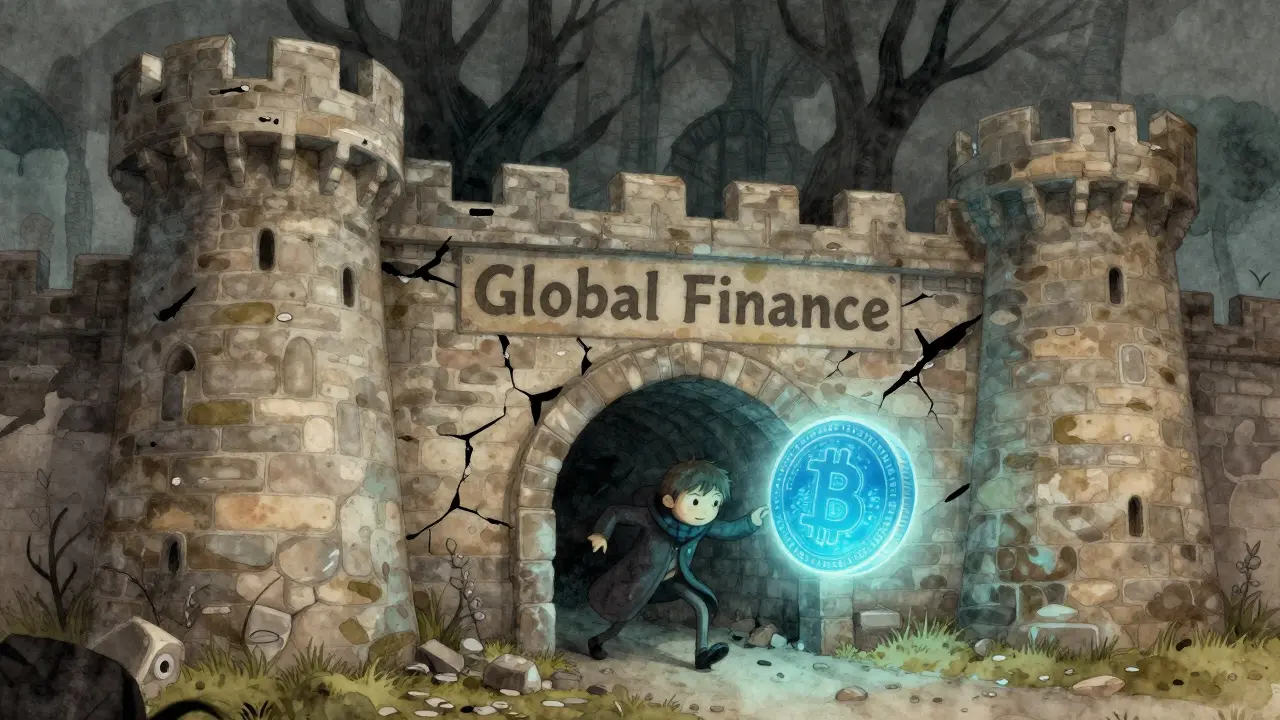
For years, the global financial system was seen as a fortress that could be locked down with sanctions. When countries wanted to isolate an adversary economically, they cut off access to SWIFT, froze assets in Western banks, and blocked transactions. But since 2022, that fortress has developed cracks. Russia has found a way to keep its war machine funded by turning to cryptocurrency. This isn't just about buying Bitcoin on a public exchange anymore. It involves custom-built tokens, shadow exchanges, and complex networks spanning multiple jurisdictions.
The landscape of sanctions evasion has shifted dramatically by mid-2026. What started as simple transfers has evolved into sophisticated financial engineering. To understand how this works, we need to look at the specific tools, platforms, and strategies Russia is using right now. We’ll break down the key players like the A7A5 token and the Grinex exchange, explain the role of Kyrgyzstan’s banking sector, and see why international regulators are struggling to keep up.
The Shift from Traditional Banking to Digital Shadows
When Western nations imposed severe sanctions on Russia following the invasion of Ukraine, the immediate goal was to choke off the country's ability to fund military operations. Traditional banking channels were severed. However, this created a vacuum. Money still needed to move for imports of electronics, weapons components, and other essential goods.
Russia turned to digital assets because blockchains offer a degree of opacity that traditional banking lacks. While blockchain transactions are public, the identities behind the wallets are not always clear. This anonymity allows sanctioned entities to mask their activities. Over time, this usage grew from occasional trades to a systematic approach involving billions of dollars. The scale is staggering. According to data analyzed by Elliptic, wallets linked to Russian evasion schemes have processed massive volumes of stablecoins, effectively creating a parallel financial system that operates outside Western control.
The A7A5 Token: A Custom Tool for Evasion
One of the most significant developments in this space is the creation of purpose-built cryptocurrencies. The standout example here is the A7A5 token, which is a ruble-backed cryptocurrency designed specifically to evade Western sanctions. Unlike Bitcoin or Ethereum, which are decentralized and global, A7A5 was engineered to solve a specific problem: converting sanctioned Russian rubles into usable international capital.
Issued by a firm based in Kyrgyzstan, A7A5 operates on both the TRON and Ethereum blockchains. This dual-chain strategy ensures redundancy; if one network faces regulatory pressure, the other remains active. Since its launch, the token has facilitated approximately $9.3 billion in transactions on a dedicated exchange within just four months. That volume demonstrates not just technical capability but widespread adoption among entities seeking to bypass restrictions.
The mechanism is straightforward in theory but complex in execution. Users deposit rubles, receive A7A5 tokens, and can then trade these tokens for stablecoins like USDT or USDC. These stablecoins can be moved across borders without triggering traditional banking alerts. The token acts as a bridge, allowing sanctioned currency to enter the global crypto economy and eventually be converted back into fiat currency in friendly jurisdictions.

Grinex and the Phantom Exchanges
You cannot talk about Russian crypto evasion without mentioning the evolution of cryptocurrency exchanges. For a long time, Garantex was the go-to platform for moving illicit funds. It was heavily sanctioned by the United States, leading many to believe it had been shut down. In reality, it simply changed its name and infrastructure.
On March 6, 2025, U.S. Secret Service actions targeted Garantex. Almost immediately, the operators launched Grinex, a cryptocurrency exchange that serves as a direct successor to Garantex, continuing its operations under a new identity. Grinex’s promotional materials openly admitted it was formed in response to the asset freezes affecting Garantex. They even offered services to help Garantex customers transfer their deposits to the new platform seamlessly.
This pattern highlights a major challenge for regulators: you can sanction a company, but if the underlying technology and team remain intact, they can rebrand overnight. Grinex has since facilitated billions of dollars in transactions before itself being designated for sanctions by the U.S. Treasury’s Office of Foreign Assets Control (OFAC). The cycle continues, with new platforms like Meer emerging to fill the gaps left by previous crackdowns.
| Platform/Entity | Role | Status (as of 2026) | Key Feature |
|---|---|---|---|
| Garantex | Original darknet/crypto exchange | Sanctioned & Rebranded | Pioneered large-scale illicit crypto flows |
| Grinex | Successor to Garantex | Sanctioned by OFAC | Seamless migration of user funds from Garantex |
| A7A5 Token | Ruble-backed stablecoin | Active & Targeted | Processes $9.3B+ in transactions |
| Capital Bank | Kyrgyzstani financial gateway | Under Investigation | Converts crypto to fiat for military purchases |
The Role of Kyrgyzstan and Capital Bank
Cryptocurrency doesn't exist in a vacuum. It needs to connect to the real world where goods are bought and sold. This is where Kyrgyzstan comes into play. The country has become a critical node in the sanctions evasion network due to its less stringent financial regulations and geographic proximity to Russia.
A central figure in this operation is Capital Bank, a Kyrgyzstani bank led by director Kantemir Chalbayev. Capital Bank serves as the interface between the digital crypto world and the physical supply chain. It receives digital assets, converts them into fiat currency, and facilitates payments for military goods and other restricted items. This integration allows Russia to maintain a flow of resources despite being cut off from traditional correspondent banking relationships.
The involvement of Capital Bank illustrates how conventional financial institutions can be co-opted into crypto-based evasion schemes. By acting as a liquidity provider, the bank enables the conversion of A7A5 tokens and other stablecoins into cash that can be used to purchase hardware, software, and weaponry. This hybrid model-combining blockchain anonymity with traditional banking utility-is what makes these networks so resilient.

International Responses and Regulatory Crackdowns
The international community has not been idle. Throughout 2025 and into 2026, coordinated efforts by the United States, United Kingdom, and European Union have intensified. The goal is to dismantle the infrastructure supporting these evasion tactics.
In October 2025, the UK government announced targeted sanctions against the Grinex and Meer exchanges, along with the A7A5 token infrastructure. This was part of a broader strategy to hit the financial lifelines of the Russian war effort. Similarly, the European Union adopted its 19th package of sanctions, which explicitly banned transactions on crypto platforms used to bypass restrictions. This marked a significant shift, as previous EU sanctions focused more on traditional finance.
Regulators are also leveraging data leaks to identify key players. For instance, information leaked in September 2025 regarding Ilan Shor, a Moldovan politician sanctioned for aiding Russia, revealed extensive use of crypto wallets. Analysis showed that associated businesses received $8 billion in stablecoin transactions over 18 months. These funds were used to support political activism and infrastructure projects aligned with Russian interests. Such investigations provide crucial evidence for enforcing sanctions and identifying new targets.
Implications for the Crypto Industry
These events have profound implications for the broader cryptocurrency industry. Legitimate businesses face increased scrutiny and compliance costs. Companies like Elliptic have had to adapt their products to screen for A7A5 tokens and monitor transactions on TRON and Ethereum networks. This means that any wallet interacting with these sanctioned entities risks being flagged, frozen, or blacklisted.
The rise of state-sponsored evasion schemes forces the industry to choose sides. Exchanges must implement stricter Know Your Customer (KYC) and Anti-Money Laundering (AML) protocols to avoid becoming complicit. Failure to do so results in severe penalties, as seen with Garantex and Grinex. Conversely, some actors continue to operate in the shadows, catering to those willing to pay a premium for anonymity.
Looking ahead, experts predict a continued cat-and-mouse game. Russia will likely develop new tokens and partnerships to circumvent emerging regulations. Meanwhile, regulators will enhance their tracking capabilities, using AI and blockchain analytics to uncover hidden connections. The result is a more fragmented crypto landscape, divided between compliant mainstream platforms and illicit underground networks.
What is the A7A5 token and why is it significant?
The A7A5 token is a ruble-backed cryptocurrency issued by a Kyrgyzstani firm. It is significant because it was specifically designed to help Russia bypass Western sanctions. It allows users to convert sanctioned rubles into a digital asset that can be traded globally, facilitating billions of dollars in transactions without touching traditional banking systems.
How did Grinex replace Garantex?
After Garantex was sanctioned by the U.S., its operators created Grinex as a direct successor. They migrated customer deposits and infrastructure to the new platform, effectively continuing their operations under a different name. Grinex later faced its own sanctions from OFAC for being controlled by Garantex.
Why is Kyrgyzstan important in this sanctions evasion network?
Kyrgyzstan provides a jurisdiction with looser financial regulations, making it an ideal hub for crypto exchanges and banks involved in evasion. Institutions like Capital Bank act as gateways, converting cryptocurrency into fiat currency to pay for military goods and other restricted items.
Have Western sanctions been effective against crypto evasion?
Sanctions have disrupted some operations, forcing platforms like Garantex to rebrand. However, they have not stopped the flow entirely. New tokens and exchanges emerge quickly, and the total volume of illicit crypto transactions remains high. International coordination has improved, but the adaptive nature of crypto makes complete eradication difficult.
What should legitimate crypto users watch out for?
Legitimate users should ensure their wallets and exchanges comply with KYC and AML regulations. Avoid interacting with known sanctioned tokens like A7A5 or platforms like Grinex, as doing so can lead to account freezes or legal issues. Use reputable services that actively screen for illicit activity.