Blockchain networks were never meant to handle millions of daily transactions. When Ethereum first hit 1 million transactions per day, fees skyrocketed. People paid $50, $100, even $200 just to send a token or swap crypto. That’s not finance - that’s a tax on using the network. But then came rollups, and everything changed.
What Rollups Actually Do
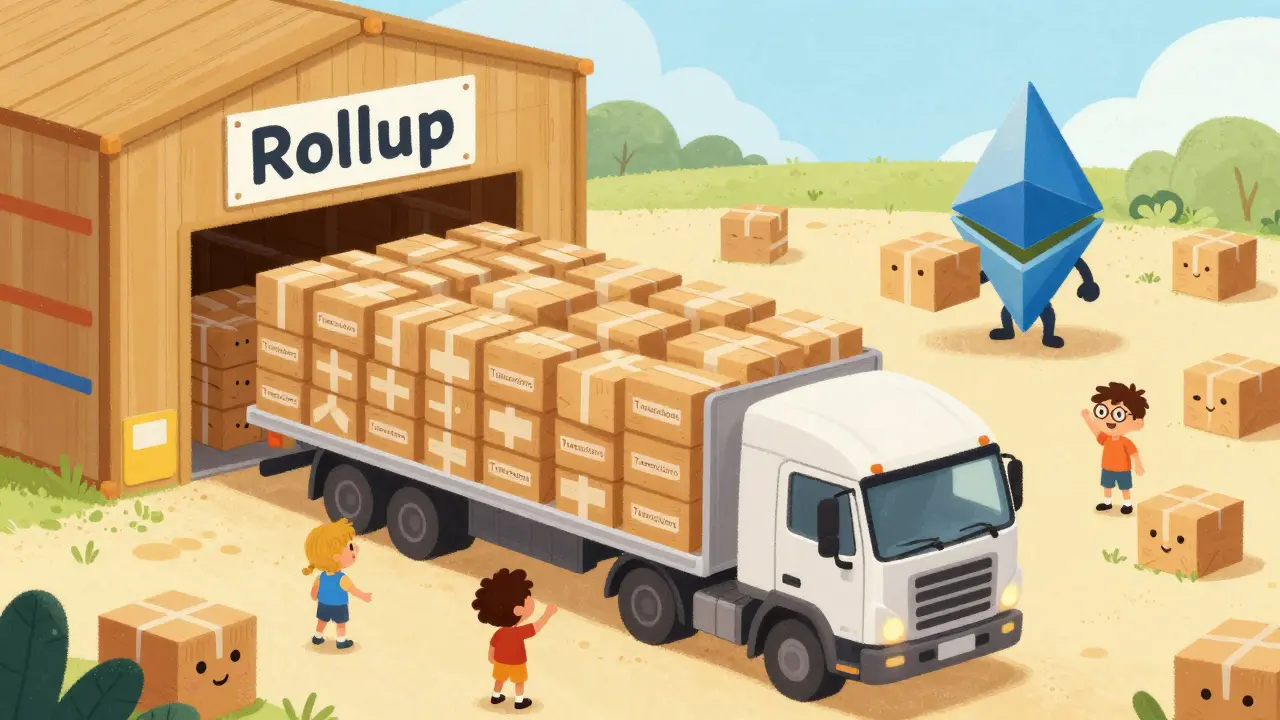
Rollups don’t replace blockchains. They work alongside them. Think of them like a warehouse that sorts, packs, and ships hundreds of packages in one truck instead of sending each one separately. On-chain, you pay for every single package. Off-chain, rollups bundle hundreds of transactions into one, then send a tiny proof to the main chain to verify they all happened correctly. This isn’t theory. In practice, a Bitcoin transaction that normally costs 5,000 satoshis can drop to just 50 satoshis using a rollup. That’s a 99% drop. On Ethereum, gas fees that used to hit $15 per swap now hover around $0.10 on some rollups. This isn’t a minor tweak - it’s what makes DeFi, gaming, and NFTs usable for regular people.How They Cut Costs So Hard
The magic happens in three places: batching, off-chain processing, and proof verification.- Batching: Instead of 10,000 separate transactions clogging up the blockchain, rollups collect them all, compress them into one file, and submit it as a single unit. That file is maybe 1/100th the size of the original data.
- Off-chain processing: All the heavy lifting - checking signatures, updating balances, running smart contracts - happens on a fast, separate chain. No need to wait for Ethereum miners to process each one.
- Proof verification: The rollup sends a cryptographic proof to the main chain. It doesn’t say “here are 5,000 transactions.” It says, “here’s proof these 5,000 transactions are valid.” The main chain doesn’t need to re-run them. It just checks the proof. That’s why it’s so cheap.
ZK-Rollups vs. Optimistic Rollups
Not all rollups are the same. There are two main types: ZK-rollups and optimistic rollups.| Feature | ZK-Rollups | Optimistic Rollups |
|---|---|---|
| Proof Type | Zero-knowledge proofs (cryptographic) | Fraud proofs (challenge period) |
| Finality Time | Fast (seconds) | Slow (7-14 days) |
| Cost per Transaction | Lower (more efficient proofs) | Higher (needs more data on-chain) |
| Security | Mathematically guaranteed | Relies on watchers to report fraud |
| Use Case Fit | High-frequency trading, payments | Complex DeFi, smart contracts |

Real-World Impact
You’re already using rollups without realizing it.- DeFi: Platforms like Uniswap V3 and Aave moved to rollups because users couldn’t afford to trade on Ethereum’s main chain. Now, swapping tokens costs pennies.
- Gaming: Games like Illuvium and Immutable X let players trade in-game items with near-zero fees. Imagine buying a rare sword for $0.02 instead of $50.
- NFTs: Minting an NFT used to cost $100+. Now, on rollups like Polygon zkEVM, it’s under $0.50. That’s why NFT adoption exploded in 2025.
- Payments: Bitcoin Layer 2s like the Lightning Network (a form of rollup) now process over 10 million transactions per day. Micropayments for content, tips, or coffee are now possible.
Why Rollups Are the Only Real Solution
Other scaling ideas failed. Sidechains? They’re not secure - if the sidechain breaks, your money is gone. Plasma chains? Too slow. Validiums? They don’t store data on-chain, so you can’t prove ownership if the operator disappears. Rollups fix all of that. They use the main blockchain as a security anchor. Even if the rollup operator vanishes, you can still withdraw your funds directly to Layer 1. No middleman. No trust. Just math. That’s why every major blockchain - Ethereum, Bitcoin, Solana - is now building or integrating rollups. Ethereum’s upcoming “danksharding” update will make rollups even cheaper by giving them more space to store data. Bitcoin’s upcoming Taproot upgrades are enabling ZK-rollups on its network. This isn’t a trend. It’s the new standard.
What You Lose With Rollups
No technology is perfect. Rollups have trade-offs.- Liquidity fragmentation: Your ETH might be on Arbitrum, but the DEX you want is on Optimism. You need bridges - and bridges add complexity and risk.
- Less composability: You can’t easily use a smart contract on one rollup with another. It’s like trying to use an app on iPhone with an Android phone. Possible? Yes. Smooth? Not yet.
- Still tied to Layer 1: Rollups can’t escape Ethereum or Bitcoin’s blockspace costs entirely. If the base layer becomes expensive again, rollups will too - just less so.
What’s Next?
The next wave of rollups will focus on privacy, speed, and integration.- Privacy rollups: ZK-rollups can now hide transaction details while still proving validity. Think anonymous payments on public blockchains.
- Native rollups: Chains like zkSync and Starknet are building their own rollup-native tokens and infrastructure - no more bridging needed.
- Rollup-as-a-service: Companies are offering plug-and-play rollup solutions so startups don’t need to build from scratch.
Are rollups safe?
Yes. Rollups inherit the security of the underlying blockchain - Ethereum or Bitcoin. Even if the rollup operator goes offline, you can still withdraw your funds directly to Layer 1. Unlike sidechains, there’s no risk of total fund loss. ZK-rollups are cryptographically secure; optimistic rollups rely on a challenge period where anyone can dispute fraud.
Do I need to use a bridge to access rollups?
Yes, for now. You’ll need to move your assets from Ethereum (or Bitcoin) to the rollup using a bridge. But bridges are getting faster and safer. Some wallets now offer one-click rollup onboarding. In the future, native rollup tokens and seamless interoperability will reduce this need.
Can rollups replace Ethereum entirely?
No, and they’re not meant to. Rollups rely on Ethereum (or Bitcoin) to settle disputes and store final proofs. They’re a scaling layer, not a replacement. Think of Ethereum as the highway, and rollups as the high-speed lanes that keep traffic moving without clogging the main road.
Why are ZK-rollups cheaper than optimistic ones?
ZK-rollups use smaller cryptographic proofs that require less data to be stored on-chain. Optimistic rollups need to publish more transaction data so that fraud can be challenged later. More data = higher fees. ZK proofs are compact and verified instantly, making them more efficient.
Will rollups make gas fees disappear?
No - but they’ll make them negligible for most users. You’ll still pay a small fee to submit the batch to Layer 1, but it’s shared across hundreds of transactions. For users, that means fees under $0.10. For comparison, credit card processing fees are often 2-3%. Rollups are cheaper than traditional finance.


Sharon Tuck
March 9 2026Wow, this is such a clear breakdown! I’ve been trying to explain rollups to my sister who’s new to crypto, and this is literally the explanation I’ll be sending her. The warehouse analogy? Perfect. It’s like sending a whole box of groceries instead of 50 individual bags - so obvious once you see it. Thanks for making this so digestible!