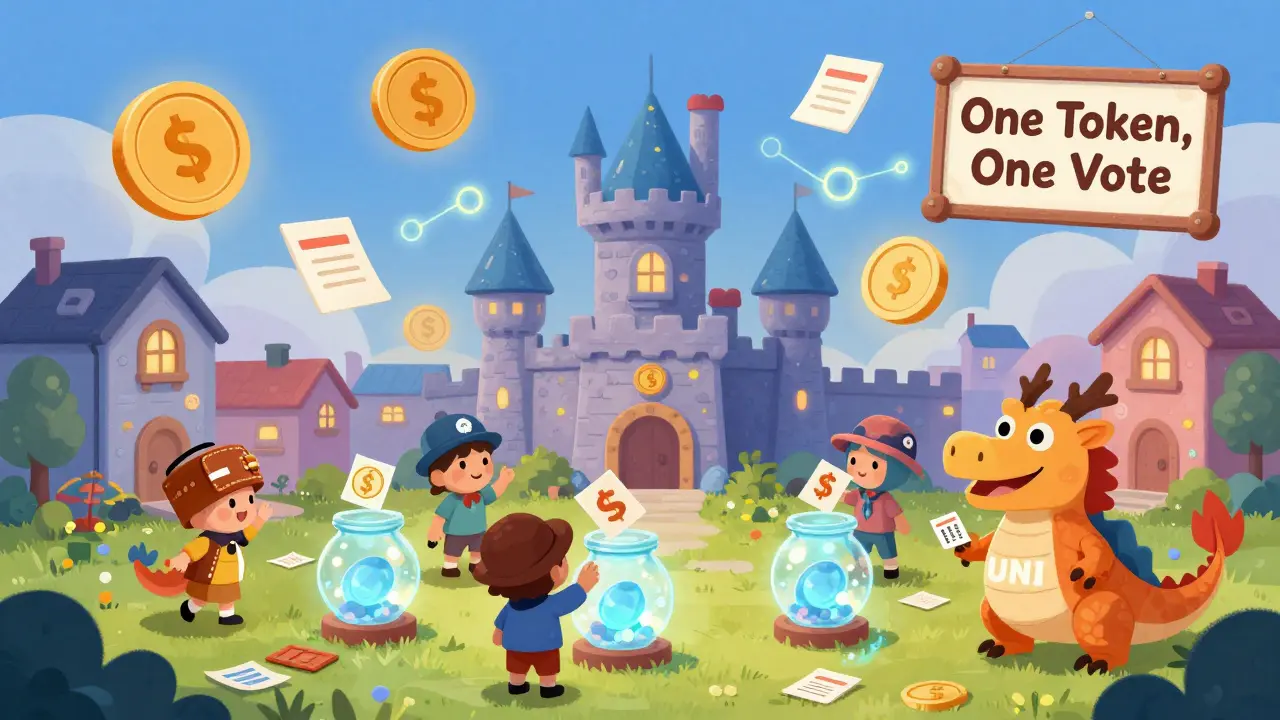
When you hold a governance token, you’re not just owning a piece of digital asset-you’re holding a vote. That’s the core idea behind how DAOs make decisions without a CEO, board, or headquarters. Unlike traditional companies where power flows from the top down, DAOs (Decentralized Autonomous Organizations) let anyone with tokens decide what happens next: who gets paid, what features get built, or even whether the whole protocol should change its rules. It sounds simple, but the mechanics behind it are anything but. Governance tokens are the engine of this system, and understanding how they work is key to grasping the future of digital organizations.
What Exactly Is a Governance Token?
A governance token isn’t meant to be traded like Bitcoin or used as a currency like USDT. Its real value lies in the voting rights it gives you. Think of it like a shareholder vote in a public company-but instead of shares, you hold tokens. The more tokens you own, the more votes you get. This is called the “one token, one vote” model. It’s the most common setup, used by over two-thirds of DAOs today.
Take Uniswap, for example. If you hold 10,000 UNI tokens, you have 10,000 votes. If you hold 100 tokens, you get 100 votes. No middlemen. No paperwork. Everything is recorded on the blockchain. When a proposal comes up-say, changing how fees are distributed-you can cast your vote directly from your wallet. The results are public, permanent, and verifiable by anyone.
The first DAO to use this model was MakerDAO in late 2017, with its MKR token. Back then, it was experimental. Now, over 10,000 DAOs rely on similar systems, managing nearly $23 billion in assets. Governance tokens turned the idea of decentralized decision-making from theory into practice.
How Voting Actually Works in a DAO
Not all DAOs vote the same way. While “one token, one vote” is the default, there are smarter alternatives that try to fix its biggest flaw: concentration of power.
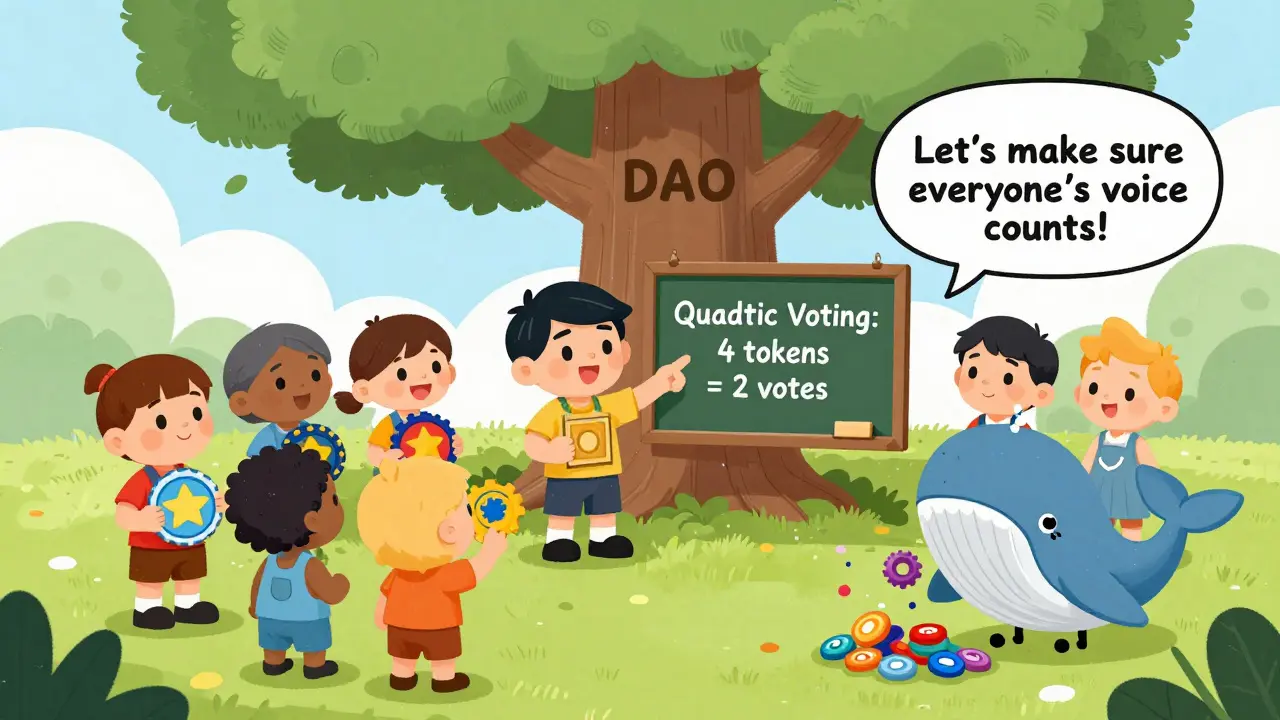
- Token-based voting: The simplest version. If you have 1% of the total supply, you get 1% of the votes. This favors whales-those with large holdings. In Uniswap, the top 10 holders controlled nearly 25% of voting power in mid-2023.
- Quadratic voting: This system makes it harder for big holders to dominate. To cast 2 votes, you need 4 tokens. For 3 votes, you need 9. The cost goes up quadratically. Gitcoin, a DAO funding public goods, used this in 2021 and cut whale influence by 73% in its funding rounds.
- Reputation-based voting: Instead of tokens, your voting power comes from your contributions. Did you write code? Help with marketing? Organize events? Some DAOs like Colony reward you with reputation points, not tokens. This encourages long-term involvement over short-term speculation.
- Delegated voting: Not everyone has time to read every proposal. That’s why 45% of DAOs let you assign your vote to someone else-a delegate. In Uniswap, over half of all voting power was delegated to just 1,200 people in late 2023. It’s efficient, but it risks creating new elites.
- Multisig voting: A hybrid approach. Community votes on proposals, but only a small group of trusted members can actually execute them. MakerDAO used this during the 2020 “Black Thursday” crash to shut down the system fast. But critics say it undermines decentralization.
Most DAOs use a mix. Aave now lets users assign different delegates for different types of proposals. Optimism introduced a “Citizen House” where quadratic funding decides public spending. These aren’t just tweaks-they’re evolution.
Why Token Voting Has a Dark Side
It’s easy to romanticize decentralized governance. But real-world data shows serious problems.
In 2021, a hacker borrowed 100,000 COMP tokens from a lending protocol, voted to redirect treasury funds to themselves, and walked away with millions. This wasn’t a hack of the code-it was a hack of the system. The rules allowed it. That’s the risk of “one token, one vote”: if you can rent tokens, you can rent votes.
Then there’s voter fatigue. A 2023 survey found that some users received over 25 governance notifications in a single week. Most didn’t vote. Why? Because reading proposals takes hours. Understanding the technical details? Even longer. The average voter turnout across DAOs is just 3.2%. That means a tiny fraction of holders decides the fate of billion-dollar protocols.
And then there’s the whale problem. In Aave’s 2022 proposal 75, 67% of small holders opposed the change. But because a few large wallets held enough tokens, the proposal passed. The community was outvoted-not because they were wrong, but because they were outnumbered by capital.
Vitalik Buterin called this “plutocratic governance.” And he’s not alone. Dr. Georgios Vlachos of the University of Zurich found that DAOs using hybrid systems-mixing token weight with reputation-had 37% higher participation and more diverse outcomes. The lesson? Pure token power doesn’t equal fair democracy.
What’s Being Done to Fix It
DAOs aren’t ignoring these issues. They’re testing new models.
Fei Protocol tested time-locked voting power in 2022. If you hold tokens for 30 days, your vote counts more. Hold them for 90 days? Even more. This discourages short-term speculation and rewards long-term commitment.
1Hive, a small DAO focused on local economies, is experimenting with conviction voting. Instead of voting once, you signal ongoing support. The longer you support a proposal, the more weight it gains. It’s slow, but it filters out noise and lets strong ideas rise naturally.
Quadratic funding is expanding beyond Gitcoin. Projects like Optimism now use it to allocate public goods budgets-funding open-source tools, documentation, and community events. This shifts power from token holders to contributors, which is exactly what many DAOs need.
Even the tools are improving. Snapshot.org, the most popular off-chain voting platform, lets users vote without paying gas fees. But it’s not perfect. Users report 3.8-second delays loading proposals. And while 4.2 out of 5 stars sounds good, it’s still not reliable enough for high-stakes decisions.

Who’s Really in Charge?
Here’s the uncomfortable truth: most DAOs aren’t governed by the crowd. They’re governed by a small group of active participants-developers, early investors, and professional delegates.
Electric Capital’s 2023 report found that 82% of active DAO voters have held crypto for over two years. That’s not a broad base. That’s a closed club. And the geographic split? 39% of voters are in North America. 28% in Europe. 22% in Asia. The rest? Almost none.
And yet, the system keeps growing. The DAO governance market hit $4.7 billion in 2023 and is projected to grow at 38% annually through 2030. DeFi still leads, with 62% of DAOs focused on lending, trading, and liquidity pools. NFTs and social DAOs are catching up.
But here’s the kicker: regulatory pressure is rising. In 2023, the SEC took aim at Uniswap Labs, suggesting governance tokens could be classified as securities. If that happens, DAOs might have to register like investment funds-or shut down.
Can DAOs Survive Without Governance Tokens?
Naval Ravikant once said governance tokens are “valueless” without revenue-sharing rights. He has a point. Many tokens have no cash flow. No dividends. No stake in profits. They’re just voting rights. And if no one uses them, they’re just digital paper.
But the bigger issue isn’t value-it’s legitimacy. If 97% of token holders never vote, is it really governance? Or just a marketing tool?
The most promising DAOs are the ones that combine systems. They use tokens to give weight to economic stake, reputation to reward contribution, and time locks to discourage speculation. They don’t rely on one model-they mix them.
That’s the future: modular governance. DAOs that let you choose how you vote-based on your role, your history, your time invested. Not just your wallet size.
Right now, governance tokens enable voting. But the goal isn’t just to vote. It’s to make good decisions. And that takes more than tokens. It takes participation, transparency, and fairness.
The experiment is still young. But the data is clear: if DAOs want to be more than hype, they need to fix how they vote.
What is the main purpose of a governance token?
The main purpose of a governance token is to give holders the right to vote on decisions within a DAO, such as protocol upgrades, treasury spending, or rule changes. Unlike other crypto assets, governance tokens don’t primarily serve as currency or store of value-they exist to enable decentralized decision-making.
Can I vote without owning governance tokens?
No, you cannot vote directly in a DAO without owning its governance token. However, you can delegate your voting power to someone else if you don’t have time to vote yourself. Some DAOs also allow non-token holders to participate in advisory votes or community forums, but final decisions always require token ownership.
How do I get governance tokens?
You can get governance tokens by purchasing them on exchanges like Uniswap or Coinbase, earning them through liquidity mining (providing funds to a protocol), or receiving them as an airdrop for early usage. Some DAOs also distribute tokens based on contribution, such as writing code or moderating community discussions.
Why do some DAOs have low voter turnout?
Low voter turnout happens because reading and understanding proposals takes time and technical knowledge. Many token holders are passive investors who don’t engage with governance. Others face voter fatigue from too many proposals. The average voter turnout across DAOs is only 3.2%, meaning a tiny fraction decides major outcomes.
Are governance tokens regulated?
Regulation is unclear and evolving. In 2023, the SEC signaled that governance tokens could be classified as securities if they function like investment contracts. This could require DAOs to register, disclose financials, or limit participation. Several DAOs are now redesigning their token models to avoid regulatory risk.
What’s the difference between governance tokens and utility tokens?
Utility tokens give access to a service-like paying for cloud storage or computing power. Governance tokens give voting rights. Some tokens do both, but their primary function defines them. For example, UNI lets you vote on Uniswap’s future, while AAVE lets you vote and also earn fees from the lending protocol.
Can governance tokens lose value?
Yes. Many governance tokens dropped 68% from their 2021 peaks, not because the protocol failed, but because the market lost faith in their governance model. If voting is ignored, if whales dominate, or if proposals lead to bad outcomes, token holders sell. Value follows participation, not just supply.
What happens if a DAO proposal passes but isn’t implemented?
In most DAOs, proposals are executed automatically by smart contracts once they pass. But some use multisig systems where a small group of trusted members must manually trigger the change. If they refuse, the proposal stalls. This creates a governance risk-community votes can be blocked by a few individuals.


Tanvi Atal
February 23 2026Governance tokens? More like voting rights for the rich. I don’t care if it’s ‘decentralized’-if 10 whales control 70% of the votes, it’s just Wall Street with a blockchain logo.
And don’t even get me started on ‘quadratic voting.’ Sounds fancy, but who’s really reading those proposals? I’ve got a job, not a DAO committee to run.
Token holders who never vote? They’re not lazy-they’re smart. Why waste time on a system that doesn’t listen anyway?