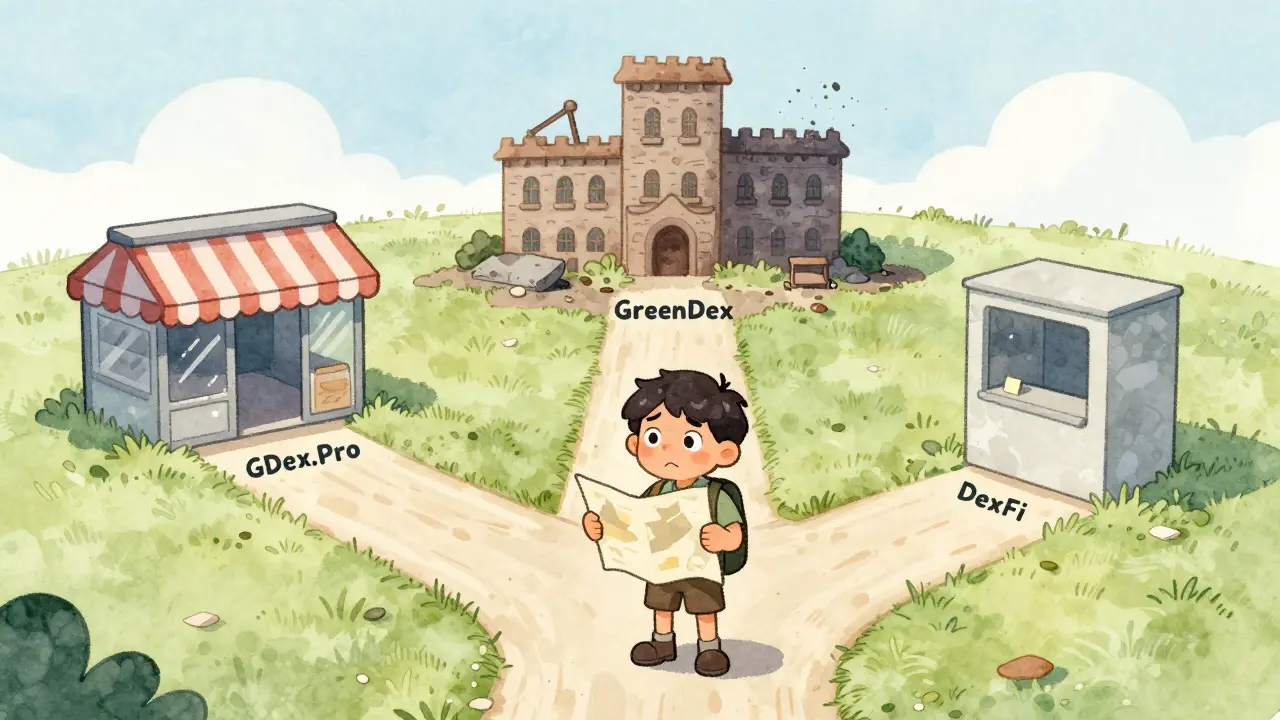
You’ve probably seen the name GDEX pop up in search results or social media ads promising easy cross-chain swaps and AI-powered trading. But here is the hard truth: GDEX isn’t just one platform. It’s a confusing mix of at least three different projects that share similar branding but have nothing to do with each other. If you are looking for a reliable place to trade your Bitcoin or Ethereum in 2026, this confusion is a major red flag.
I’ve spent weeks digging into the technical docs, user reviews, and market data for every entity using the GDEX name. The goal? To help you avoid losing money to empty promises or zero-liquidity traps. Below, I break down exactly what these platforms are, why they struggle to compete with giants like Uniswap, and whether any of them deserve a spot in your portfolio.
The Three Faces of GDEX: Who Are You Dealing With?
Before you connect your wallet, you need to know which specific project you are interacting with. The term "GDEX" currently covers three distinct entities, each with its own history, token, and level of viability.
1. GDex.Pro (by Gemach DAO) is a decentralized cross-chain exchange interface launched in late 2023. This is the most active of the group, focusing on user experience features like Apple Pay integration and portfolio tracking. It operates on networks like Ethereum, BNB Chain, Arbitrum, and Aptos.
2. GreenDex (Token: GED) is an older project claiming implementation since 2019, but it remains largely unlisted and inactive. Despite marketing itself as an AI-driven exchange, it has failed to gain traction on major centralized exchanges.
3. DexFi Governance (Token: GDEX) is an ERC-20 governance token for the DexFi platform, listed on CoinGecko since early 2022. It doesn’t function as an exchange itself but allows holders to vote on protocol changes. Its market presence is minimal compared to top-tier governance tokens.
Why does this matter? Because if you buy the wrong token based on a vague ad, you might end up with an asset that has no liquidity, no utility, and no way to sell.
GDex.Pro Review: Features vs. Reality
Let’s start with GDex.Pro, the most visible brand under the GDEX umbrella. On paper, it looks impressive. Developed by Gemach DAO, it boasts six core components designed to simplify decentralized finance (DeFi):
- DISCOVERY: Helps you find new token pairs.
- PORTFOLIO: Tracks your assets across chains.
- MEMESCOPE: A feed for trending meme coins.
- BUBBLE MAP: Visualizes market cap movements.
- BRIDGE: Facilitates cross-chain swaps between Ethereum, BNB Chain, Arbitrum, and Aptos.
- COPYTRADE: Allows users to replicate successful traders’ strategies.
The standout feature here is the Apple Pay integration. Unlike competitors such as Uniswap or PancakeSwap, GDex.Pro lets you buy crypto directly with Apple Pay, starting at a $50 minimum. For beginners who don’t want to deal with bridging funds from a bank account, this is convenient.
However, convenience doesn’t equal safety or efficiency. Independent verification of their claims is scarce. While Gemach DAO claims an 87% user satisfaction rate for their DISCOVERY and PORTFOLIO tools, there are no verified reviews on Trustpilot as of late 2024. More importantly, the platform suffers from the same issue plaguing all niche DEXs: low liquidity. When you swap large amounts, you risk high slippage because the order books aren’t deep enough.
GreenDex (GED): The Ghost Project
If you encounter GreenDex, proceed with extreme caution. This project claims to have been "implementing since 2019," yet as of mid-2024, its token (GED) was not traded on any major exchange. Marketscreener noted in April 2023 that it promised AI-powered market analysis, but HOLDER.IO reported in July 2024 that the token price was unknown and the project was still "awaiting listing."
Here’s the tokenomics breakdown for GED, which raises eyebrows:
| Category | Allocation % | Lockup Period | Risk Level |
|---|---|---|---|
| Staking Pool | 29% | N/A | High (Inflationary pressure) |
| Presale | 15% | N/A | Medium |
| Team | 10% | 6 Months | Low |
| Retro | 10% | 1 Month | Medium |
| Liquidity | 8.82% | N/A | Very Low (Insufficient for volume) |
Notice how only 8.82% of the supply is allocated to liquidity? Compare that to established protocols where liquidity pools are often much larger relative to circulating supply. Reddit users in r/CryptoCurrency have explicitly warned against GED, citing the lack of exchange listings after five years of development. If a project can’t get listed on a minor exchange after half a decade, it’s likely dead in the water.
DexFi Governance (GDEX): Minimal Impact
The third player, DexFi Governance, uses the ticker GDEX. This is an ERC-20 token used for voting on the DexFi platform. To participate in governance, you need to hold at least 1,000 GDEX tokens.
In the world of DeFi governance, this token is a dwarf. Competitors like Uniswap (UNI) and Compound (COMP) dominate the space with billions in total value locked (TVL) and massive community engagement. In contrast, GDEX sits beyond position #500 on CoinGecko rankings. As of October 2024, its 24-hour trading volume was a mere $12,742. That’s not enough to support meaningful institutional trading or even significant retail speculation.
Furthermore, governance activity is virtually non-existent. CoinGecko documented only three proposals in all of 2024, all passing with over 90% approval but involving trivial protocol tweaks. This suggests a lack of active community interest or developer momentum.
Liquidity Crisis: Why Volume Matters
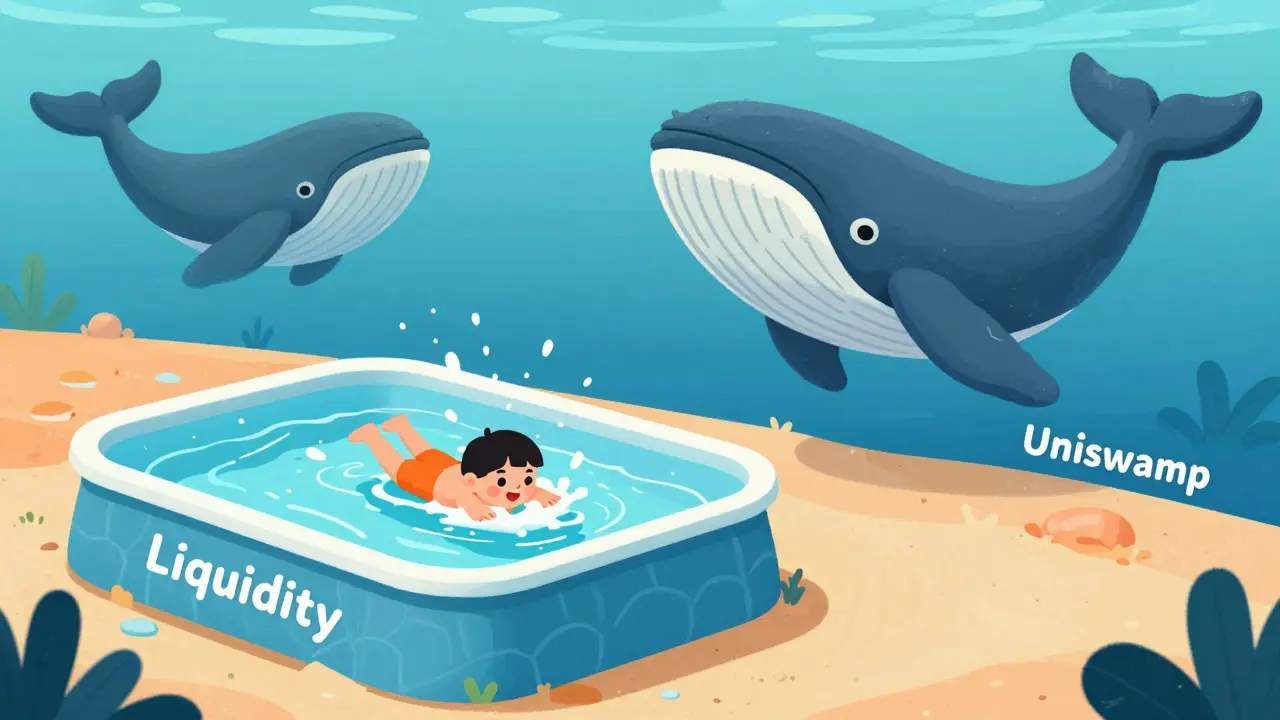
The biggest problem across all GDEX-branded platforms is liquidity. Let’s put this in perspective. According to DeFi Llama data from October 2024, Uniswap processes over $1 billion in daily volume. PancakeSwap handles roughly $300 million. Curve Finance manages another $100 million+. These platforms have deep liquidity pools, meaning you can buy or sell large amounts without moving the price significantly.
Now look at GDEX. No GDEX-branded platform appears in DeFi Llama’s top 100 DEXs by volume. This implies each processes less than $1 million monthly. Revain’s 2021 review of an earlier GDEX iteration noted "zero liquidity and trade volume" and website response times exceeding 15 seconds during peak hours. While GDex.Pro may have improved speed, the liquidity issue remains fundamental.
When liquidity is low, you face two risks:
- Slippage: Your trade executes at a worse price than expected because there aren’t enough buyers/sellers.
- Exit Risk: You might not be able to sell your tokens when you want to, especially during market downturns.
For example, if you try to trade GDEX tokens on a small exchange, you might find the order book is empty. CoinGecko user reviews from late 2024 confirmed this, with traders noting they couldn’t execute orders across multiple exchanges due to lack of depth.

Security and Regulatory Red Flags
Security is paramount in crypto. Unfortunately, GDEX-branded projects fail several basic checks. First, none of them appear to hold licenses from major regulatory bodies like the SEC (US), FCA (UK), or MAS (Singapore). Operating without clear regulatory compliance increases the risk of sudden shutdowns or legal action.
Second, academic research from the University of California’s 2023 DeFi Security Report cited unnamed "GDEX-branded platforms" as examples of projects with "unclear token utility" that failed to meet basic security audit standards. Messari’s Crypto Theses 2025 report categorized these projects as "high-risk speculative assets with unproven fundamentals," warning that similar branding creates confusion and erodes trust.
User experiences back this up. AffGadgets reviews for GDEX.io showed an average rating of 2.3/5, with complaints about "promised features never materializing." While GDex.Pro has a cleaner interface, the absence of independent security audits or bug bounty programs makes it risky for holding significant capital.
Comparison: GDEX vs. Established Alternatives
To help you make a better decision, let’s compare GDEX platforms against industry leaders. This table highlights key differences in reliability, volume, and features.
| Feature | GDex.Pro / GDEX Entities | Uniswap | PancakeSwap |
|---|---|---|---|
| Daily Volume | < $1 Million (Estimated) | > $1 Billion | > $300 Million |
| Supported Chains | Ethereum, BNB, Arbitrum, Aptos | Ethereum, Polygon, Optimism, etc. | BNB Chain, Ethereum, Arbitrum |
| Fiat On-Ramp | Apple Pay (GDex.Pro only) | Third-party integrations | Multiple fiat options |
| Regulatory Status | Unclear / Unlicensed | Operating globally (varies by region) | Operating globally (varies by region) |
| Trust Score | Low (No major audits) | High (Extensively audited) | High (Extensively audited) |
As you can see, while GDex.Pro offers a unique Apple Pay feature, it lacks the scale, security, and liquidity of established players. Unless you specifically need that Apple Pay integration for small purchases, the risks outweigh the benefits.
Final Verdict: Should You Use GDEX?
Based on the evidence, my recommendation is clear: **Avoid GDEX-branded platforms for serious trading.**
GDex.Pro might be interesting for tiny, experimental trades if you love trying new interfaces and don’t mind the risk of slippage. However, for any meaningful amount of capital, stick to proven platforms like Uniswap, PancakeSwap, or Curve. They offer deeper liquidity, better security audits, and more reliable execution.
GreenDex (GED) and DexFi Governance (GDEX) should be avoided entirely. One is effectively dormant, and the other has negligible market impact. Both carry high risks of total loss due to lack of liquidity and uncertain future development.
In the crypto world, familiarity and volume are your best friends. Don’t let flashy names or vague AI promises distract you from the fundamentals: liquidity, security, and transparency. GDEX fails on all three counts.
Is GDEX a scam?
While not all GDEX-branded projects are outright scams, they exhibit many characteristics of high-risk or abandoned ventures. GreenDex (GED) has been inactive for years despite claims of development, and DexFi Governance (GDEX) has minimal liquidity and usage. GDex.Pro is operational but lacks independent security audits and suffers from low liquidity. Always treat these platforms with extreme caution.
What is the difference between GDex.Pro and GreenDex?
They are completely separate entities. GDex.Pro is a newer decentralized exchange interface launched by Gemach DAO in 2023, featuring Apple Pay integration. GreenDex is an older, largely inactive project that claims to have started in 2019 but has failed to list its token (GED) on major exchanges. Do not confuse the two.
Can I buy GDEX tokens with Apple Pay?
Yes, but only through GDex.Pro. This platform allows users to purchase cryptocurrency directly with Apple Pay, starting at a $50 minimum. However, this feature is limited to GDex.Pro and does not apply to GreenDex (GED) or DexFi Governance (GDEX) tokens.
Is GDEX safe for large investments?
No. All GDEX-branded platforms suffer from extremely low liquidity compared to industry leaders like Uniswap or PancakeSwap. This means you could face significant slippage or be unable to sell your assets quickly. Additionally, the lack of regulatory licensing and independent security audits makes them unsuitable for large investments.
Which blockchain networks does GDex.Pro support?
GDex.Pro supports Ethereum, BNB Chain, Arbitrum, and Aptos. According to their roadmap, they plan to integrate zkSync and Optimism networks in the near future. However, always verify current compatibility on their official site before connecting your wallet.
Why is there so much confusion around the name GDEX?
The name GDEX is used by at least three different projects: GDex.Pro (a DEX interface), GreenDex (an inactive token project), and DexFi Governance (a governance token). This overlapping branding creates confusion and potential security risks, as users may accidentally interact with the wrong platform or token.