
Fraxswap on Arbitrum isn’t just another decentralized exchange. It’s a precision tool built for traders who want low fees, fast swaps, and deep liquidity-especially for FRAX and other Frax ecosystem tokens. But here’s the catch: most reviews you’ll find online are outdated, vague, or outright wrong. That’s because Fraxswap on Arbitrum doesn’t get the same attention as Uniswap or SushiSwap. If you’re considering using it, you need real data-not hype.
What Fraxswap Actually Is on Arbitrum
Fraxswap is the decentralized exchange arm of Frax Finance, a protocol that launched in late 2020 with a revolutionary stablecoin called FRAX. Unlike traditional stablecoins backed 1:1 by USD reserves, FRAX uses a hybrid model: part collateral (usually USDC), part algorithm. This lets it stay pegged to $1 even during volatile markets. Fraxswap was built to make trading FRAX, FXS (its governance token), and other Frax-related assets as smooth as possible. When Fraxswap launched on Arbitrum in late 2022, it wasn’t just copying what existed on Ethereum. It was optimized. Arbitrum’s Layer 2 technology slashed gas fees by over 90% and cut transaction times from 15 seconds to under 3 seconds. That’s huge when you’re swapping FRAX for USDC or adding liquidity during a price swing.How Fees Work on Fraxswap (Arbitrum)
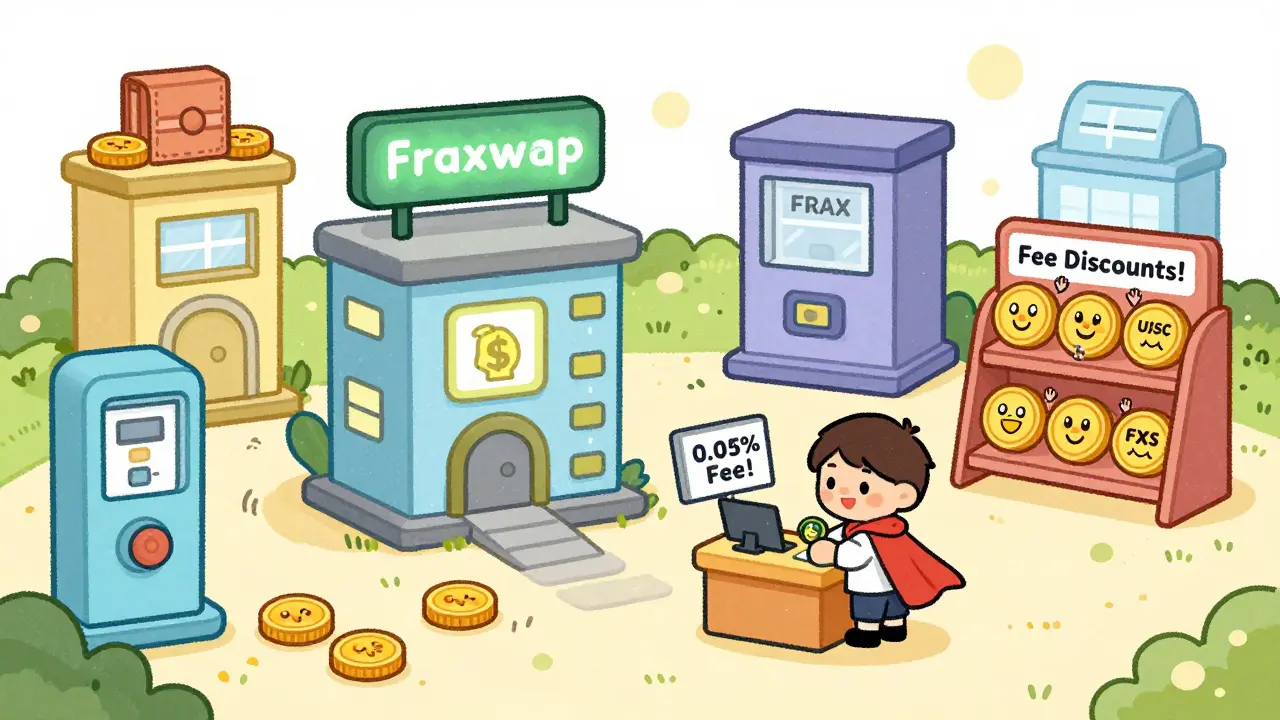
Most DEXs charge 0.30% per trade. Fraxswap on Arbitrum does too-but it’s not that simple. The platform uses a dynamic fee structure based on the trading pair and liquidity depth. For stablecoin pairs like FRAX/USDC, fees can drop as low as 0.05% because the pools are deep and stable. For more volatile pairs like FXS/WETH, fees stay at 0.30% to protect liquidity providers from impermanent loss. There’s also a special perk: FXS token holders get fee discounts. Hold 1,000 FXS? You pay 0.25% instead of 0.30%. Hold 5,000 FXS? You drop to 0.20%. This isn’t a gimmick-it’s designed to reward long-term supporters of the protocol. Compare that to Uniswap, where you pay the same fee whether you hold governance tokens or not.Liquidity and Trading Volume
As of December 2025, Fraxswap on Arbitrum manages over $420 million in total value locked (TVL), making it the third-largest DEX on the network after Uniswap and SushiSwap. That’s not Coinbase-level volume, but it’s more than enough for most traders. The biggest pools are:- FRAX/USDC - $180M liquidity
- FXS/WETH - $95M liquidity
- FRAX/WETH - $72M liquidity
- FRAX/ARB - $48M liquidity
How It Compares to Other Arbitrum DEXs
| Feature | Fraxswap | Uniswap V3 | SushiSwap | Swapr |
|---|---|---|---|---|
| Total Value Locked (TVL) | $420M | $2.1B | $680M | $110M |
| Standard Trading Fee | 0.05%-0.30% | 0.30% | 0.20%-0.30% | 0.30% |
| FXS Fee Discount | Yes (up to 33% off) | No | No | No |
| Concentrated Liquidity | Yes (V3-style) | Yes | Yes | No |
| FRAX/USDC Liquidity | $180M | $120M | $85M | $15M |
| Arbitrum Native | Yes | Yes | Yes | Yes |
Security and Audits
Frax Finance’s smart contracts have been audited by three top firms: CertiK, OpenZeppelin, and Trail of Bits. The Arbitrum deployment uses the same codebase as the Ethereum version, with only minor adjustments for gas optimization. No critical vulnerabilities have been found since its launch. It’s non-custodial, meaning you never hand over your keys. All trades happen directly from your wallet-MetaMask, WalletConnect, or Rabby. There’s no KYC, no sign-up, no account to get hacked. That’s the standard for DeFi, but not everyone follows it. Fraxswap does.What You Can’t Do on Fraxswap
It’s important to know the limits:- No fiat on-ramps. You can’t buy crypto with a credit card here.
- No margin trading or leverage. It’s spot-only.
- No mobile app. You need a wallet browser or desktop.
- FXS discounts require holding tokens on-chain. You can’t earn them just by trading.

Who Should Use Fraxswap on Arbitrum?
You should use Fraxswap if:- You trade FRAX, FXS, or other Frax ecosystem tokens regularly
- You want lower fees than Uniswap on stablecoin pairs
- You hold FXS and want to reduce your trading costs
- You care about deep liquidity and minimal slippage
- You’re new to crypto and need a simple UI
- You want to buy crypto with a credit card
- You’re trading obscure tokens with low liquidity
How to Get Started
1. Get ETH on Ethereum mainnet. You’ll need it to pay for bridging fees. 2. Bridge to Arbitrum using the official Frax Finance bridge or Arbitrum’s native bridge. Avoid third-party bridges. 3. Connect your wallet to app.frax.finance/swap. Make sure you’re on the Arbitrum network. 4. Swap or add liquidity. Choose your pair. Watch the fee slider-it changes based on pool depth. 5. Hold FXS to unlock fee discounts. Even 500 FXS gives you a small edge. Pro tip: Use the Fraxswap interface to check real-time slippage before confirming. Set it to 0.5% for stablecoins, 1.5% for volatile pairs.Future Roadmap
Frax Finance is working on three key upgrades for Fraxswap on Arbitrum:- Dynamic fee adjustments based on market volatility
- Integration with Fraxlend (their lending protocol) for collateralized swaps
- On-chain voting for fee distribution to liquidity providers
Is Fraxswap on Arbitrum safe to use?
Yes. Fraxswap uses audited, non-custodial smart contracts. It has been reviewed by CertiK, OpenZeppelin, and Trail of Bits. No exploits have occurred since its launch on Arbitrum in late 2022. Always use the official site (app.frax.finance) and never share your private key.
How do I get FRAX or FXS to trade on Fraxswap?
Buy FRAX or FXS on centralized exchanges like Coinbase or Kraken, then bridge them to Arbitrum using the official Frax or Arbitrum bridge. You can also swap ETH for FRAX directly on Fraxswap if you already have ETH on Arbitrum.
What are the gas fees on Fraxswap?
Transaction fees on Arbitrum are typically $0.05-$0.20 per swap, depending on network congestion. This is 95% cheaper than Ethereum mainnet. Fraxswap itself doesn’t charge extra fees beyond the standard 0.05%-0.30% trading fee.
Does Fraxswap offer staking or yield farming?
No. Fraxswap is only a decentralized exchange. For yield, you need to use Fraxlend (lending) or Frax Finance’s veFXS staking on Ethereum. These are separate protocols.
Why is Fraxswap better than Uniswap for FRAX trading?
Fraxswap has deeper liquidity for FRAX pairs, lower fees for stablecoin swaps, and fee discounts for FXS holders. Uniswap treats all tokens the same. Fraxswap is optimized for its own ecosystem, which means less slippage and better prices when you’re trading FRAX.
If you’re already trading on Arbitrum and holding FRAX or FXS, Fraxswap isn’t just an option-it’s the smartest one. It’s not flashy. It doesn’t have a mobile app or a celebrity CEO. But it works. And in DeFi, that’s what matters.


Mandy McDonald Hodge
December 31 2025just swapped 10k FRAX for USDC and my fee was 0.07% - i didn’t even notice it happened. this is what DeFi should feel like. no drama, no gas wars, just smooth.