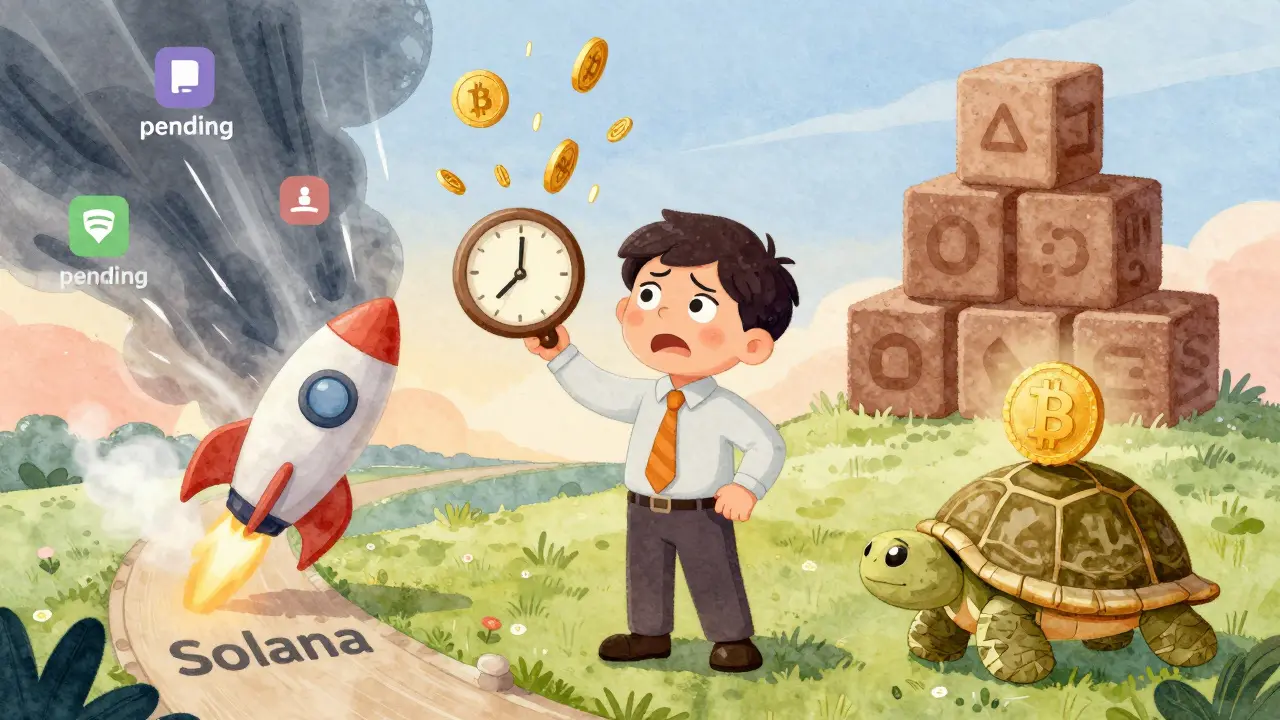
When you send crypto, how long should you wait before you’re sure it’s gone for good? If you’re trading on a decentralized exchange, a delay of even two seconds can cost you hundreds of dollars. But if you rush it, you risk losing everything to a chain reorg. This is the core tension behind fast finality-the promise of instant confirmation versus the need for unbreakable security.
What Is Finality, Really?
Finality isn’t just about confirmation. It’s about irreversibility. In Bitcoin, a transaction isn’t final until it’s buried under six blocks-about an hour. That’s probabilistic finality: the more blocks on top, the harder it is to reverse. But it’s never 100% guaranteed. A 51% attack could still rewrite history, even after six confirmations. That’s why exchanges and DeFi protocols don’t trust Bitcoin for fast trades. Modern blockchains like Solana, Algorand, and Ethereum 2.0 use deterministic finality. Once a transaction is included in a block and signed by enough validators, it’s done. No more waiting. No more guesswork. This is what traders and DeFi apps need. But getting there isn’t free. Every gain in speed comes with a cost somewhere else.The Safety vs. Liveness Trade-off
Every consensus protocol faces a choice: keep the network running even under attack, or shut down to protect integrity. This is the safety-liveness trade-off. Algorand is the extreme. It achieves what it calls "instant finality"-zero seconds between transaction and final confirmation. How? By using random jury selection via Verifiable Random Functions (VRF). Every round, a small, unpredictable group of stakeholders votes on the next block. No forks. No uncertainty. If the network detects a split, it stops. No blocks are produced until the majority agrees again. That’s safety-first. But if your internet cuts out for five minutes, Algorand halts. No transactions. No access. For some, that’s a dealbreaker. Ethereum 2.0 takes the opposite path. It prioritizes liveness. Even if 30% of validators go offline or act maliciously, the chain keeps going. Finality still happens-every 15 seconds-but it’s not absolute during attacks. Transactions can be temporarily uncertain. That’s why you still see "pending" on MetaMask during network stress. But the chain doesn’t die. Users keep trading. Apps keep running. That’s the compromise.Why Speed Matters in DeFi and Trading
In DeFi, milliseconds decide profits. If you’re arbitraging between Uniswap and SushiSwap, and one chain confirms faster than the other, you can front-run the price gap. But if finality is slow, your trade gets caught in limbo. Slippage spikes. Your liquidation risk rises. Your user experience turns frustrating. Solana handles 65,000 transactions per second with finality in under a second. That’s why it’s popular for NFT mints and high-frequency trading bots. But Solana has crashed multiple times due to network overload. When validators get overwhelmed, the chain stalls. Transactions don’t get finalized-they just vanish. That’s not safety. That’s fragility disguised as speed. Compare that to Bitcoin. It’s slow. It’s predictable. It’s been running for 15 years without a single successful 51% attack. But if you’re trying to settle a $10,000 payment in seconds, Bitcoin is useless. You’d wait an hour and still have to worry about chain reorgs.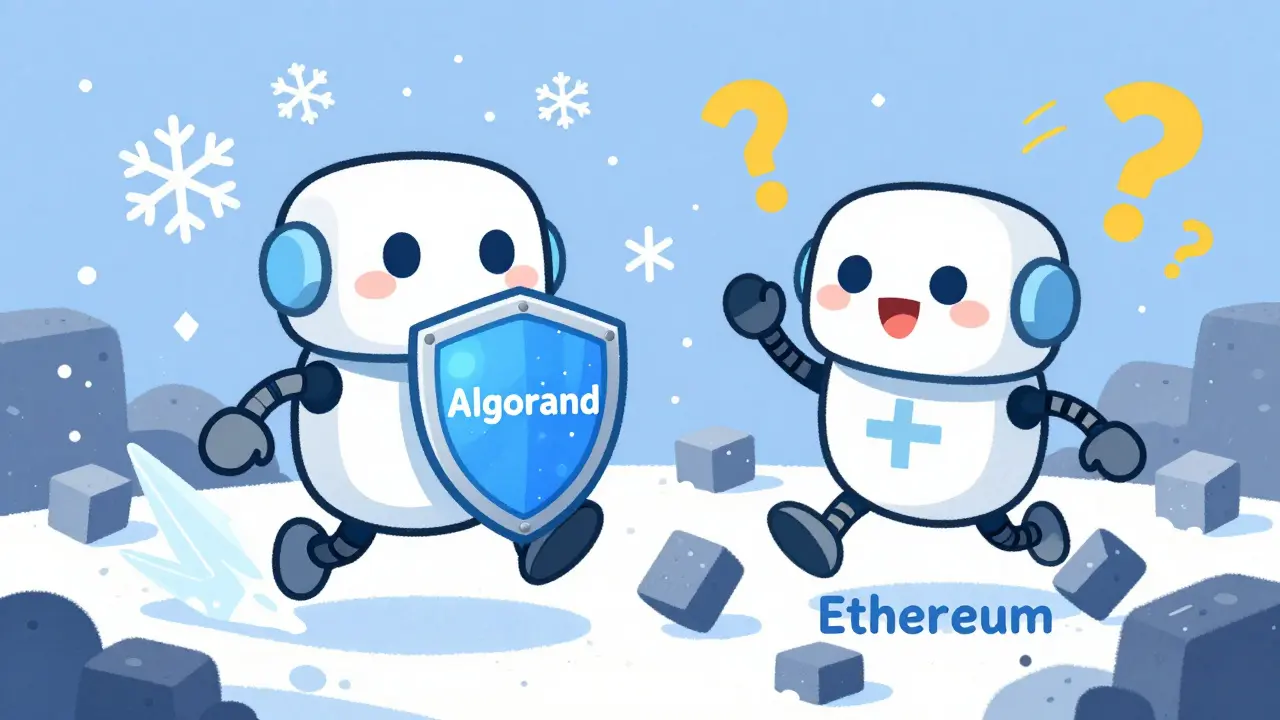
What About Cross-Chain Finality?
Cross-chain bridges are where things get messy. You send ETH from Ethereum to Polygon. Polygon confirms in 2 seconds. But Ethereum doesn’t know that yet. You need Ethereum to confirm the bridge’s proof. Then Polygon needs to confirm the receipt. That’s two finalities. Two chances to fail. Most bridges rely on external validators or threshold signatures. If those validators get hacked-as happened with the Ronin Bridge in 2022-your funds vanish. Even the most advanced bridges can’t bypass the fundamental problem: you’re trusting a third party to relay truth between two independent systems. Some protocols like Cosmos IBC try to solve this with light clients that verify chain states directly. But that requires heavy computational overhead. It’s secure-but slow. There’s no magic bullet. Faster cross-chain finality means trusting more centralized points. Slower means users wait longer. You pick your poison.Bitcoin’s Finality vs. Ethereum’s Finality
Bitcoin’s finality is economic. To reverse a transaction, you’d need to spend more than the entire network’s mining power. That’s expensive. It’s also slow. But it’s proven. Ethereum’s finality is cryptographic. Validators stake ETH. If they misbehave, their stake gets slashed. This creates a financial disincentive to cheat. Finality happens every 15 seconds, but it’s not foolproof during large-scale attacks. Ethereum’s design lets the chain survive chaos. Bitcoin’s design lets it survive forever. Neither is "better." They serve different needs. Bitcoin is digital gold. Ethereum is a global computer. You don’t need fast finality to store value. But you do need it to run a lending protocol or a derivatives exchange.
What’s Next? Hybrid Models and Proof-of-Proof
The next wave isn’t about choosing one model. It’s about combining them. Researchers are exploring Proof-of-Proof (PoP), where Bitcoin’s security is anchored to other chains. Imagine a DeFi app on Solana that uses Bitcoin’s hash as a finality checkpoint. Even if Solana crashes, the anchor on Bitcoin holds. Your funds are still safe. Ethereum’s research team is also testing single-slot finality-finality in one block. That would cut confirmation time to under a second without sacrificing security. But it’s still experimental. No live network has pulled it off yet. The future isn’t one-size-fits-all. It’s layered. Some chains will be fast and fragile. Others will be slow and bulletproof. And the smartest apps will use both.Choosing the Right Chain for Your Use Case
So how do you pick?- If you’re holding crypto long-term: Bitcoin. Slow, but unbreakable.
- If you’re trading DeFi tokens: Solana or Avalanche. Fast finality, low fees, but higher risk of downtime.
- If you’re building a lending protocol: Ethereum. Slower than Solana, but battle-tested and decentralized.
- If you’re sending payments across chains: Use a bridge with on-chain verification, not just a custodial one.
- If you need absolute certainty: Wait for 3+ confirmations on Bitcoin or 30+ seconds on Ethereum.
Is fast finality always better than slow finality?
No. Fast finality is better for trading and DeFi, but worse for long-term value storage. Bitcoin’s slow finality is actually a feature-it makes attacks prohibitively expensive. Speed without security is just a faster way to lose money.
Can a blockchain have both fast finality and high decentralization?
It’s extremely hard. Fast finality usually requires fewer validators or tighter coordination, which reduces decentralization. Algorand and Near achieve fast finality with hundreds of validators, but they’re still far less decentralized than Bitcoin’s millions of nodes. True decentralization often means slower consensus.
Why does Ethereum still have delays even after the merge?
Ethereum’s finality is 15 seconds under normal conditions. But delays happen during network congestion, validator downtime, or attacks. The system prioritizes staying alive over being fast. If 30% of validators go offline, Ethereum slows down but doesn’t crash. That’s a design choice, not a bug.
Are cross-chain bridges safe with fast finality?
Most aren’t. Fast finality on one chain doesn’t mean the other chain trusts it. Bridges rely on external validators, and if those are compromised, funds are stolen. Even if finality is instant, the bridge itself is the weak link. Always assume cross-chain transfers carry higher risk.
What’s the difference between economic and cryptographic finality?
Economic finality (Bitcoin) means reversing a transaction costs more than it’s worth. Cryptographic finality (Ethereum) means the protocol’s rules make it mathematically impossible to reverse without slashing staked ETH. One relies on economics, the other on code.


Mandy McDonald Hodge
January 4 2026I just tried swapping tokens on Solana and my tx vanished twice 😅 like bro, i paid gas and then... poof. No error, no refund. Just gone. I get the speed but at what cost??