NFT Token Standard Cost Calculator
Compare NFT Standards
Cost Comparison
ERC-721
Unique tokens
ERC-1155
Multi-token support
Solana NFT
High-volume transactions
Your Recommendations
Recommended Standard
Select your use case and calculate to see recommendations
Why this recommendation?
Select your use case and calculate to see why this recommendation was made
The first NFT wasn’t a Bored Ape or a CryptoPunk. It was a pixelated octagon that pulsed with color, created by digital artist Kevin McCoy on May 3, 2014, on the Namecoin blockchain. He called it Quantum. Back then, almost no one noticed. But that tiny digital object was the seed of a revolution - one built not on art or hype, but on standards. Without them, NFTs would’ve stayed as experiments. With them, they became a new way to own digital things.
Before Standards: Colored Coins and the Wild West
Before ERC-721, there were Colored Coins. In 2012, Meni Rosenfield proposed using Bitcoin’s transaction metadata to represent real-world assets - like a house or a car - by coloring specific coins. It was clever, but Bitcoin’s design wasn’t built for this. No one could easily track ownership, transfer them safely, or prove they were unique. The system was clunky, slow, and rarely used. NFTs didn’t exist yet - just ideas floating in whitepapers.
Then Ethereum came along. Unlike Bitcoin, Ethereum let developers write programs - smart contracts - that could do more than just send money. Suddenly, you could build digital objects with rules. And when CryptoKitties launched in late 2017, everything changed.
ERC-721: The Standard That Broke the Network
CryptoKitties wasn’t just a game. It was a stress test. Thousands of people were breeding, buying, and selling digital cats. Each cat was unique. Each needed its own identity on the blockchain. The team behind it built a custom contract that let users own and trade these cats - and it worked. Too well.
The Ethereum network slowed to a crawl. Gas prices spiked. Transactions took hours. People were furious. But the real win? They proved something: digital scarcity could be real. And it needed a standard.
In January 2018, the ERC-721 standard was officially published. It defined exactly how an NFT should behave:
balanceOf(address)- tells you how many NFTs someone ownsownerOf(tokenId)- shows who owns a specific NFTtransferFrom(from, to, tokenId)- lets you send it to someone elseapprove(address, tokenId)- lets someone else sell it for you
It also included optional metadata: a tokenURI that points to a JSON file storing the NFT’s name, image, and traits. That file? Usually stored on IPFS or a centralized server. And that’s where problems started.
By 2023, over 87% of all NFTs on Ethereum used ERC-721. OpenSea, Rarible, Foundation - they all built their platforms around it. CryptoPunks, Bored Apes, Art Blocks - all ERC-721. It became the default. But it had flaws.
The Cost of Uniqueness: Gas, Inefficiency, and Broken Links
ERC-721 treats every NFT as a separate object. That’s great for uniqueness. Terrible for efficiency.
If you want to sell 10 NFTs, you need 10 separate transactions. Each one costs gas. At 50 gwei in early 2023, that meant $14.20 just to list 10 items. For gamers or creators selling hundreds of items? Impossible.
And what if the image file hosted on a server goes down? That’s not rare. A Nansen report in January 2023 found 12.7% of NFT collections had broken metadata links. Your $50,000 Bored Ape? Just a blank square. No image. No value.
Security was another issue. A 2022 Imperial College study found 68.3% of ERC-721 contracts deployed between 2018 and 2021 had critical flaws - often in the approval system. A hacker could trick you into approving them to sell your NFT. You didn’t even know it happened.
ERC-1155: The Game Changer
In June 2018, Witek Radomski from Enjin introduced ERC-1155. It didn’t replace ERC-721 - it improved it.
ERC-1155 lets one contract manage multiple types of tokens - both fungible and non-fungible. Think of it like a digital warehouse. Instead of 10 separate boxes for 10 unique swords, you have one box with 10 different types of swords inside. Each type has its own ID. You can send 5 of one type, 2 of another, in a single transaction.
Gas savings? Up to 90%. Enjin’s own case study showed transferring 10 items with ERC-1155 cost $0.15 - compared to $14.20 with ERC-721.
That’s why gaming exploded with ERC-1155. Axie Infinity migrated 2.1 million assets from ERC-721 to ERC-1155 in late 2021. Their gas costs dropped 83%. The Sandbox cut their average transaction cost from $4.21 to $0.47 per asset. That’s not a tweak - it’s a lifeline.
But adoption wasn’t automatic. Wallets had to update. MetaMask needed version 8.0+ to support ERC-1155. Marketplaces had to build new interfaces. OpenSea didn’t fully support batch transfers until 2022. Many creators still struggle - Trustpilot reviews show 27% of negative feedback on OpenSea cites “inconsistent ERC-1155 support.”
Solana and the Low-Cost Alternative
Ethereum’s high fees pushed some projects elsewhere. Solana became the go-to for high-volume, low-value NFTs - social media collectibles, meme tokens, fan art.
Solana’s NFT standard, built on the Metaplex protocol, charges around $0.00025 per transfer. That’s 5,000 times cheaper than ERC-721. It’s fast. It’s cheap. But it’s not as secure. Solana’s network has had outages. Its consensus model is more centralized than Ethereum’s. And if the chain goes down? Your NFT disappears until it comes back.
For digital art collectors? Ethereum’s security still wins. For meme NFTs sold in bulk? Solana’s speed wins. Different tools for different jobs.
The Next Wave: ERC-6551 and Beyond
By 2023, the conversation shifted from “how to make NFTs” to “what can NFTs do?”
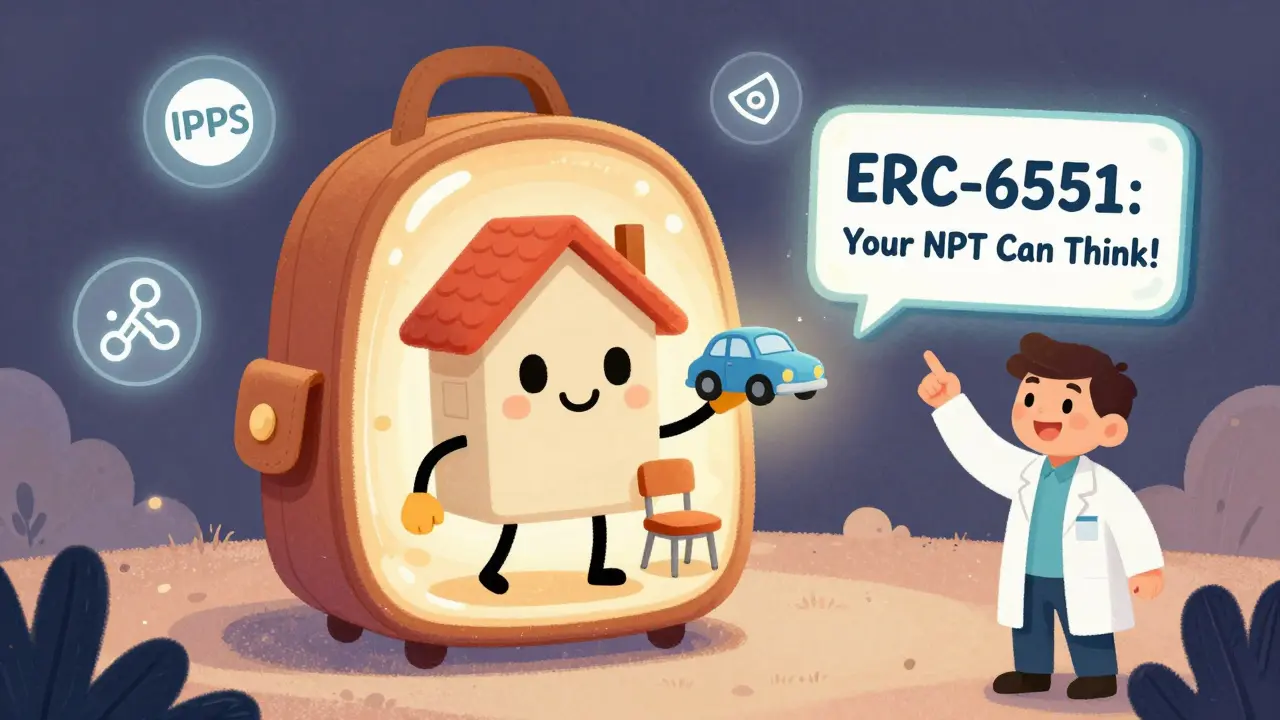
Enter ERC-6551, proposed in January 2023 and rolling out in late 2023. This isn’t just another standard - it’s a paradigm shift. ERC-6551 lets each NFT have its own wallet. That means your NFT can hold other NFTs, tokens, or even interact with smart contracts on its own.
Imagine a virtual land NFT that owns a car NFT, a furniture NFT, and a membership NFT. All of them live inside the land. You don’t need to manage them separately. The land NFT does it for you.
That’s huge for games, metaverses, and digital identities. Your NFT isn’t just a picture anymore - it’s a container. A digital person. A mini-account.
And then there’s EIP-6454, released in May 2023. It lets you prove you own an NFT without transferring it. No more sending a token to verify access. You just sign a message. OpenSea and Rarible already use it for member-only spaces and gated content.
Who Uses What - And Why
It’s not about which standard is “better.” It’s about fit.
| Standard | Best For | Cost per Transfer | Batch Support | Security |
|---|---|---|---|---|
| ERC-721 | Digital art, collectibles, high-value items | $1.42 (Ethereum, 2023) | No | High (Ethereum mainnet) |
| ERC-1155 | Gaming, utility tokens, in-game items | $0.15 (for 10 items) | Yes | High |
| Solana NFT | High-volume, low-value NFTs, social tokens | $0.00025 | Yes | Moderate (network stability issues) |
Over 78% of NFT volume in 2022 came from Ethereum - mostly ERC-721 for art, ERC-1155 for gaming. Solana handled 15% - mostly low-cost, high-volume sales. Enterprise use? 48% of Fortune 500 companies tested NFTs in 2023. Most used ERC-1155 for loyalty programs and digital memberships.
What Developers Need to Know
If you’re building an NFT project in 2025:
- Use OpenZeppelin’s contracts. They’re battle-tested.
- For art: stick with ERC-721. It’s the gold standard.
- For games or apps with many items: use ERC-1155. Save gas. Scale easily.
- Pin metadata to IPFS or Filecoin’s NFT Storage. Don’t rely on centralized servers.
- Use Hardhat for development. It’s the most popular tool for new projects.
- Learn ERC-6551. It’s not mainstream yet - but it will be.
Beginners need 40-60 hours to build their first ERC-721 contract. Experts? 8-12 hours. The learning curve is steep, but the tools are better than ever. The Ethereum NFT Developers Discord has over 48,000 members. There’s help.
The Future: Standards as Infrastructure
Five years ago, NFTs were a curiosity. Today, they’re part of how we prove ownership online. The standards behind them - ERC-721, ERC-1155, ERC-6551 - are becoming as essential as HTTP for websites.
By 2030, JP Morgan predicts 80% of digital assets will use token standards. That includes music rights, real estate deeds, academic certificates, even your digital passport.
But it’s not perfect. The Bank for International Settlements warns: without regulation, NFTs can’t be trusted in finance. Environmental concerns? Ethereum’s Merge in 2022 cut energy use by 99.95%. That’s a win.
The evolution isn’t over. New standards will come. Cross-chain bridges will improve. Decentralized identity will tie NFTs to your real-world credentials.
What started with a pixelated octagon is now a foundation for digital ownership. The next NFT won’t just be owned. It will act. It will remember. It will belong to you - and only you - forever.
What’s the difference between ERC-721 and ERC-1155?
ERC-721 is for one-of-a-kind tokens - like a unique piece of art. Each token is its own contract entry. ERC-1155 lets you manage multiple types of tokens - both unique and identical - in one contract. That means you can send 10 different NFTs in one transaction, saving 90% on gas. ERC-721 is simpler and widely supported. ERC-1155 is more efficient and better for games or apps with many items.
Why do some NFTs lose their images?
Most NFTs store their image and metadata off-chain - usually on a server or IPFS. If the server shuts down or the link breaks, the image disappears. That’s happened to over 12% of NFT collections. To avoid this, use permanent storage like Filecoin’s NFT Storage or Arweave. Never rely on a company’s website to host your NFT’s data.
Is Solana better than Ethereum for NFTs?
It depends. Solana is faster and cheaper - perfect for high-volume, low-value NFTs like memes or social tokens. Ethereum is slower and pricier, but far more secure and decentralized. If you’re selling a $10,000 digital artwork, Ethereum’s reputation and security matter. If you’re selling 10,000 $2 collectibles, Solana’s low cost wins. Neither is universally better.
What is ERC-6551 and why does it matter?
ERC-6551 lets each NFT have its own wallet. Instead of just being a picture, your NFT can now hold other tokens, NFTs, or even interact with apps. Imagine a virtual land NFT that owns a car, a chair, and a membership card - all inside it. This turns NFTs from static images into active digital entities. It’s the biggest leap since ERC-721.
Can I still use ERC-721 in 2025?
Absolutely. ERC-721 is still the standard for high-value digital art, collectibles, and provenance-heavy use cases. Over 87% of Ethereum NFTs still use it. It’s not outdated - it’s foundational. The difference is that now you have better options. Use ERC-721 for uniqueness. Use ERC-1155 for efficiency. Use both when needed.
How do I avoid losing my NFTs?
First, always use a secure wallet like MetaMask or Phantom - never leave NFTs on exchanges. Second, verify that your NFT’s metadata is stored permanently on IPFS or Arweave. Third, keep your private keys safe - no one else should have them. And finally, avoid projects that don’t open-source their contracts. If you can’t see the code, you can’t trust it.