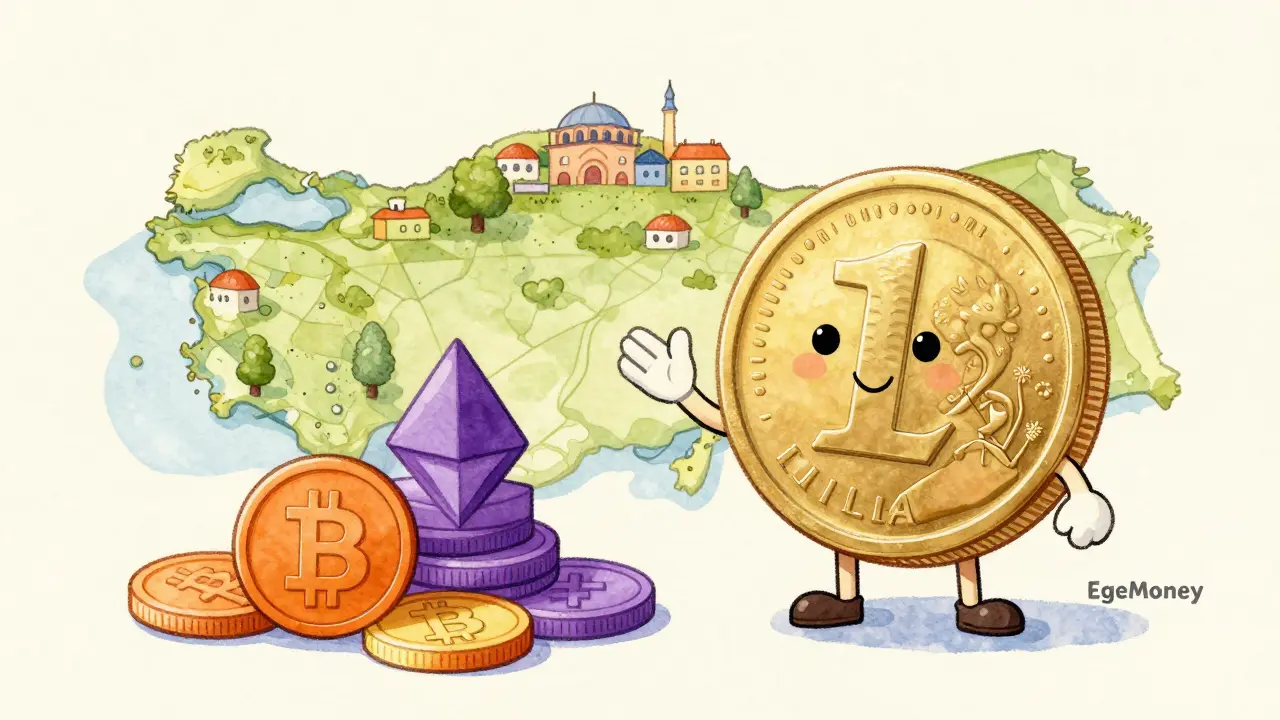
Buying Bitcoin with your Turkish Lira is getting easier every day, but finding a platform that also lets you invest in real estate without buying a whole house? That’s rare. Enter EgeMoney, a Turkish cryptocurrency exchange launched in 2022 that combines standard crypto trading with fractional real estate investments via NFTs. If you’ve been scrolling through app stores or hearing whispers on Telegram groups about this Istanbul-based platform, you’re probably asking the same question: is it legit?
I’ve spent weeks digging into their whitepaper, testing the mobile interface, and cross-referencing user reports from Reddit and Trustpilot. Here’s the honest truth about what works, what doesn’t, and whether EgeMoney deserves a spot in your portfolio.
The Core Promise: Crypto Meets Concrete
Most exchanges just want you to trade tokens. EgeMoney wants you to own assets. Their unique selling point isn’t just another spot trading pair; it’s their blockchain-based real estate investment model. They tokenize physical properties using Non-Fungible Tokens (NFTs) backed by government documentation. You buy a fraction of an apartment in Istanbul, and the rental income comes to you in USDT.
This approach targets two distinct crowds. First, there are the crypto natives who want stable, tangible assets instead of volatile meme coins. Second, there are traditional investors who find the entry price for Turkish real estate too high but want exposure to the market. By lowering that barrier, EgeMoney creates a niche that global giants like Binance simply don’t touch.
However, this innovation comes with complexity. The platform operates as a non-custodial exchange using Solidity smart contracts. For beginners, this means your assets aren’t held in a central bank-like vault controlled by the company. Instead, they live on the blockchain. While this offers security against internal theft, it requires users to understand wallet management and private keys better than they might on a fully centralized platform.
Security Architecture: Strong Foundations with a Caveat
Security is the first thing I check on any exchange. EgeMoney builds its trust on six critical technical features outlined in their November 2024 whitepaper. They use ERC-1155 standards for efficient multi-asset NFT management and ERC-20 for token supply. More importantly, they implement upgradable contracts, allowing them to fix bugs without redeploying the entire system-a huge plus for long-term stability.
They also require multiple signatures for critical contract transactions and enforce strict conditions to prevent invalid states. But here is where you need to pay attention: their "self-destruct" capability. The whitepaper admits that if necessary, they can delete a contract. While intended as an emergency measure, blockchain experts at CertiK noted concerns. If access controls were ever compromised, this function could theoretically be exploited. It’s a double-edged sword common in some DeFi protocols, but something to keep in mind before locking up large sums.
For everyday users, the practical side of security looks decent. The KYC process is fully automated, with 92% of Turkish ID verifications completed within 12 hours. This speed suggests robust backend integration with local identity systems, reducing the risk of manual error or fraud during onboarding.
Fees, Liquidity, and Trading Experience
Let’s talk money. How much does it cost to trade? EgeMoney claims "low" and "competitive" rates, but vague marketing language doesn’t help your bottom line. Based on aggregated user reports from Turkish crypto forums, maker fees average around 0.15%, while taker fees sit at 0.25%.
| Exchange | Taker Fee | Maker Fee | Best For |
|---|---|---|---|
| EgeMoney | 0.25% | 0.15% | TRY Pairs & Real Estate NFTs |
| Kraken | 0.16% | 0.10% | Global Low-Cost Trading |
| Paribu | 0.30% | 0.20% | Local Turkish Market |
These rates are slightly higher than global powerhouses like Kraken but lower than domestic rival Paribu. For casual traders, this difference is negligible. For high-frequency scalpers, however, those extra basis points add up quickly.
Liquidity is another story. EgeMoney focuses exclusively on TRY pairs. This gives them regional dominance for quick exits to Turkish banks, which is a massive advantage when you need cash fast. However, the selection of cryptocurrencies is limited to about 50 assets. Compare that to Binance’s 1,000+ options, and you’ll feel the constraint if you’re hunting for obscure altcoins. Stick to BTC, ETH, USDT, and BUSD, and you’ll be fine.

User Interface and Mobile Performance
You spend most of your time on the app, so let’s judge it there. The iOS version weighs in at 128MB, requiring iOS 13.0+, while Android needs 8.0+ and takes up 112MB. These are lightweight numbers, meaning the app loads fast even on older devices.
The interface splits cleanly between beginner tools and advanced charts. Beginners get the "Rapid Convert" feature for instant swaps and AI-based Elliott wave analysis-a neat touch for educational purposes. Advanced traders, however, will find the charting tools lacking. There are no sophisticated drawing instruments or custom indicator libraries compared to TradingView-integrated platforms.
Stability is a mixed bag. Google Play reviews show a 3.8-star rating out of 1,247 reviews. About 18% of negative complaints cite app crashes or lag during peak volatility periods. Customer support is another pain point. During business hours (9 AM-6 PM TRT), live chat responds in 15 minutes. Outside those hours? Expect waits of 24 to 72 hours. In a 24/7 crypto market, that silence can be stressful.
The Real Estate NFT Feature: Killer App or Gimmick?
This is the feature that sets EgeMoney apart. One verified user on Trustpilot documented a $15,000 purchase of a real estate NFT that generated an 8.2% annual yield through rental income, paid out in USDT. That’s a compelling return, especially compared to stagnant savings accounts.
But there are questions. As user "IstanbulInvestor" pointed out on Reddit, valuation metrics are opaque. How do you know the underlying property is priced fairly? Who conducts the appraisal? Without transparent, third-party audit trails for each property’s value, you’re trusting EgeMoney’s pricing model entirely. It’s a significant leap of faith for conservative investors.
Furthermore, liquidity for these NFTs is low. Unlike Bitcoin, which you can sell instantly, offloading a fractional real estate token might take days or weeks depending on buyer demand. Treat this feature as a long-term hold, not a quick flip.

Regulatory Landscape in Turkey
Operating in Turkey means navigating complex regulations. Since the 2023 Crypto Asset Decree, all exchanges must obtain licenses from the Banking Regulation and Supervision Agency (BDDK). EgeMoney claims compliance through partnerships with licensed financial institutions but lacks specific public documentation detailing these agreements. This ambiguity is a red flag for institutional investors but may pass for retail users focused on usability.
Competition is heating up. Global players like Bybit and Bitget are expanding their Turkish language support and TRY pairs. Meanwhile, local incumbents like Paribu hold 41% of the domestic market share. EgeMoney sits at an estimated 4-6%. To grow, they need to execute their roadmap flawlessly, including integrating with Turkey’s e-Government Gateway and expanding asset listings to 75+ by Q2 2025.
Who Should Use EgeMoney?
EgeMoney isn’t for everyone. If you’re a day trader needing deep order books, zero-latency execution, and hundreds of altcoin pairs, look elsewhere. Binance or Bybit will serve you better.
However, if you are a Turkish resident looking for a straightforward way to convert TRY to major cryptos with reasonable fees, EgeMoney is a solid choice. Even better, if you want diversification beyond crypto-specifically, exposure to Turkish real estate yields without the headache of property management-EgeMoney’s NFT marketplace offers a unique, albeit risky, opportunity. Just start small, verify the property details yourself, and never invest more than you can afford to lock away for years.
Is EgeMoney safe for storing large amounts of crypto?
EgeMoney uses non-custodial smart contracts with multiple signature requirements, which enhances security. However, the presence of a "self-destruct" function in their contracts poses a theoretical risk if access controls are compromised. For large holdings, consider using a hardware wallet and only keeping trading capital on the exchange.
How long does it take to withdraw funds to a Turkish bank account?
Withdrawal times vary based on volume. During normal periods, transfers can take 24 hours. However, user reports indicate delays up to 72 hours during high-volume market spikes. This is slower than some competitors like Paribu but acceptable for occasional withdrawals.
What are the trading fees on EgeMoney?
Based on user data, maker fees average 0.15% and taker fees average 0.25%. These rates are competitive within the Turkish market, sitting below local rivals like Paribu but slightly above global exchanges like Kraken.
Can I sell my real estate NFTs easily?
Liquidity for real estate NFTs is low compared to standard cryptocurrencies. Selling depends on finding a buyer willing to purchase the fraction at the current valuation. It should be treated as a long-term investment rather than a liquid asset for quick exits.
Does EgeMoney comply with Turkish regulations?
EgeMoney claims compliance with the 2023 Crypto Asset Decree through partnerships with licensed financial institutions. However, they do not publicly disclose specific BDDK license details, which remains a point of uncertainty for regulatory scrutiny.