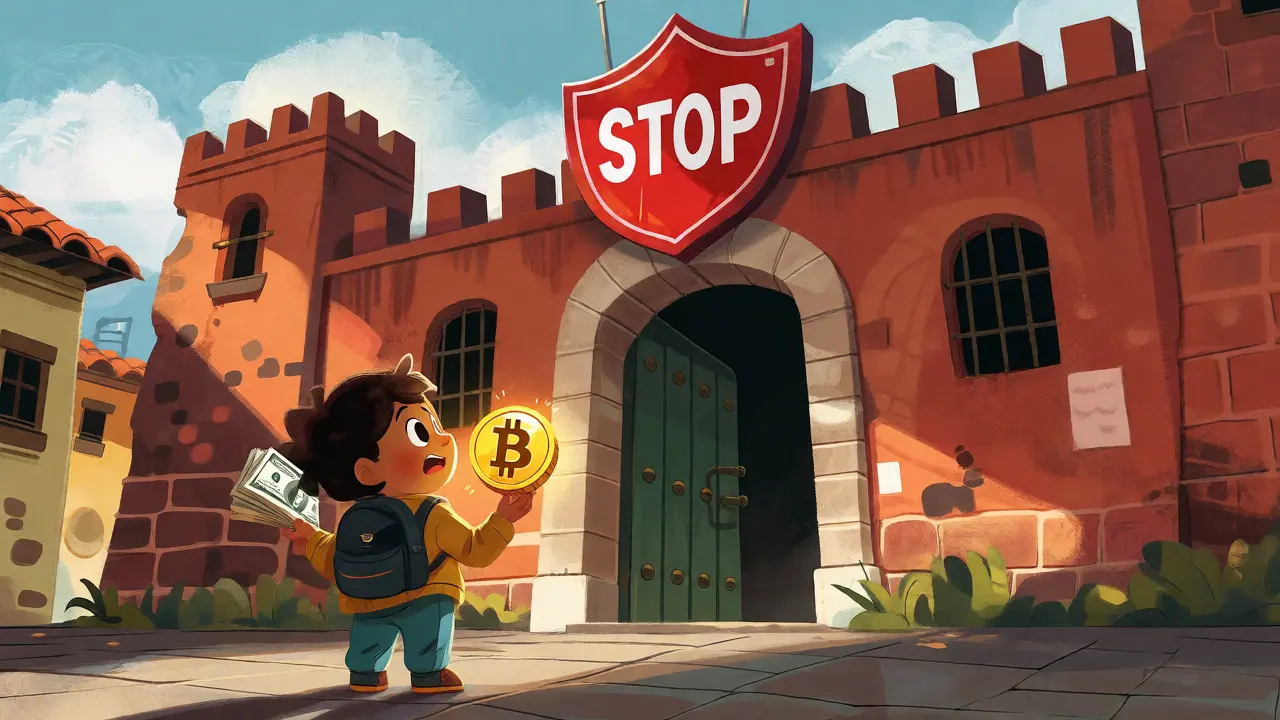
Imagine trying to buy a coffee with Bitcoin in Quito. You scan the code, your wallet shows the transaction pending, but the bank account linked to that merchant just got flagged. For millions of people, this isn't a hypothetical-it's daily life in Ecuador, where the government maintains a strict ban on banks processing cryptocurrency transactions. Since dollarizing its economy in 2000, Ecuador has treated digital assets with extreme caution. But here’s the twist: while banks are forbidden from touching crypto, regular citizens aren’t technically breaking the law by owning it. This creates a weird gray zone where you can trade peer-to-peer, but if you try to move that money through a traditional bank, you might face frozen accounts or blocked transfers.
If you live in Ecuador or plan to invest there, understanding these rules is crucial. You’re not dealing with a total prohibition like China’s mining ban, nor a full embrace like El Salvador’s legal tender status. Instead, Ecuador sits in a regulatory middle ground that prioritizes monetary stability over financial innovation. This article breaks down exactly what is banned, who enforces it, and how locals actually manage their digital assets without getting their bank accounts shut down.
Why Ecuador Blocks Banks from Crypto
To understand the ban, you have to look at Ecuador’s unique economic history. In 2000, the country abandoned its local currency, the Sucre, and adopted the US Dollar to stop hyperinflation. This process, known as dollarization, means the Central Bank of Ecuador (BCE) cannot print money or adjust interest rates independently. Their primary job is protecting the value of the dollar within the national system.
The logic behind the ban is straightforward: if banks start accepting cryptocurrencies, they introduce volatility into a system designed for absolute stability. A sudden crash in Bitcoin prices could theoretically destabilize bank balance sheets, threatening the entire dollarized economy. Consequently, the Monetary Code declares only the US dollar as legal tender. Any other asset, including Bitcoin or Ethereum, is considered a commodity, not money. Therefore, banks-which are regulated entities-are prohibited from facilitating trades or holding crypto assets on behalf of customers.
| Country | Banking Status | Legal Tender? | Primary Risk Concern |
|---|---|---|---|
| Ecuador | Banned for banks | No | Dollarization stability |
| El Salvador | Allowed | Yes | Volatility exposure |
| Brazil | Regulated/Licensed | No | Tax compliance |
| Argentina | Permitted | No | Inflation hedging |
Who Enforces the Rules?
It’s not just one agency cracking down. The enforcement structure involves multiple layers of government, each with specific responsibilities. At the top is the Junta de Política y Regulación Monetaria y Financiera (JPRM). This body issues resolutions that define what counts as a valid payment method. They’ve explicitly stated that cryptocurrencies do not qualify.
Then there’s the Superintendency of Banks (SB). Think of them as the police force for financial institutions. They maintain a public registry of unauthorized crypto service providers. As of mid-2025, they listed nearly 50 entities, including major exchanges like Binance and OKX. If a bank processes a transfer to one of these flagged platforms, the SB can impose fines. In 2024 alone, twelve financial institutions faced sanctions totaling $1.2 million for slipping up on these rules.
Meanwhile, the tax authority, the SRI (Internal Revenue Service), doesn’t care about the banking ban. They care about profits. If you make money trading crypto, even if you did it via a foreign app, you owe taxes. The SRI applies progressive income tax rates up to 35% for individuals. So, while you can’t use a bank to buy crypto easily, you absolutely must report your gains.

The Gray Area: Private Trading vs. Banking
This is where things get confusing for many users. The BCE Governor has clarified in congressional testimony that the state “has no power to ban” private individuals from trading cryptocurrencies. You can own Bitcoin. You can sell it to your neighbor. You can use offshore exchanges. The restriction is strictly on regulated financial entities.
However, moving fiat currency (USD) in and out of the banking system is the bottleneck. When you send money from your Ecuadorian bank account to an international exchange, the bank’s automated systems often flag it. These systems, updated with Version 3.1 of the Transaction Monitoring System, look for specific patterns associated with crypto exchanges. If the algorithm suspects a crypto-related transfer, it may freeze the funds for review. Users report freezes lasting anywhere from three days to two weeks. This friction discourages casual investors and pushes serious traders toward workarounds.
How Locals Actually Trade Crypto
Since direct banking integration is risky, Ecuadorians have developed creative methods to participate in the market. The most common approach is Peer-to-Peer (P2P) trading. Platforms like Binance P2P allow users to find local buyers and sellers. One person sends USD via a standard bank transfer (labeled as a generic payment), and the other releases the crypto.
Another popular tactic involves using stablecoins. Many users convert volatile assets like Bitcoin into USDT (Tether) before attempting any bank interaction. Because USDT is pegged to the dollar, some banks are less likely to flag transfers involving it compared to Bitcoin, though this is still a gamble. Approximately 74% of surveyed users reported converting to stablecoins first to reduce suspicion during bank transfers.
- P2P Marketplaces: Direct swaps between individuals, minimizing bank involvement.
- Offshore Accounts: Wealthier users often hold accounts in Panama or the US to bypass local banking filters.
- Cash Transactions: Physical cash meets physical crypto keys, completely avoiding the banking system.
- Gift Card Arbitrage: Buying gift cards with crypto and selling them for cash, accounting for about 22% of over-the-counter volume.

Impact on Businesses and Startups
For entrepreneurs, the ban creates significant hurdles. A tech startup in Quito cannot simply accept Bitcoin payments for services. Doing so violates the Monetary Code’s prohibition on non-dollar payments, carrying fines up to $50,000 per violation. This limits revenue streams and complicates accounting.
Furthermore, raising capital is tough. Venture capital flows into Ecuador’s blockchain sector were minimal in 2024-around $12.7 million-compared to hundreds of millions in neighboring Brazil. Investors hesitate because they know exit strategies are limited by the lack of local liquidity and banking support. While Bill 6538 proposes a licensing framework for exchanges, requiring minimum capital of $500,000, it hasn’t passed yet. Until then, businesses operate in uncertainty, relying on third-party processors that charge higher fees (3-5%) to handle crypto settlements.
Future Outlook: Will It Change?
Is the ban permanent? Probably not forever, but don’t expect a quick reversal. The Central Bank is currently testing a Central Bank Digital Currency (CBDC). This digital version of the dollar could offer the speed of crypto without the volatility. If successful, it might further marginalize private cryptocurrencies by providing a state-approved digital alternative.
However, pressure is mounting. With 42% of adults unbanked, many Ecuadorians see crypto as a tool for financial inclusion. Remittances, which make up a huge part of the economy, cost high fees through traditional channels. Blockchain offers cheaper alternatives. Experts predict that regulatory softening could happen by 2026 or 2027, driven by the need to modernize the financial system. But for now, the priority remains protecting the dollar.
Can I legally own Bitcoin in Ecuador?
Yes, private ownership is legal. The ban applies to banks and financial institutions processing transactions, not to individuals holding assets. However, you cannot use crypto as legal tender for paying goods and services.
Do I pay taxes on crypto gains in Ecuador?
Yes. The Internal Revenue Service (SRI) treats cryptocurrency gains as taxable income. Individuals face progressive tax rates up to 35%, and corporations pay 25%. You must declare these gains even if the trading happened on a foreign platform.
What happens if my bank freezes my account for crypto?
Banks may freeze accounts for 3 to 14 days while reviewing suspicious transactions. To resolve this, you usually need to provide proof that the transaction was not a commercial crypto service but a personal investment or P2P trade. Frequent violations can lead to stricter monitoring or closure.
Can businesses accept crypto payments?
Generally, no. Accepting crypto directly as payment for goods or services violates the Monetary Code, which mandates the US dollar as the sole legal tender. Violations can result in fines up to $50,000. Most businesses avoid direct acceptance to stay compliant.
Are there plans to change the regulations soon?
There is ongoing debate. Bill 6538 proposes a licensing framework for exchanges, but it faces legislative delays. Additionally, the Central Bank is exploring a CBDC. Significant changes are unlikely before 2026, given the strong political commitment to preserving dollarization.