
Have you stumbled upon Domitai, a platform claiming to be a secure cryptocurrency exchange offering offline storage and multi-factor encryption? You might have seen it listed on comparison sites like Slashdot or SourceForge, boasting about "Top Grade Security" and "Best Uptime." But here is the hard truth: after digging through every available record, regulatory database, and industry report, there is zero evidence that Domitai is a legitimate, operational business. In fact, the lack of basic information is a massive red flag that suggests this could be a non-operational site or, worse, a potential scam designed to steal your funds.
In the world of digital assets, trust isn't given; it's earned through transparency. When an exchange hides behind vague marketing slogans instead of providing concrete data, you need to stop and ask questions. This review breaks down exactly why Domitai fails the most basic checks for legitimacy and helps you understand what real security looks like so you can protect your capital.
The Silence of the Industry Giants
If Domitai were a real player in the crypto market, it would show up where it matters. Legitimate exchanges, even small ones, leave footprints. They are tracked by data aggregators, discussed by users, and regulated by authorities. Domitai has none of these.
First, check the major tracking platforms. CoinGecko and CoinMarketCap are the two largest databases for cryptocurrencies and exchanges. If a platform lists tokens or facilitates trading, it appears here. A search for Domitai returns nothing. No listing, no trading volume data, no token price history. For a platform claiming to exist, being invisible to the entire industry’s primary data sources is impossible unless it doesn’t actually trade anything.
Second, look at the regulatory landscape. Operating a crypto exchange requires licenses in almost every major jurisdiction. The U.S. Securities and Exchange Commission (SEC), the UK Financial Conduct Authority (FCA), and the Singapore Monetary Authority (MAS) all maintain public registers of licensed entities. There is no record of Domitai holding any such license. Without regulatory oversight, there is no recourse if things go wrong. Your money disappears into the void with no government body to help you recover it.
Vague Marketing vs. Real Security Proof
The few pages that mention Domitai use identical, templated language. Phrases like "offline storage," "constant transaction monitoring," and "multi-factor encryption" sound impressive until you realize they mean nothing without specifics. Any website can type those words. The question is: how do they implement them?
Let’s compare Domitai’s vague claims to what established leaders do. Take Coinbase. In their transparency reports, Coinbase explicitly states that 98% of customer assets are stored in cold storage (offline). They publish proof-of-reserves audits conducted by top-tier accounting firms like Baker Tilly. They detail their insurance coverage and incident response plans.
Now look at Domitai. Where are the audit reports? Who conducted the security scans? What percentage of assets are in cold wallets? Which insurance provider covers user losses? The answers are nowhere to be found. Instead, we get generic buzzwords. This is a classic tactic used by fraudulent sites to create an illusion of competence without doing the actual work.
Consider MEXC Global, another major exchange. They publicly partner with cybersecurity firms like Palmim and Knownsec for smart contract audits and penetration testing. They list these partnerships on their homepage because it builds trust. Domitai has no such partners. No third-party verification exists.
Red Flags That Scream Scam
When evaluating a new financial platform, certain patterns indicate danger. Domitai hits almost every negative marker known in the industry. Here is a checklist of the specific issues found during this investigation:
- No Team Information: Legitimate companies list their founders, CEOs, and technical leads with LinkedIn profiles. Domitai has no team page. Anonymous operators are a hallmark of rug pulls, where developers launch a project, collect deposits, and vanish.
- Identical Templated Content: The descriptions of Domitai appear on multiple comparison sites with the exact same wording. This suggests SEO-generated spam rather than genuine editorial coverage. Real reviews contain unique insights, user experiences, and critical analysis.
- Zero Community Presence: Go to Reddit, Twitter (X), or Trustpilot. Search for "Domitai." You will find no discussions, no complaints, no praise. Even struggling exchanges have angry customers posting online. Complete silence means no one is using it-or everyone who tried lost their money and moved on.
- Missing Fee Structure: Every exchange publishes its trading fees, withdrawal limits, and deposit methods. Domitai provides no pricing information. How can you trade if you don’t know the cost?
- Future-Dated References: Some comparison sites reference Domitai with dates in 2025 or later, which raises credibility concerns. Legitimate content reflects current reality, not hypothetical future timelines.
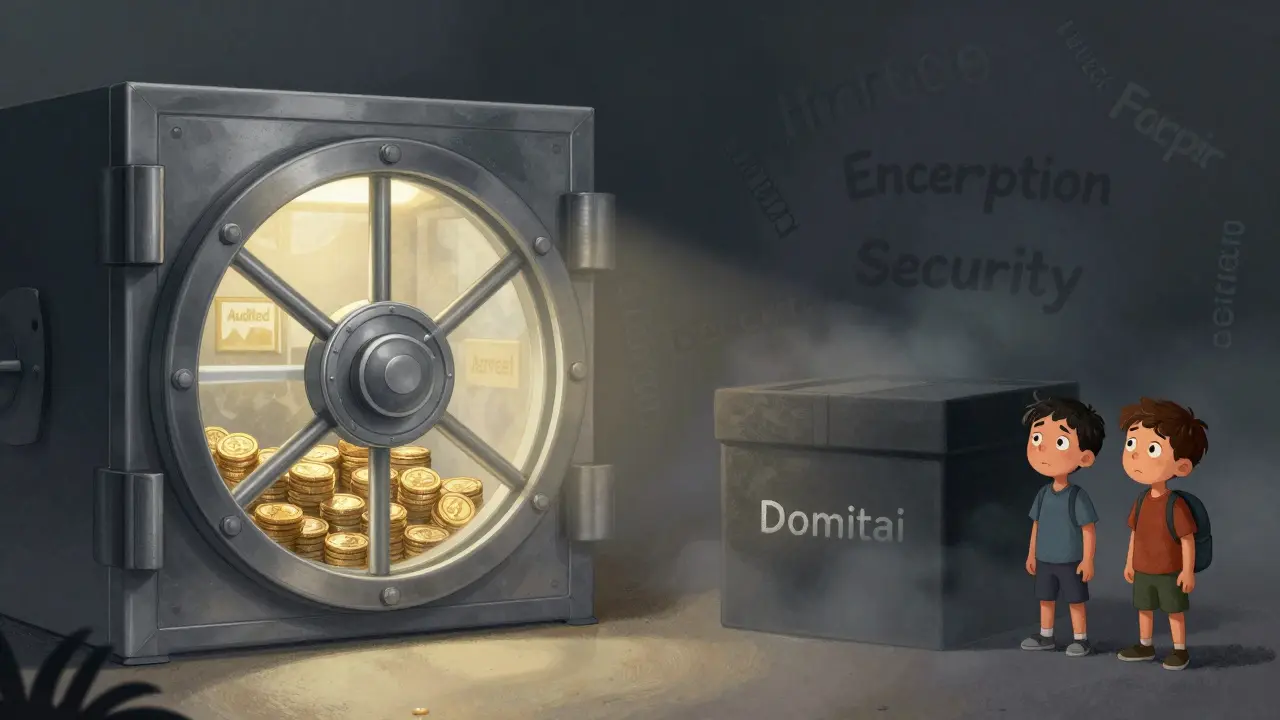
What Real Security Looks Like
To understand why Domitai’s claims are empty, you need to know what robust security entails. The industry standard involves a layered approach, often referred to as "defense in depth."
First is Cold Storage. This means keeping the majority of user funds in wallets disconnected from the internet. Hardware security modules (HSMs) are used to store private keys. Exchanges like Kraken and Binance regularly update users on their cold storage ratios.
Second is Multi-Signature (Multi-Sig) Wallets. These require multiple private keys to authorize a transaction. For example, a withdrawal might need approval from three out of five executives. This prevents a single compromised employee or hacker from draining funds. Domitai mentions "multi-factor encryption" but never specifies multi-sig protocols, which are the industry norm for fund protection.
Third is Regular Audits. Independent firms perform code reviews and security assessments. Reports from companies like Certik or SlowMist are published publicly. These audits identify vulnerabilities before hackers can exploit them. Domitai has no audit history.
Fourth is Proof of Reserves (PoR). Introduced widely after the collapse of FTX, PoR allows users to verify that the exchange holds enough assets to cover all user liabilities. It uses cryptographic Merkle trees to prove solvency without revealing individual balances. Domitai offers no PoR.
Comparison: Domitai vs. Established Exchanges
| Feature | Domitai | Coinbase / Kraken |
|---|---|---|
| Regulatory Licenses | None Found | Registered with SEC, FCA, MAS |
| Cold Storage Percentage | Not Disclosed | 98%+ (Publicly Verified) |
| Third-Party Audits | None | Annual SOC-2 & Penetration Tests |
| Team Visibility | Anonymous | Public Profiles & Backgrounds |
| User Reviews | None | Thousands on Trustpilot/Reddit |
| Insurance Coverage | Unverified Claims | Fidelity Bond & Asset Insurance |

How to Protect Yourself from Fake Exchanges
The rise of fake crypto platforms is a growing problem. Scammers create websites that look professional, buy ads, and list themselves on low-quality comparison directories to gain credibility. Here is how you can spot them before you lose money.
1. Check the Domain Age. Use tools like WHOIS to see when the website was registered. New domains (less than a year old) with big promises are risky. Legitimate exchanges have been around for years.
2. Verify Social Media Activity. Look for organic engagement. Do people ask questions and get answers? Or are the comments just bots saying "Great platform!"? Real communities have debates, support tickets, and news updates.
3. Demand Proof. If an exchange claims high security, ask for the audit link. If they claim regulation, ask for the license number. If they hesitate or provide broken links, walk away.
4. Start Small. If you must try a new platform, deposit only what you can afford to lose. Try to withdraw immediately. Many scams allow small deposits but block withdrawals once larger amounts are involved.
5. Use Hardware Wallets. Never keep long-term holdings on any exchange. Use a hardware wallet like Ledger or Trezor. You control the keys, not the platform.
Conclusion: Avoid Domitai
Based on the complete absence of regulatory records, independent audits, team information, and community feedback, Domitai does not meet the minimum standards for a trustworthy cryptocurrency exchange. The generic marketing claims found on comparison sites are insufficient to overcome the overwhelming lack of verifiable data. Engaging with unverified platforms poses a severe risk to your financial security. Stick to well-established, regulated exchanges that prioritize transparency and have a proven track record of protecting user assets.
Is Domitai a legitimate crypto exchange?
No. There is no verifiable evidence that Domitai is a legitimate, operational exchange. It lacks regulatory licenses, third-party security audits, and a visible team. Major data trackers like CoinGecko do not list it, which strongly suggests it is not a real trading platform.
Why is Domitai not on CoinMarketCap or CoinGecko?
CoinMarketCap and CoinGecko require strict verification processes, including proof of trading volume, regulatory compliance, and active development. Domitai fails to meet these criteria, indicating it likely has no real trading activity or transparent operations.
What are the red flags of a fake crypto exchange?
Key red flags include anonymous teams, vague security claims without proof, no regulatory licenses, absence of user reviews, and identical templated content across multiple websites. Additionally, if the domain is very new and there is no social media presence, it is likely a scam.
Can I recover my money if I deposited into Domitai?
Recovery is extremely difficult with unregulated entities. Since Domitai has no legal registration or known physical address, there is no regulatory body to file a complaint with. Always use reputable, insured exchanges to minimize this risk.
Which exchanges are considered safe alternatives?
Established exchanges like Coinbase, Kraken, Binance, and Bitstamp are widely regarded as safer options. They are regulated in multiple jurisdictions, publish regular proof-of-reserves, undergo third-party security audits, and have large, active user bases.


ravi mahla
June 21 2026Oh wow, another 'exchange' that pops up out of nowhere with zero trace. Classic move by the scammers these days. They just slap together a website, copy-paste some buzzwords like 'multi-factor encryption,' and hope you don't check CoinGecko. It's actually hilarious how they think people are this gullible in 2024. I mean, really? No team page? No audits? Just vibes?
I've seen this playbook before. They get you in with promises of high returns or 'top-grade security,' then once your money is in, good luck getting it out. The silence from Reddit and Twitter is deafening because there's literally no one to talk to. It's a ghost town designed to look like a bank. Save yourself the headache and stick to Coinbase or Kraken where at least you know who owns the place.