
Vietnam Crypto License Cost Calculator
This calculator helps you understand the scale of Vietnam's new $379 million capital requirement for licensed crypto exchanges compared to other countries.
Enter an amount to see how it compares to Vietnam's $379M requirement
How Vietnam Compares
Thailand: $13.7M capital requirement (less than 4% of Vietnam's requirement)
Singapore: $15M cap (varies by exchange type)
Indonesia: Similar VND-only transaction rules with 40% trading volume drop
On September 9, 2025, Vietnam’s government dropped a bombshell: Resolution No. 05/2025/NQ-CP - the country’s first-ever legal framework for cryptocurrency exchanges. It didn’t just clarify rules. It rewrote them. For millions of Vietnamese crypto users, this isn’t just policy. It’s a life-changing shift. And it’s not about banning crypto. It’s about controlling it - tightly.
What Exactly Is Directive 05/CT-TTg?
Officially called Resolution No. 05/2025/NQ-CP, this isn’t a suggestion. It’s a mandate. Signed by Deputy Prime Minister Ho Duc Phoc, it launches a five-year pilot program (2025-2030) that officially recognizes cryptocurrency as a regulated asset class in Vietnam. For the first time, exchanges must apply for a government license. No license? No operation. Period.
The Ministry of Finance is now the sole gatekeeper. They’ll decide who gets to run a crypto exchange in Vietnam. And they’ve set the bar so high, only a handful of players will survive.
The $379 Million Barrier
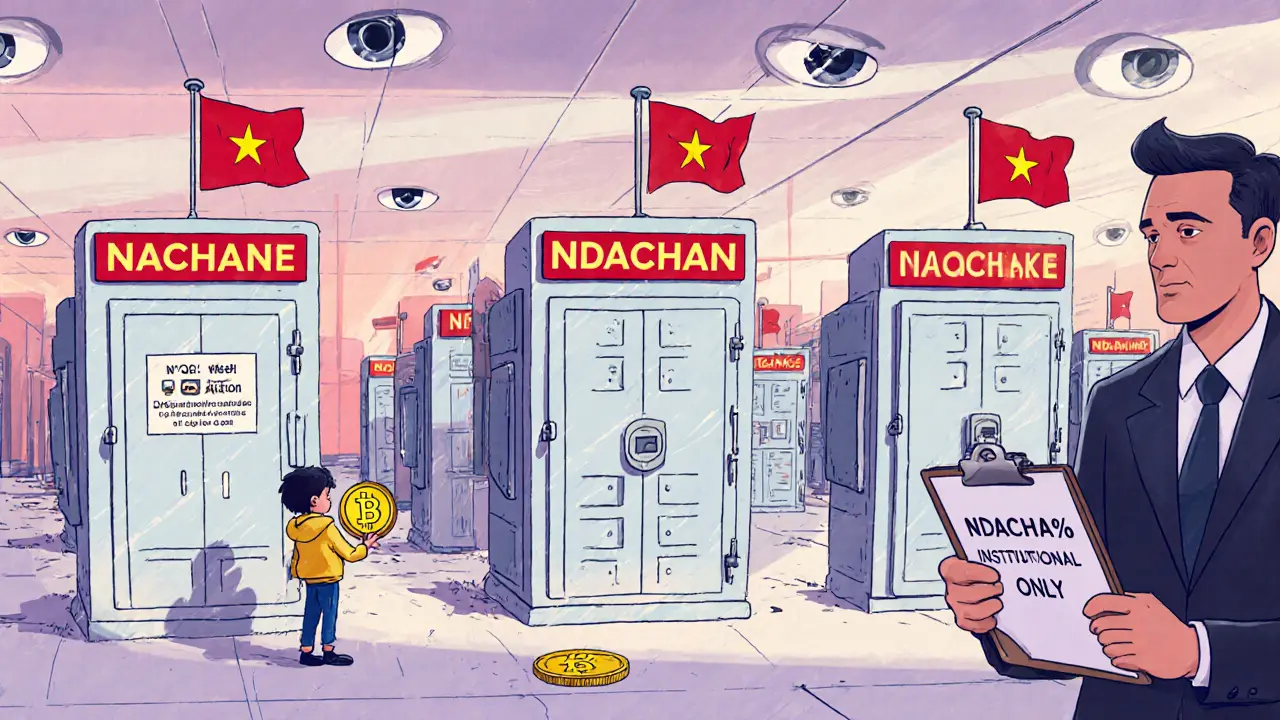
Here’s the number that’s shaking the industry: 10 trillion VND. That’s about $379 million. That’s the minimum charter capital any exchange must have to even apply for a license.
And it’s not just any money. At least 65% - or 6.5 trillion VND - must come from institutional investors. No retail investors. No crowdfunding. No small-time backers. This isn’t a startup-friendly policy. It’s a bank-and-corporate-only club.
Compare that to Thailand, where exchanges need just $13.7 million. Or Singapore, where capital requirements vary but rarely top $15 million. Vietnam’s requirement is nearly 28 times higher. That’s not regulation. That’s a wall.
Foreign Ownership? Capped at 49%
If you’re a foreign crypto company hoping to expand into Vietnam, here’s your reality: you can own no more than 49% of any licensed exchange. The rest must be Vietnamese-owned.
This isn’t about protecting local businesses. It’s about control. The government wants Vietnamese hands on the levers. It wants to make sure no foreign entity can pull the plug or move assets out without approval.
That’s stricter than Singapore, which lets foreign firms operate freely. It’s looser than China, which banned exchanges entirely. But it’s still a major turnoff for global players like Binance or Coinbase, who’ve built their business on international scaling.
No USDT. No USDC. No Fiat-Backed Stablecoins
One of the most surprising restrictions? Vietnam bans crypto assets backed by fiat currencies - meaning no USDT, no USDC, no BUSD. Not even a single token pegged to the dollar, euro, or yen.
Why? The government fears capital flight. If people can trade stablecoins, they can easily move money out of Vietnam without triggering banking alerts. So they cut off the most popular tool in global crypto.
Here’s the impact: 73.2% of global stablecoin volume is tied to fiat-backed tokens. In Vietnam, stablecoins made up 63.8% of all crypto transactions in 2025. That’s not a small slice. That’s the entire pie.
Now, exchanges have to build alternatives - maybe asset-backed tokens tied to real estate, commodities, or Vietnamese government bonds. But no one has done this at scale. No one knows how it’ll work.
Transactions in VND Only
Forget USD, EUR, or even Bitcoin for payments. All trades on licensed exchanges must happen in Vietnamese dong (VND). No exceptions.
This forces users to convert their crypto to VND before trading. It forces exchanges to hold massive VND reserves. It makes cross-border trading nearly impossible without going through banks - which means delays, fees, and paperwork.
Indonesia did something similar in 2023. The result? A 40% drop in daily trading volume. Vietnam might see the same.
Blockchain Must Be Vietnamese-Made
Every licensed exchange must use a blockchain that meets Vietnam’s National Cryptography Standard (TCVN 13057:2025). That’s not Bitcoin. Not Ethereum. Not Polygon.
It’s NDAChain - a government-developed blockchain launched in July 2025. It’s designed for traceability, not decentralization. Every transaction is logged, monitored, and stored under state control.
It’s not about security. It’s about surveillance. The State Bank of Vietnam now has real-time access to every trade, every wallet, every transfer on these platforms.
Who’s Getting Crushed?
Small exchanges are disappearing overnight.
One Reddit user, HanoiTrader88, runs a platform with $190,000 in capital and 5,000 users. He’s been profitable for two years. Now? He needs $378.8 million more. Or he shuts down.
There are an estimated 21 million crypto users in Vietnam. Most use small, unlicensed platforms. They like the low fees - 0.15% on average, compared to 0.25% globally. They like the fast sign-ups. They don’t care about regulation. They care about access.
But now, those platforms have six months after the first license is issued to comply. If they can’t raise $379 million? They vanish. And with them, millions of users.
Who’s Winning?
Big banks. State-linked funds. Wealthy families with deep pockets.
One Reddit user, SaigonVC, lost $455,000 in 2024 when a local exchange vanished. Now? He’s cheering. “Finally, some regulation,” he wrote. “No more scams.”
That’s the trade-off. Safety over freedom. Control over convenience.
Industry analysts say only 3 to 5 exchanges will qualify in the first year. They’ll serve maybe 5 million users - a quarter of today’s market. The rest? They’ll go offshore. Or stop trading.

The Human Cost
Trustpilot reviews for unlicensed exchanges show users love them - 4.2 stars out of 5. But they also complain about withdrawal delays. Average wait time? 18.7 hours. Global average? 4.3 hours.
Now, those delays will get worse. With mandatory integration into NDAChain and VND-only settlements, processing will slow. Banks aren’t built for crypto speed.
And what about taxes? The government says capital gains will be taxed at 0.1% for trades under 100 million VND ($3,800), and 0.3% above that. It sounds low. But for small traders? Every percentage point matters.
What Happens Next?
The Ministry of Finance says license applications open within 30 days. First licenses? Expected in 90 to 120 days after that.
But here’s the problem: they don’t have enough staff. The Crypto Asset Regulatory Department (CARD) has 45 people. Experts say they need 120 just to handle the workload.
Compliance costs? Between $1.9 million and $7.6 million per exchange. That’s not just capital. That’s legal teams, tech upgrades, audits, and system overhauls.
And if the pilot fails? The government can tweak the rules at 12, 24, or 36 months. Maybe the capital requirement drops. Maybe stablecoins get allowed. Maybe foreign ownership rises.
But for now? It’s a hardline stance.
Why Does This Matter Outside Vietnam?
Vietnam is the second-most crypto-adopted country in the world - after Ukraine. With 21.3 million users, it’s a market too big to ignore.
Its approach is a blueprint. Other countries watching: Indonesia, India, Brazil. All struggling with how to regulate crypto without killing innovation.
Vietnam chose control. Not ban. Not liberalization. Control.
If it works, other nations may copy it. If it fails - if users flee, if trading volume crashes, if innovation dies - it becomes a warning.
This isn’t just about Vietnam. It’s about the future of crypto regulation in emerging markets.
What Should You Do?
If you’re a Vietnamese user: Start preparing. If you’re on an unlicensed platform, expect it to disappear. Move your funds to a licensed one - when they launch. But know this: you’ll lose speed. You’ll lose flexibility. You’ll lose anonymity.
If you’re a trader outside Vietnam: Don’t expect easy access. No Binance, no Kraken, no Coinbase will get a license here anytime soon. If you want to trade crypto in Vietnam, you’ll need a local partner. And a lot of capital.
If you’re a developer or investor: Look at the gaps. Who’s building asset-backed tokens for VND? Who’s creating compliance tools for NDAChain? That’s where the real opportunity lies - not in trading, but in building the infrastructure the government didn’t plan for.
This isn’t the end of crypto in Vietnam. It’s the beginning of a new, tightly controlled version of it. And it’s going to be messy.
Is cryptocurrency illegal in Vietnam now?
No, cryptocurrency is not illegal. But operating a crypto exchange without a government license is. Individuals can still hold and trade crypto privately. However, all exchanges must now be licensed, and only those meeting strict capital and operational rules can legally operate.
Can I still use USDT in Vietnam?
No. Under Resolution No. 05/2025/NQ-CP, no crypto asset backed by fiat currencies - including USDT, USDC, or BUSD - is allowed on licensed exchanges. This ban affects over 60% of all crypto trading activity in Vietnam. Users must now trade using VND or non-fiat-backed tokens, which are still being developed.
How many crypto exchanges will be licensed in Vietnam?
Analysts estimate only 3 to 5 exchanges will qualify for licenses in the first year. The $379 million capital requirement is too high for most existing platforms. With only 21 million users in the market, this creates a near-monopoly for a few state-aligned or well-funded entities.
Can foreigners invest in Vietnamese crypto exchanges?
Yes, but only up to 49% ownership. Vietnamese entities must hold the majority stake. This rule blocks global exchanges like Binance or Coinbase from directly entering the market. Foreign investors can only participate through joint ventures with local partners who meet the capital and compliance requirements.
Will this regulation reduce crypto scams in Vietnam?
Yes, that’s the goal. In 2022, 15 unregulated Vietnamese crypto platforms collapsed, costing users over half a billion dollars. The new rules require high capital reserves, strict KYC/AML checks, and real-time monitoring by the State Bank of Vietnam. While this won’t eliminate fraud entirely, it makes it far harder for fly-by-night operators to survive.
What happens to users of unlicensed exchanges?
After the first license is issued, unlicensed exchanges have six months to comply or shut down. If they don’t, they risk being blocked by ISPs and payment processors. Users may lose access to their funds if the platform disappears. The government advises users to move to licensed platforms once they launch - but those platforms will be fewer, slower, and more expensive to use.
Are there tax implications for crypto trading under this new framework?
Yes. Capital gains from crypto trading will be taxed at 0.1% for transactions under 100 million VND ($3,800), and 0.3% for larger trades. Taxes will be automatically withheld by licensed exchanges. This is the first time Vietnam has formally taxed crypto profits, signaling full integration of crypto into the national financial system.
How does Vietnam’s crypto regulation compare to Thailand or Singapore?
Vietnam’s rules are far stricter. Thailand requires only $13.7 million in capital - less than 4% of Vietnam’s $379 million. Singapore allows foreign-owned exchanges and permits stablecoins. Vietnam bans both. While Thailand and Singapore aim to attract global crypto firms, Vietnam is building a closed, state-controlled system designed to prevent capital flight and ensure domestic control.


Bhoomika Agarwal
December 2 2025So Vietnam just turned crypto into a state-run lottery where only billionaires get to spin the wheel? 😂 10 trillion VND? That’s not regulation, that’s a middle finger to every small trader who believed in decentralization. Welcome to the new feudalism, where your coins are taxed, tracked, and tied to a government blockchain like a digital leash. #CryptoIsDeadLongLiveTheState