
Taiwan Crypto VAT Calculator
Calculate Your Crypto VAT
Determine if you need to pay 5% VAT on cryptocurrency sales based on Taiwan's current regulations. This tool calculates your liability based on the NT$40,000 monthly threshold.
Based on Taiwan's current crypto tax regulations
Buying, selling, or trading cryptocurrency in Taiwan isn’t just a tech move-it’s a tax event. Even though Taiwan doesn’t treat Bitcoin or Ethereum as legal money, the government still wants its cut. If you’re trading crypto here, you’re likely subject to both cryptocurrency taxation and strict reporting rules. And things are changing fast.
How Taiwan Classifies Cryptocurrency
Taiwan doesn’t call crypto money. The Financial Supervisory Commission (FSC) labels it a "virtual commodity." That sounds harmless, but it triggers real tax consequences. Because it’s not currency, traditional banking rules don’t fully apply. But that doesn’t mean you’re off the hook. The Ministry of Finance (MOF) treats crypto trades like any other business transaction-when you sell, you owe tax.This classification matters because it determines whether you pay business tax (VAT), income tax, or both. It also affects how exchanges operate. If you’re using BitoPro, MaiCoin, or even Binance from Taiwan, your trades are tracked under the same rules as selling used electronics or handmade goods-except the value can swing 30% in a day.
Business Tax (VAT): The 5% Rule
If you’re trading crypto in Taiwan, you might owe a 5% value-added tax (VAT). This isn’t optional. The rule applies to anyone selling crypto, whether you’re a person or a company.Here’s how it breaks down:
- Taiwanese individuals: If your monthly crypto sales exceed NT$40,000 (about $1,300 USD), you must register as a business and pay 5% VAT on all sales above that threshold. Below NT$40,000? You’re exempt.
- Taiwanese businesses: All crypto sales, no matter the size, are subject to 5% VAT. There’s no small trader exemption here.
- Foreign sellers: If you’re based outside Taiwan but sell to Taiwanese individuals, you must register and pay 5% VAT-unless your monthly sales to locals stay under NT$40,000. If you only sell to Taiwanese companies, you don’t pay VAT; the buyer does.
Many people assume crypto is tax-free because it’s not "real money." That’s a dangerous myth. The MOF has made it clear: if you’re making money from crypto trades in Taiwan, you’re running a business-and businesses pay VAT.
Income Tax: The Bigger Burden
VAT is just the start. The real tax hit comes from income tax. When you sell crypto for more than you paid, that profit is treated as income. Taiwan taxes personal income at progressive rates, but for most crypto traders, the effective rate lands around 20%.Here’s the catch: you need to prove your cost basis. That means showing exactly how much you paid for each coin you sold. If you bought 0.5 BTC in 2021 for NT$1 million and sold it in 2025 for NT$5 million, your taxable gain is NT$4 million. But what if you bought it on a foreign exchange and never saved the receipt? What if you swapped ETH for SOL and then sold the SOL? The tax office doesn’t care about your memory-they want transaction records.
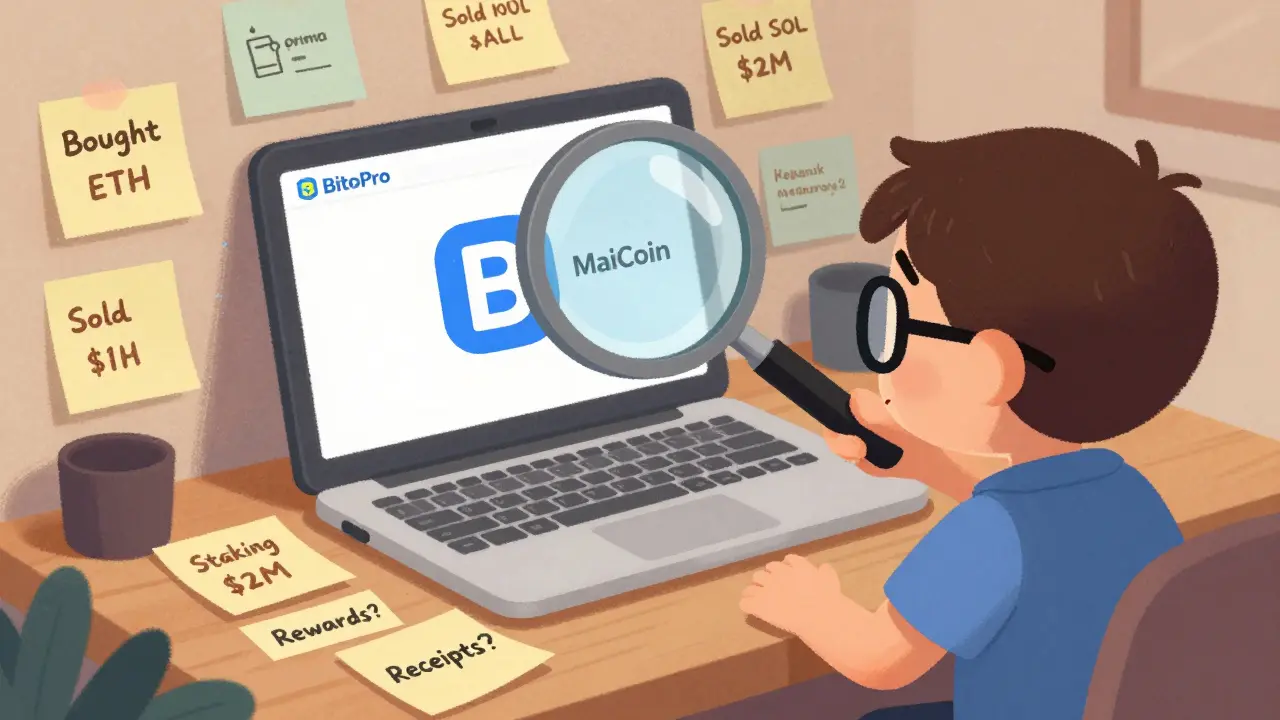
Most traders don’t keep detailed logs. That’s why audits are increasing. The FSC now requires all local exchanges to collect real-name data. BitoPro and MaiCoin are sharing transaction histories with tax authorities. If you can’t prove your purchase price, the tax office will assume your entire sale amount is profit-and tax you on it. That could mean paying tax on 100% of your sale, not just the gain.
What About Mining and Staking?
Mining crypto in Taiwan? Staking Ethereum or Solana? These activities are treated as income when you receive the coins. If you mine 0.1 BTC and it’s worth NT$50,000 when it hits your wallet, that NT$50,000 is taxable income. You’ll pay income tax on it at your marginal rate.Later, if you sell that BTC for more, you pay again-on the gain. Yes, that’s double taxation. No, there’s no relief for miners. The tax code hasn’t been updated to reflect how crypto works in practice. You’re taxed when you earn, and again when you cash out.
Staking rewards work the same way. If you earn 2 SOL from staking, and SOL is worth NT$8,000 at the time you receive it, you owe tax on NT$8,000. If you later sell it for NT$10,000, you pay tax on the NT$2,000 gain.
Exchanges and Compliance: Who’s Reporting to the Tax Office?
Taiwan has forced its crypto exchanges to become tax partners. Since July 2024, every Virtual Asset Service Provider (VASP) must register with the FSC and comply with anti-money laundering (AML) rules. That means they collect your ID, address, phone number, and full transaction history.There are 24 FSC-approved platforms in Taiwan, including:
- BitoPro - Local exchange with full compliance, supports NT$ deposits
- MaiCoin - Largest local platform, offers mobile wallets and tax-ready reporting
- Binance - International but widely used; now required to report Taiwanese users
These platforms are building tools to help users download transaction reports. Some even offer auto-generated tax summaries. But if you’re using a non-compliant exchange-like an offshore OTC desk or a peer-to-peer app-you’re flying blind. The tax office can’t get your data from them… but they can still audit you.
Legal Gray Areas and Court Cases
Taiwan’s tax system is still catching up to crypto. The law doesn’t clearly define whether crypto is property, commodity, or something else. That’s led to legal confusion.In one 2023 case, a business took Bitcoin as payment for services and was later prosecuted under the Banking Act for "illegal deposit-taking." The court ruled Bitcoin isn’t "funds" under the law, so the charge was dropped. But in another case, a different court upheld a similar charge. There’s no consistent legal standard.
This uncertainty doesn’t protect you. Tax authorities don’t wait for court rulings. They act based on what’s written: if you made money from crypto, you owe tax. Courts may eventually clarify the rules-but until then, you’re responsible for following the current interpretation.

What’s Changing in 2025?
On November 18, 2024, Taiwan’s Ministry of Finance announced it would review cryptocurrency tax rules. Why? Because prices surged after the U.S. election, and more people are trading. The current system-relying on old income tax laws and a 5% VAT-isn’t cutting it.Expect new rules soon. The MOF is waiting for all exchanges to fully implement real-name verification. Once that’s complete, they’ll likely require:
- Annual crypto income reporting
- Standardized cost-basis tracking
- Penalties for unreported gains
- Clear rules for DeFi, NFTs, and airdrops
This isn’t speculation. The FSC has already aligned its VASP rules with global standards from the Financial Action Task Force (FATF). Tax reform is the next step.
What Should You Do Now?
Don’t wait for the government to catch up. Here’s what to do today:- Track every transaction. Use a crypto tax tool like Koinly or CoinTracker. Record buys, sells, swaps, staking rewards, and fees.
- Save all receipts. Screenshots of transaction IDs, wallet addresses, and exchange confirmations are your proof.
- Register if you’re selling over NT$40,000/month. Go to the tax office and get a business registration number. Pay your 5% VAT.
- Report gains annually. Include crypto income in your personal income tax return. Don’t assume the exchange will report for you.
- Use only FSC-approved platforms. Avoid offshore exchanges if you want to stay compliant.
If you’re unsure, hire a local tax advisor who’s handled crypto cases before. Most accountants in Taiwan still don’t understand it-but a few do. Ask if they’ve filed a crypto tax return in the last year. If not, find someone who has.
Bottom Line
Cryptocurrency isn’t tax-free in Taiwan. It’s not illegal. It’s not unregulated. It’s just being taxed under rules written for a different era. The government is catching up-and they’re watching.If you’re trading crypto in Taiwan, you’re already in the system. The question isn’t whether you’ll be taxed-it’s whether you’ll be ready when they come knocking.
Do I have to pay tax if I only hold crypto and never sell?
No. Holding crypto without selling, swapping, or earning rewards doesn’t trigger a tax event in Taiwan. You only owe tax when you dispose of it-by selling, trading, or using it to buy goods or services.
Is there a capital gains tax rate for crypto in Taiwan?
Taiwan doesn’t have a separate capital gains tax. Instead, crypto profits are added to your total income and taxed at your personal income tax rate, which for most traders is around 20%. There’s no preferential rate for long-term holdings.
Can I use foreign exchanges like Binance to avoid taxes?
No. Even if you trade on Binance or another offshore platform, if you’re a resident of Taiwan and you make a profit, you still owe tax. The tax office is now receiving data from major exchanges, and they can cross-check your bank deposits. Avoiding local platforms doesn’t avoid tax-it just makes it harder to prove your cost basis.
What happens if I don’t report my crypto gains?
You risk an audit, back taxes, penalties, and interest. Taiwan’s tax authority has increased crypto enforcement since 2023. Penalties can reach 40% of the unpaid tax, plus interest charged retroactively. In extreme cases, unreported income can lead to criminal charges for tax evasion.
Are NFTs taxed the same as cryptocurrency?
Yes. NFTs are treated as virtual commodities under Taiwan’s tax rules. If you buy an NFT for NT$100,000 and sell it for NT$300,000, you owe income tax on the NT$200,000 gain. If you sell it as part of a business, you also owe 5% VAT if your sales exceed NT$40,000/month.
Do I need to report crypto received as a gift?
Receiving crypto as a gift isn’t taxable at the time of receipt. But if you later sell it, you owe tax on the gain. The cost basis is the original purchase price of the person who gave it to you. If you don’t know that price, the tax office may assume it’s zero-and tax you on the full sale amount.


samuel goodge
December 5 2025It’s fascinating-Taiwan’s approach to crypto as a "virtual commodity" is, in many ways, more coherent than the U.S.’s regulatory limbo. The 5% VAT threshold for individuals is pragmatic; it acknowledges small-scale activity without exempting the system from fiscal responsibility. But the double taxation on mining and staking? That’s archaic. If you’re taxed on receipt and again on disposal, you’re effectively penalizing liquidity. It’s like taxing the air you breathe, then taxing the oxygen you exhale. The law hasn’t evolved with the asset class-it’s still trying to shoehorn blockchain into 20th-century accounting frameworks.