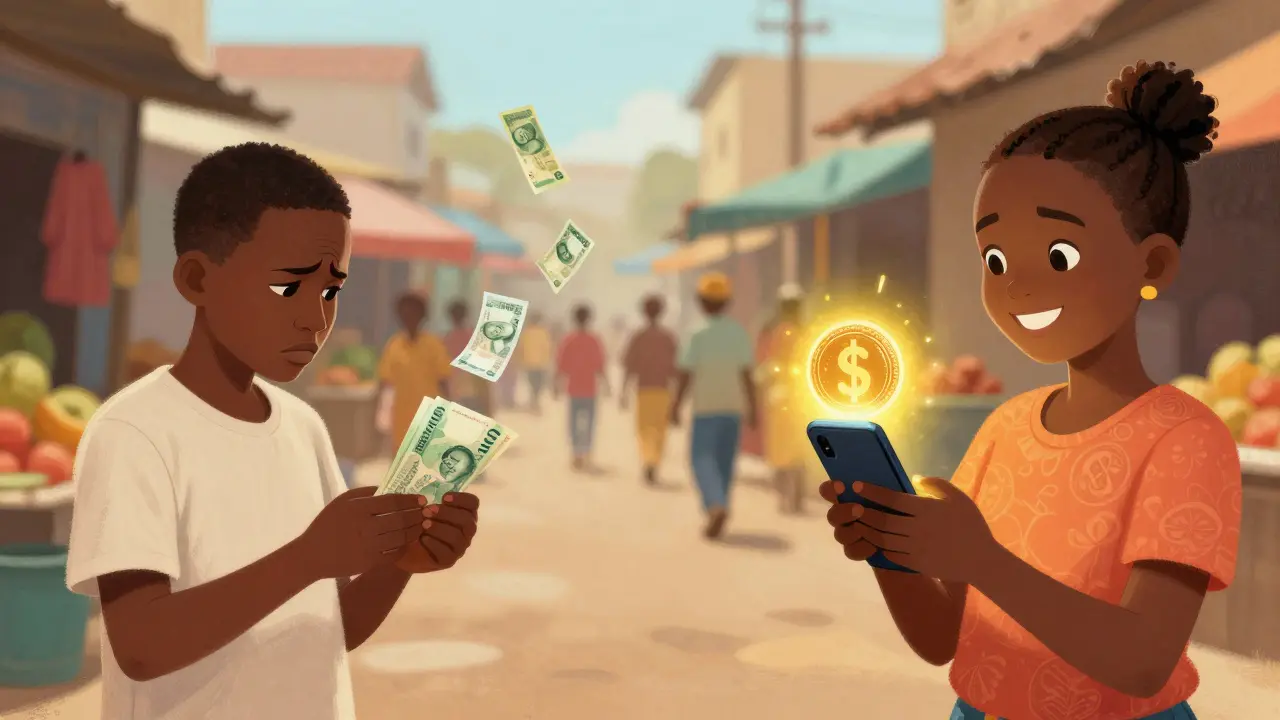
Imagine watching your life savings lose three-quarters of their value in a few years. For millions of Nigerians, this isn't a nightmare-it's a reality. When the Nigerian Naira plummets and inflation hits 24%, people don't just wait for the government to fix things; they find a way to survive. This economic desperation has turned Nigeria into one of the world's most aggressive hubs for Crypto adoption in Nigeria, moving from a niche hobby to a financial lifeline for over 22 million people.
The Quick Rundown: Nigeria's Crypto Landscape
- Global Rank: Nigeria consistently ranks in the top 2 globally for adoption.
- User Base: Approximately 10.3% of the population (22 million people) held crypto by 2025.
- Primary Drivers: Hyperinflation, currency devaluation, and a 36% unbanked adult population.
- Key Shift: Moving from risky P2P trades to regulated, institutional-grade financial tools.
Why Nigerians Are Choosing Crypto Over Banks
Traditional banking in Nigeria often feels like a closed club. With 36% of adults completely unbanked, the barriers to entry for a standard savings account are too high for many. Meanwhile, the macroeconomic instability has made the local currency an unreliable store of value. When the Naira loses value daily, holding a Stablecoin (a cryptocurrency pegged to the US Dollar) isn't about speculating on the next big moonshot; it's about making sure you can still afford groceries next month.
Then there is the issue of getting money from abroad. Traditional remittance channels are notoriously expensive, sometimes charging up to 8% per transaction. For a freelancer in Lagos working for a client in New York, waiting a week for a bank transfer and losing a chunk of the payment to fees is frustrating. Switching to blockchain allows these workers to receive payments almost instantly with minimal costs, bypassing the slow and expensive legacy systems.
Breaking Through the Restrictions: From P2P to Regulation
For years, the relationship between the Central Bank of Nigeria (CBN) and the crypto community was a game of cat and mouse. The government previously banned banks from servicing crypto businesses, which didn't actually stop the trading-it just pushed it underground. This led to the explosion of Peer-to-Peer (P2P) trading, where individuals trade directly with each other without a middleman bank.
Everything changed in late 2023 when the CBN lifted that ban. This regulatory pivot acknowledged a simple truth: you cannot stop a digitally native population from using a tool they've already integrated into their survival strategy. By allowing licensed exchanges to operate, the government shifted the market toward a more transparent, institutional-grade environment. This move significantly boosted investor confidence and paved the way for the massive transaction volumes we saw in 2025.
| Feature | Traditional Banking | Cryptocurrency |
|---|---|---|
| Accessibility | 36% of adults are unbanked | Requires only a smartphone & internet |
| Value Preservation | High risk due to Naira devaluation | Hedging via Stablecoins (USD-pegged) |
| Remittance Speed | Slow, multi-day processing | Near-instantaneous |
| Cost of Transfer | Up to 8% in fees | Minimal network fees |

The Institutional Leap: Blockchain Beyond Trading
Crypto in Nigeria is no longer just about buying and selling coins on an app. We are seeing a deep integration into the country's core financial plumbing. A prime example is the partnership between the Nigeria Inter-Bank Settlement System (NIBSS) and Zone's blockchain network in 2025. By using blockchain for interbank settlements, the system is faster, more transparent, and far less prone to the fraud that plagued older systems.
The rise of local fintech giants has also played a role. Moniepoint recently hit unicorn status with a $1 billion valuation, proving that digital payment innovation is a massive growth engine in the region. These companies are creating the infrastructure that makes it easier for the average person to move between traditional money and digital assets without needing a degree in computer science.
Real-World Use Cases: How Nigerians Actually Use Crypto
If you browse Nigerian Telegram groups or Reddit forums, you'll see that the use of crypto is highly pragmatic. It's rarely about "HODLing" a random meme coin and more about practical utility:
- Inflation Hedging: Moving Naira into USD-pegged assets during periods of sudden devaluation to freeze the value of their wealth.
- Remote Work Payments: Freelancers receiving payments in stablecoins to avoid the high fees and delays of SWIFT transfers.
- Micro-Transactions: In Sub-Saharan Africa, a huge portion of transactions are under $10,000, highlighting a retail-driven market rather than one dominated by a few "whales."
- Cross-Border Trade: Small business owners importing goods from China or the US often use crypto to settle payments quickly without waiting for government approval for foreign exchange.

The Learning Curve and Community Support
Getting started isn't as scary as it used to be. For a technically literate Nigerian, the learning curve for basic trading usually takes about two to four weeks. Most users start with a P2P Platform like Binance, where they can swap Naira for crypto via bank transfers. From there, they move toward understanding private keys and digital wallets.
The real secret to Nigeria's success is the community. Because official documentation can be dense, a massive network of WhatsApp and Telegram groups has emerged. Experienced users act as unofficial mentors, teaching newcomers how to avoid scams and navigate exchange interfaces. This grassroots education system has scaled faster than any formal government program ever could.
What the Future Holds for Nigeria's Digital Economy
Looking ahead, the trajectory is clear: Nigeria will remain a global leader in crypto adoption, but the nature of that adoption will change. We are moving away from the "wild west" era of avoiding restrictions and toward a structured ecosystem where blockchain is a standard layer of the economy. Whether it's through the potential implementation of a Central Bank Digital Currency (CBDC) or further integration of blockchain into the NIBSS, the goal is the same-financial inclusion.
The risk, of course, is regulatory volatility. If the government pivots back to strict bans, the market will simply move further underground. However, given the current economic pressures, the necessity for these tools is too strong for a ban to be effective. The long-term viability of crypto in Nigeria isn't based on hype; it's based on the fundamental need for a stable, accessible, and fast financial system.
Is cryptocurrency legal in Nigeria now?
Yes, as of late 2023, the Central Bank of Nigeria (CBN) lifted its previous ban on banks servicing crypto businesses. This means licensed cryptocurrency exchanges can now operate more openly and banks can facilitate transactions for these platforms, though users should always use regulated services to ensure safety.
Why is crypto adoption so high in Nigeria compared to other countries?
High adoption is driven by a combination of economic necessity and a young, tech-savvy population. Massive inflation of the Naira, high unemployment among youth, and limited access to traditional banking (with 36% of adults unbanked) make cryptocurrency an attractive alternative for saving and earning.
What are stablecoins and why are they popular in Nigeria?
Stablecoins are cryptocurrencies designed to have a stable value, usually pegged 1:1 to a fiat currency like the US Dollar. Nigerians use them as a hedge against the devaluation of the Naira, allowing them to preserve the purchasing power of their money without needing a foreign bank account.
How do Nigerians receive international payments using crypto?
Freelancers and remote workers typically use stablecoins. A client sends the payment to their digital wallet almost instantly. The user can then either keep the funds in USD-pegged coins to avoid inflation or sell them for Naira via P2P (Peer-to-Peer) platforms to spend locally.
What are the main risks of using crypto in Nigeria?
The primary risks include market volatility, the potential for scams on unregulated platforms, and regulatory uncertainty. While the current environment is more open, sudden policy changes by the government can impact how users access their funds through traditional banks.


Charlie Queen
April 23 2026This is such a fascinating look at how tech actually changes lives! 🌍 It's incredible to see people using stablecoins not for gambling but for literal survival and protecting their families. Really opens my eyes to the global struggle with inflation 📈✨