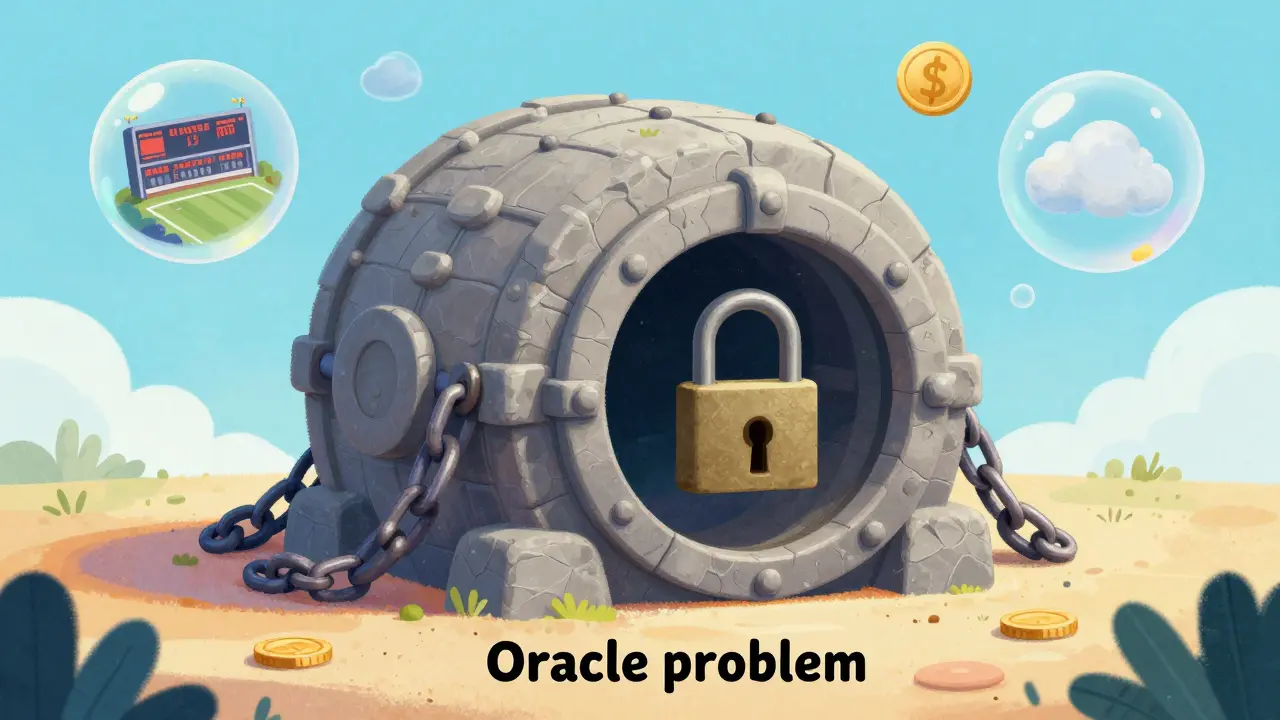
Imagine you've built a smart contract that automatically pays out a bet based on who wins the Super Bowl. The code is perfect, but there's one massive problem: the blockchain has no idea who won the game. Blockchains are like sealed vaults; they are incredibly secure internally, but they can't "look out" at the internet or a sports API to see the final score. This is known as the oracle problem. Without a way to get trusted data from the outside world, smart contracts are essentially blind.
This is where Chainlink Oracle Network is a decentralized oracle network (DON) that acts as a secure middleware layer, connecting blockchain-based smart contracts to external data sources, APIs, and off-chain systems. By bridging this gap, it allows blockchains to interact with the global economy without sacrificing the security that makes them valuable in the first place.
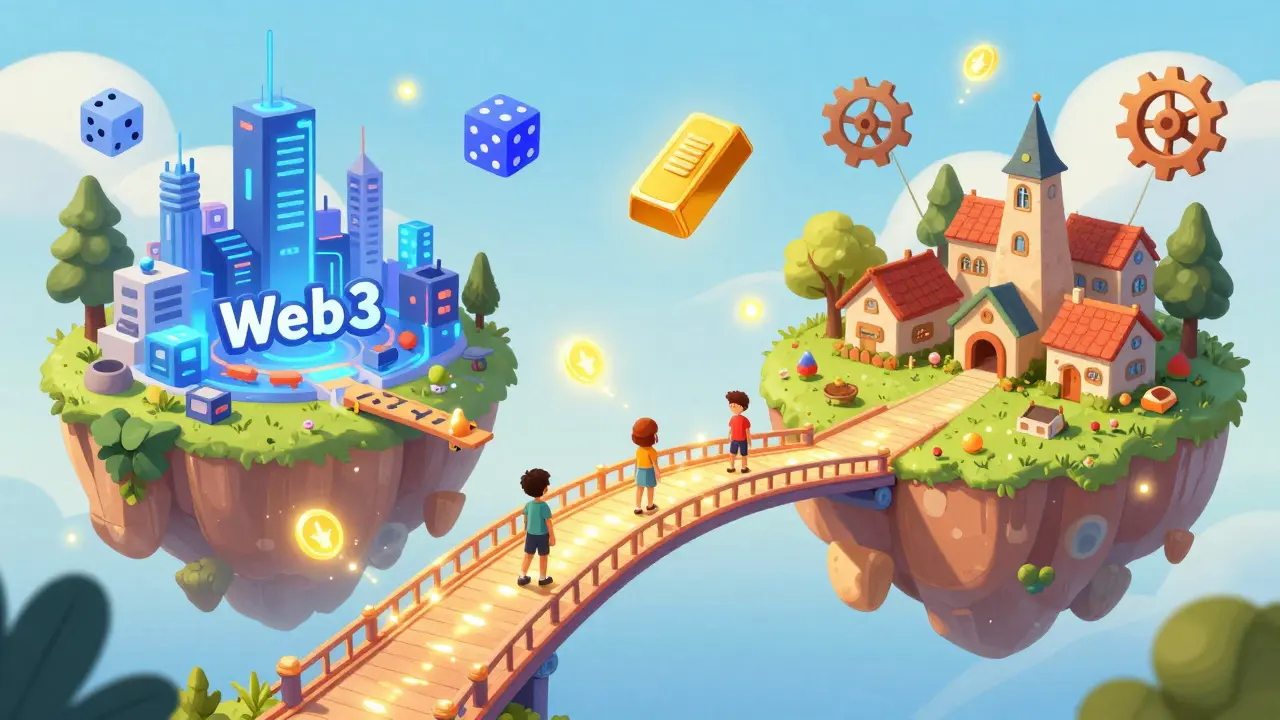
If you've ever used a DeFi app or a tokenized asset, you've likely interacted with Chainlink without even knowing it. It's the invisible glue holding the bridge between web2 and web3 together.
The Magic of Hybrid Smart Contracts
Most people think of smart contracts as purely on-chain scripts. However, the real power comes from Hybrid Smart Contracts contracts that combine on-chain code with off-chain data provided by decentralized oracles . This combination allows a contract to react to real-time events-like a temperature drop in a specific city or the current price of gold-and execute a transaction based on that truth.
Think of it like this: the smart contract is the "brain" and the oracle network is the "eyes and ears." For these to work, you need a system that doesn't rely on a single source of truth. If a smart contract relied on one single API and that API went down or was hacked, the contract would either freeze or execute based on false data. That's a disaster when billions of dollars are at stake.
How the Architecture Actually Works
Chainlink doesn't just use one "oracle"; it uses a multi-layered approach to decentralization. This eliminates the single point of failure that plagues centralized solutions. The system operates across three main levels:
- Data Source Level: Instead of one API, Chainlink pulls data from multiple independent sources.
- Node Operator Level: Multiple independent Chainlink Nodes specialized servers that run the Chainlink software to retrieve and verify external data retrieve that data.
- Network Level: The nodes reach a consensus on the data before sending it to the blockchain.
For example, in Chainlink Price Feeds the most widely used Chainlink service that provides reliable asset price data to DeFi protocols , the network aggregates prices from various exchanges. If one exchange reports a glitchy price, the other nodes filter it out. This is why DeFi giants like Aave and Compound trust Chainlink to secure tens of billions in assets; they know the price isn't being manipulated by a single faulty server.
| Feature | Centralized Oracle | Chainlink (Decentralized) |
|---|---|---|
| Reliability | Single point of failure | Multi-node redundancy |
| Trust Model | Trust the provider | Trust the consensus/math |
| Data Accuracy | Dependent on one API | Aggregated from multiple sources |
| Security | Easier to manipulate/hack | Cryptographically verified |

The Role of the LINK Token
You can't have a decentralized network without an incentive. The LINK Token an ERC-677 utility token used to pay node operators for providing reliable data is the fuel for the entire ecosystem. Node operators are essentially freelancers who provide a service. They are paid in LINK for delivering high-quality, verifiably honest data.
But it's not just about rewards. The system is designed to punish dishonesty. If a node operator provides bad data or goes offline frequently, their reputation suffers, and they lose the ability to earn LINK. This creates a self-corrective economy where the most reliable nodes win, and the unreliable ones are phased out.
Practical Use Cases: Beyond Just Price Feeds
While everyone talks about price feeds, Chainlink is doing much more for the blockchain ecosystem. Here are a few real-world applications:
- Provably Fair Gaming: Using Chainlink VRF Verifiable Random Function, a service that provides cryptographically secure random numbers to smart contracts , developers can create games where the outcome is truly random and cannot be manipulated by the game creator or a lucky player.
- Asset Tokenization: Through Proof of Reserve (PoR) a system that verifies the existence and amount of collateral backing a token in real-time , Chainlink ensures that stablecoins or gold-backed tokens actually have the assets they claim to hold in the real world.
- Enterprise IoT: Companies like Siemens have used Chainlink to bring industrial data into the blockchain, allowing automated payments to be triggered when a physical machine hits a certain production milestone.
Implementing Chainlink: The Developer Perspective
Integrating Chainlink isn't as simple as plugging in a USB drive. There is a learning curve, often taking a few weeks for developers to master. To get it running, you generally follow three steps:
- Deploy the Base Token: Use an ERC-20 or similar contract to handle the value.
- Build a Consumer Contract: You must write a custom smart contract that acts as the "client." This contract requests data from the oracle and tells it what to do with the result.
- Automate and Fund: You need to ensure your consumer contract has enough LINK tokens to pay the nodes. If the balance hits zero, your data stream stops.
A common pitfall for beginners is ignoring gas optimization. Since oracle requests involve on-chain transactions, making requests too frequently can eat through your budget. Most pros recommend using a "pull" model-where the contract only requests data when a specific trigger occurs-rather than a constant "push" of data.

The Road to Chainlink 2.0 and CCIP
The network is evolving. The move toward Chainlink 2.0 introduces the Cross-Chain Interoperability Protocol (CCIP) a communication standard that allows different blockchains to send messages and transfer tokens securely . This is a game-changer because it solves the fragmentation problem. Instead of having separate assets on Ethereum, Polygon, and Avalanche, CCIP allows them to "talk" to each other.
We're also seeing the rise of Chainlink Functions, which allow developers to make direct API calls without needing to build a custom oracle from scratch. This significantly lowers the barrier to entry and speeds up development time for new dApps.
What exactly is the 'oracle problem'?
The oracle problem is the conflict between the deterministic nature of blockchains (which cannot access external data) and the need for smart contracts to interact with real-world events. If a contract relies on a single external source for data, it introduces a point of failure that defeats the purpose of decentralization.
Do I need to hold LINK tokens to use Chainlink?
If you are a developer building a consumer contract, yes. You must fund your contract with LINK to pay the node operators who retrieve the data. If you are just a user of a DeFi app (like Aave), you don't need to hold LINK, as the protocol handles the payments in the background.
How secure is Chainlink compared to a standard API?
Much more secure. A standard API is a single point of failure. Chainlink uses a decentralized network of nodes that must agree on the data. It uses cryptographic proofs to ensure the data hasn't been tampered with between the source and the smart contract.
Can Chainlink be used for things other than price feeds?
Absolutely. It is used for Verifiable Randomness (VRF) in gaming, Proof of Reserve (PoR) for asset backing, and automating workflows via an external trigger (Chainlink Automation) to execute tasks at specific times or conditions.
What is the difference between Chainlink and API3?
The main difference is the node model. Chainlink uses third-party node operators who fetch data from APIs. API3 focuses on 'first-party' oracles, where the data providers themselves (the companies owning the API) run the nodes, potentially removing one layer of the middleman.
Next Steps and Troubleshooting
If you're a developer looking to start, don't try to build a custom node immediately. Start by using the Chainlink Price Feeds on a testnet like Sepolia. It's the easiest way to understand the request-response cycle without spending real money.
If you run into "Insufficient LINK" errors, check your consumer contract's balance. A common mistake is sending LINK to the developer wallet instead of the smart contract address itself. Also, if you notice data delays during high volatility, remember that Chainlink updates feeds based on specific thresholds (e.g., a price deviation of 0.5%) or time intervals-this is a feature to prevent network congestion, not a bug.


Surender Kumar
April 13 2026nice breakdown man. realy helps to understand how the bridge works between the real world and chain. keep it up!