
Imagine a world where you can cast your vote for president or a local mayor while sitting in your pajamas, knowing with 100% certainty that your ballot wasn't changed, deleted, or stolen. For years, the promise of blockchain voting is a decentralized method of electronic voting that uses distributed ledger technology to record and verify votes across multiple nodes has been touted as the ultimate fix for election fraud. But is it actually a security miracle, or just a high-tech illusion?
The Mechanics: How a Blockchain Ballot Actually Works
To understand if this works, we have to look under the hood. Unlike a traditional database where a central admin can theoretically edit a row, a blockchain is a chain of blocks linked by cryptographic hashes. In a voting scenario, each single vote is treated like a cryptocurrency transaction.
When you cast your vote, the system doesn't just save "Yes" or "No." It creates a transaction that includes a timestamp and your choice, then assigns it a unique identification number. Because of cryptographic hashing, each new block of votes is tied to the one before it. If a hacker tried to change a vote in block 10, it would break the link to block 11, alerting the entire network immediately. This is what experts call immutability.
The process usually follows these steps:
- Identity Verification: You register through an app and verify your citizenship using digital IDs.
- Credential Encryption: The system uses your public key to encrypt your identity on the network.
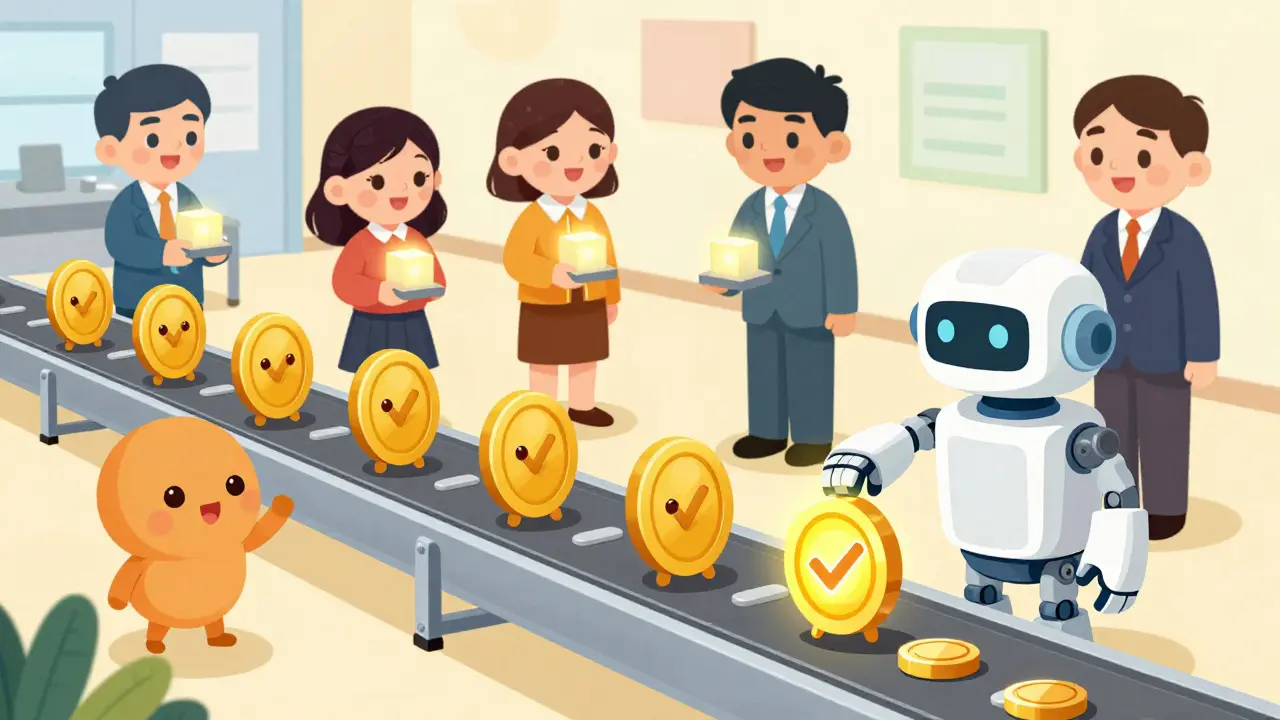
- Token Issuance: A single "ballot token" is dropped into your digital wallet. You can't vote twice because you only have one token.
- Casting the Vote: You send that token to the address representing your chosen candidate.
To handle the counting, developers use smart contracts. These are self-executing scripts that automatically tally the votes as they arrive. A project called BELEM, for example, uses these contracts to track and calculate totals in real-time, removing the need for human counters who could make mistakes or commit fraud.
Who Controls the Chain? Two Different Paths
Not all blockchain voting systems are built the same. Depending on who owns the hardware, you end up with two very different levels of trust.
First, there's the multi-owner chain. In this setup, several independent organizations-think universities, NGOs, and government agencies-all run nodes. They don't necessarily trust each other, but they trust the math. If one organization tries to cheat, the other peers will reject the fake data. This is the true spirit of decentralization.
Then there's the single-owner chain. This is more of a private ledger where one central agency maintains the infrastructure. While it's faster and easier to manage, it's basically just a fancy database. If the agency running the chain is compromised or corrupt, the "security" of the blockchain becomes irrelevant because the owner holds the keys to the kingdom.
| Feature | Multi-Owner Chain | Single-Owner Chain |
|---|---|---|
| Control | Distributed among peers | Central authority |
| Trust Model | Collective trust / Math-based | Trust in one organization |
| Tamper Resistance | Very High | Moderate (Owner can edit) |
| Speed | Slower (Requires consensus) | Faster |
The Upside: Why People Are Excited
If you ask a think tank like the Brookings Institution, they'll tell you that blockchain could fundamentally fix the "trust gap" in elections. The potential wins are huge: higher voter turnout because it's easier to vote, lower administrative costs, and a counting process that takes seconds instead of weeks.
The real draw here is end-to-end verification. In a traditional system, you drop a paper ballot in a box and hope for the best. With blockchain, you could theoretically use your transaction ID to verify that your vote was recorded correctly without revealing who you voted for. This level of transparency is a dream for election observers who are tired of arguing over whether a tally was rigged.
The Reality Check: Where it All Falls Apart
Here is where the honeymoon phase ends. Cybersecurity experts, including those at MIT's Digital Currency Initiative, argue that the blockchain part of the process is actually the easy part. The real danger happens before the vote hits the chain.
Think about it: your vote travels from your phone, through your internet provider, across various routers, and finally to the blockchain. If your phone has malware or your browser is hijacked, a hacker can change your vote before it ever becomes a "permanent" block. The blockchain will faithfully record a fake vote, and because it's immutable, you can't change it back.
Then there's the issue of Denial of Service (DoS) attacks. If a nation-state attacker decides to flood the voting network with garbage data, they can crash the system. Having 100 redundant servers doesn't help if the overall communication capacity is overwhelmed. MIT warns that this could lead to undetectable, nation-scale election failures-a nightmare scenario for any democracy.
David Jefferson from the U.S. Vote Foundation puts it bluntly: blockchain isn't a security strategy. It's a way to store data, but it doesn't protect the integrity* of the voter's device or the secrecy of the ballot during transmission.

Can We Actually Implement This?
Right now, the gap between theory and practice is a canyon. While we're seeing pilot programs for corporate boardrooms or small-scale local polls, national elections are a different beast. For a blockchain system to work for millions, every citizen would need a level of technical literacy that simply doesn't exist. Managing cryptographic keys is hard; imagine telling millions of seniors that if they lose their private key, they effectively lose their right to vote.
Interestingly, research from the University of Minnesota Morris suggests that hand-marked paper ballots are still the gold standard for security. Why? Because paper doesn't have "bugs," it can't be hacked from across the ocean, and it provides a physical audit trail that anyone can see. Blockchain might be great for a remote worker in a different time zone, but for the general public, the risks currently outweigh the rewards.
The Path Forward: Low Stakes First
We probably won't see a blockchain-based presidential election anytime soon. Instead, the technology will likely evolve in "low-stakes" environments. Think of company shareholder meetings, university student government votes, or local community polls. These environments allow developers to iron out the bugs without risking the stability of a national government.
The future depends on two things: better hardware-level security for our devices and a regulatory framework that defines what a "digital vote" actually means legally. Until we can guarantee that the device in your hand is secure, the most secure ledger in the world can't save a compromised election.
Is blockchain voting completely anonymous?
In theory, yes. These systems typically use public keys and encrypted credentials to separate the voter's identity from their specific choice. The ledger shows that "a valid voter" cast a vote, but it doesn't explicitly link your name to the candidate you chose.
Can a vote be changed once it is recorded on the blockchain?
No. One of the core features of blockchain is immutability. Once a vote is hashed and added to a block, changing it would require altering every subsequent block in the chain across a majority of the network's nodes, which is computationally nearly impossible in a well-secured network.
Why do experts still prefer paper ballots?
Paper ballots provide a physical, human-readable audit trail that is immune to cyber-attacks, software bugs, and large-scale electronic failures. Experts argue that the risk of a systemic digital failure is far more dangerous than the localized fraud associated with paper voting.
What is a "ballot token" in this context?
A ballot token is a unique digital asset issued to a verified voter's digital wallet. It acts as a "single-use ticket." Once the token is sent to a candidate's address, it is gone from the voter's wallet, preventing double-voting.
What are the biggest risks of online voting?
The primary risks include device-level malware (which can change a vote before it's sent), Denial of Service (DoS) attacks that can take the voting system offline, and the potential for disenfranchisement if voters struggle with the necessary technology.