
If you've ever tried to launch a digital asset project or trade tokens across borders, you probably realized that the rules change the moment you cross a digital frontier. One country might treat your token as a currency, while another views it as a security, and a third might not even have a law for it yet. This lack of harmony creates a massive headache for developers and investors alike, often leading to what experts call "regulatory arbitrage," where companies move their headquarters to jurisdictions with the friendliest rules.
Navigating a blockchain regulatory framework isn't just about staying out of legal trouble; it's about survival. When frameworks are fragmented, compliance costs skyrocket. For example, some reports suggest that businesses operating across multiple disjointed jurisdictions face compliance costs up to 22% higher than those in integrated systems. In the blockchain world, where speed is everything, an 18% slower market entry time due to red tape can mean the difference between being a market leader or a footnote.
The Big Divide: Horizontal vs. Sectoral Approaches
When we look at how different regions handle blockchain and digital assets, two main philosophies emerge. On one side, you have the "horizontal" approach, and on the other, the "sectoral" approach. Understanding this distinction is key to predicting how a country will actually treat your project.
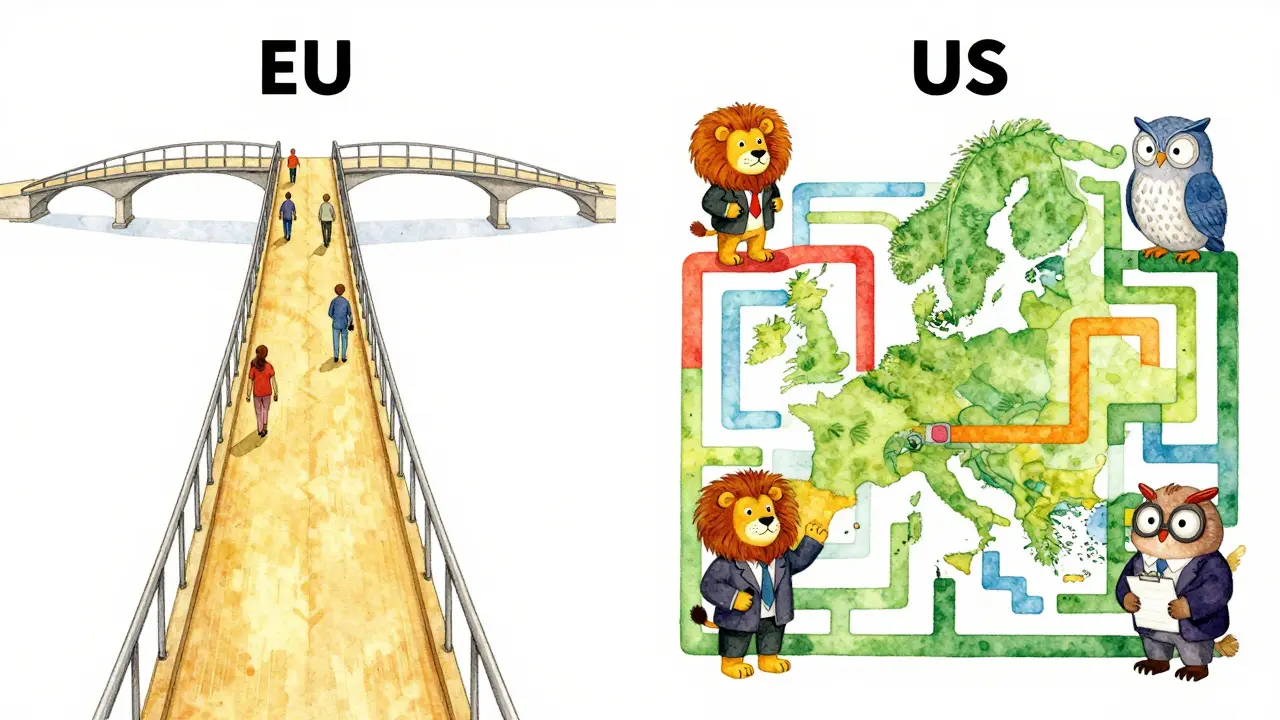
The European Union is the champion of horizontal regulation. Instead of having different rules for every single niche, they create broad frameworks that apply across the board. A prime example is MiCA (Markets in Crypto-Assets), which is a comprehensive set of rules designed to bring legal certainty to the entire EU market. By creating a single set of rules for 27 member states, the EU is trying to avoid the chaos of 27 different national approval processes.
Conversely, the United States typically sticks to a sectoral approach. They don't have one "Crypto Law." Instead, they apply existing laws from different agencies. You might deal with the SEC (Securities and Exchange Commission) if your token looks like an investment, or the CFTC (Commodity Futures Trading Commission) if it's treated as a commodity. While this allows for deep specialization, it creates a mess of jurisdictional overlaps. In fact, some legal scholars note that the US suffers from roughly 40% more jurisdictional overlaps between federal and state authorities than unitary systems do.
| Feature | EU (Horizontal/Integrated) | US (Sectoral/Fragmented) |
|---|---|---|
| Primary Goal | Market Harmonization | Investor Protection & Specialization |
| Key Entity | ESMA / MiCA | SEC / CFTC / FinCEN |
| Compliance Path | Single Framework (Unified) | Multiple Agencies (Overlapping) |
| Speed to Market | Slower initial entry, clearer path | Faster initial launch, higher legal risk |
Why Coordination Matters for Your Bottom Line
You might think a few extra forms don't matter, but the data shows that regulatory quality is directly tied to economic growth. According to World Bank data, countries with high regulatory quality see about 1.3% higher annual GDP growth than those with poor systems. Why? Because predictability attracts capital. When a founder knows exactly what the rules are, they invest. When the rules are a mystery, they hesitate.
Consider the operational burden. For a mid-sized firm, maintaining a dedicated regulatory intelligence team can cost anywhere from $350,000 to $750,000 annually. If you're a small business owner, it's even worse. Some entrepreneurs have reported spending hundreds of hours a year just navigating varying tax requirements across different states, costing them tens of thousands of dollars in professional fees. This is why RegTech (Regulatory Technology) has exploded into a multi-billion dollar industry. These tools automate compliance monitoring so that humans don't have to spend their entire lives reading government gazettes.
The Precautionary Principle vs. The Innovation First Mindset
There's a fundamental cultural difference in how regulators view risk. The EU often leans on the "precautionary principle." Essentially, they believe that if an action or policy has a suspected risk of causing harm, the burden of proof falls on those taking the action to prove it's safe. This leads to standards that can be 15-20% stricter than those in the US, especially regarding data privacy and consumer protection.
The US, while strict on securities, generally allows more room for "permissionless innovation" in the early stages. This creates a fascinating trade-off: the EU offers a more stable, long-term legal environment once you're approved, but the US offers a faster runway to get a product off the ground. However, the US approach often ends in "regulation by enforcement," where the government lets you build something and then sues you later to define what the law actually is.
Practical Steps for Global Compliance
If you're operating a blockchain business today, you can't just hope for the best. You need a concrete strategy to handle the global patchwork of laws. Here is a realistic roadmap for managing these complexities:
- Map Your Entities: Determine exactly what your asset is. Is it a payment token, a utility token, or a security? The answer changes which agency you answer to.
- Identify "Anchor" Jurisdictions: Instead of trying to be everywhere, pick a primary hub with a clear framework (like the EU under MiCA) and expand from there.
- Audit Your Data Flow: Regulations like GDPR in Europe affect how you handle on-chain data. Since blockchains are immutable, the "right to be forgotten" is a technical nightmare that requires specific architectural solutions.
- Invest in RegTech: Don't rely on a spreadsheet. Use automated tools for KYC (Know Your Customer) and AML (Anti-Money Laundering) to keep up with changing requirements in real-time.
The Future: Convergence or Chaos?
As we move toward 2030, we're seeing a strange mix of divergence and convergence. On one hand, the world is splitting on digital governance. Some countries want total control over their digital currencies (CBDCs), while others want a totally decentralized ecosystem. On the other hand, the economic cost of fragmentation is becoming too high to ignore. The OECD's effort to create common metrics for regulatory impact is a sign that countries realize that if they don't coordinate, they'll all lose business to a few "regulatory havens."
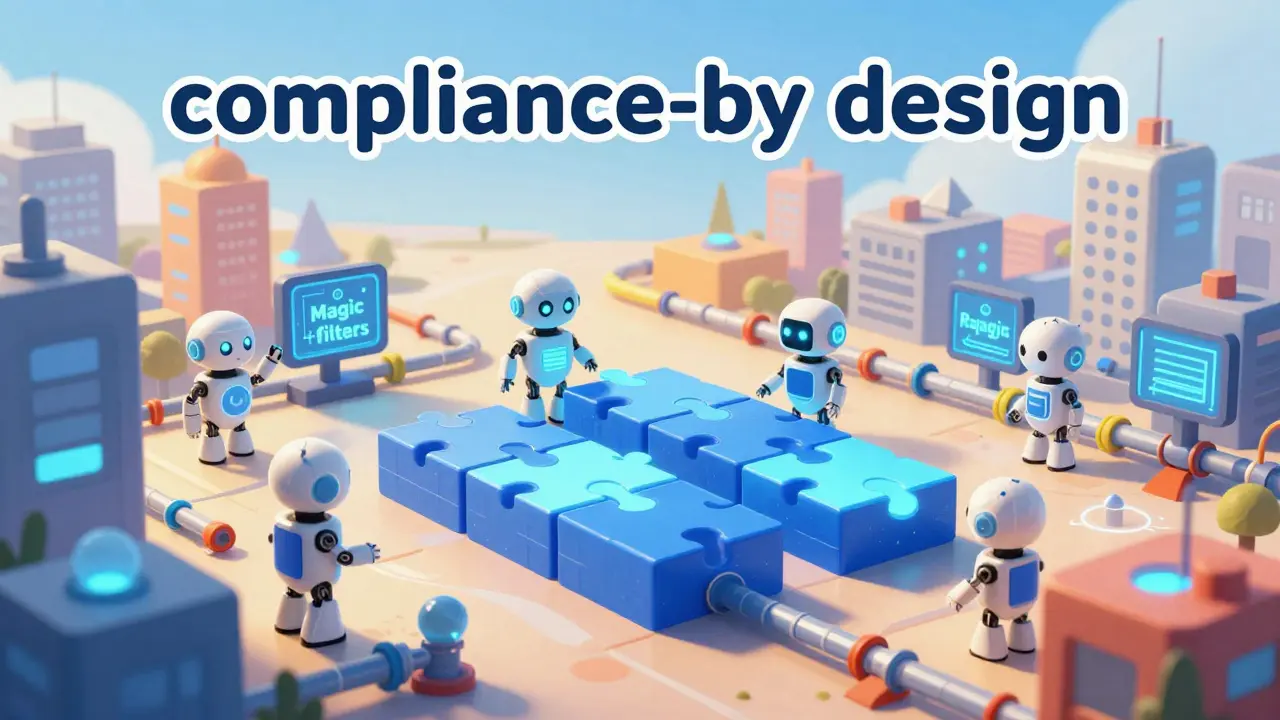
The real winners in the next few years will be the projects that build "compliance-by-design." Instead of treating regulation as a hurdle to jump over at the end, they are integrating these rules into the smart contracts themselves. Imagine a token that automatically restricts its own transferability based on the geographic location of the wallet-that's where the industry is heading.
What is the biggest difference between US and EU blockchain regulation?
The EU uses a horizontal approach via frameworks like MiCA, creating one set of rules for the whole region. The US uses a sectoral approach, where different agencies (SEC, CFTC) apply existing laws to crypto, often leading to overlapping and sometimes conflicting requirements.
Why does regulatory fragmentation increase costs for blockchain companies?
When rules differ by country, companies must hire separate legal teams for each region, adapt their technical architecture to meet various standards, and spend more time on administrative filings. This can increase compliance costs by over 20% compared to unified systems.
What is the "precautionary principle" in regulation?
It's a strategy where regulators require proof that a new technology is safe before it's widely deployed. This is common in the EU and often results in stricter standards and longer market access times compared to the US approach.
How does RegTech help with blockchain compliance?
RegTech provides software tools that automate the monitoring of regulatory changes and the reporting of transactions. This reduces the need for massive manual compliance teams and helps firms avoid costly fines through real-time auditing.
Is there a global standard for crypto regulation?
Not yet. While organizations like the OECD are working on common metrics and guidelines, most countries still maintain their own sovereign rules. However, the EU's MiCA is often seen as a blueprint that other nations might follow.


Andrew Todd
April 27 2026US way is the only way that actually works. All this EU stuff just sounds like a slow way to kill a business before it even starts. We build first and fix it later because that's how you win. The rest of the world just copies what we do anyway so why bother with their boring rules.