Creator Revenue Comparison Calculator
Compare Your Earnings
See how much you'd earn with traditional platforms versus blockchain-based monetization models
Traditional Platform Settings
Blockchain Platform Settings
Results
Why Blockchain Earnings Differ
Traditional platforms take 30-50% fees and only pay for initial views. Blockchain lets you keep 90%+ of your earnings with NFTs, plus earn royalties every time your content is resold. The calculator shows you the difference in revenue potential.
What if you could sell your blog post, video, or music directly to your fans-and keep 90% of the money-without a platform taking a cut, changing the rules, or shutting you down? That’s not a fantasy. It’s happening right now, thanks to blockchain content monetization models.
Traditional platforms like YouTube, TikTok, and Patreon take 30-50% of your earnings. They can demonetize your content overnight. They control your audience. They decide what’s allowed. Blockchain flips that script. Instead of relying on middlemen, creators use decentralized tech to connect directly with their audience. No gatekeepers. No surprise bans. Just code enforcing fair deals.
How Blockchain Turns Content Into Ownable Assets
At the core of this shift are non-fungible tokens, or NFTs. These aren’t just JPEGs of apes. They’re digital proof of ownership. When a musician releases a song as an NFT, buyers don’t just get a download-they get a unique, verifiable asset. And because of smart contracts, the creator earns a percentage every time that NFT is resold.
Platforms like Zora make this automatic. A musician mints a track as an NFT. They set a 10% royalty. If someone buys it for $50 and later sells it for $200, the musician gets $20-no paperwork, no chasing payments. The blockchain does it all. This is called secondary royalty, and it’s something traditional platforms don’t offer. On Spotify, you get paid once. On Zora, you keep earning every time your work changes hands.
TIME Magazine tested this in 2024. They turned select articles into NFT-gated content. Readers needed to own an NFT to unlock premium stories. The result? A 30% jump in engagement and a 22% quarter-over-quarter rise in digital revenue. People didn’t just read-they invested. And that’s the difference: ownership changes behavior.
Smart Contracts: The Invisible Enforcers
Smart contracts are self-executing agreements written in code. They don’t need lawyers or banks. They just run when conditions are met. For content creators, this means automatic payments, transparent terms, and zero chance of being cheated.
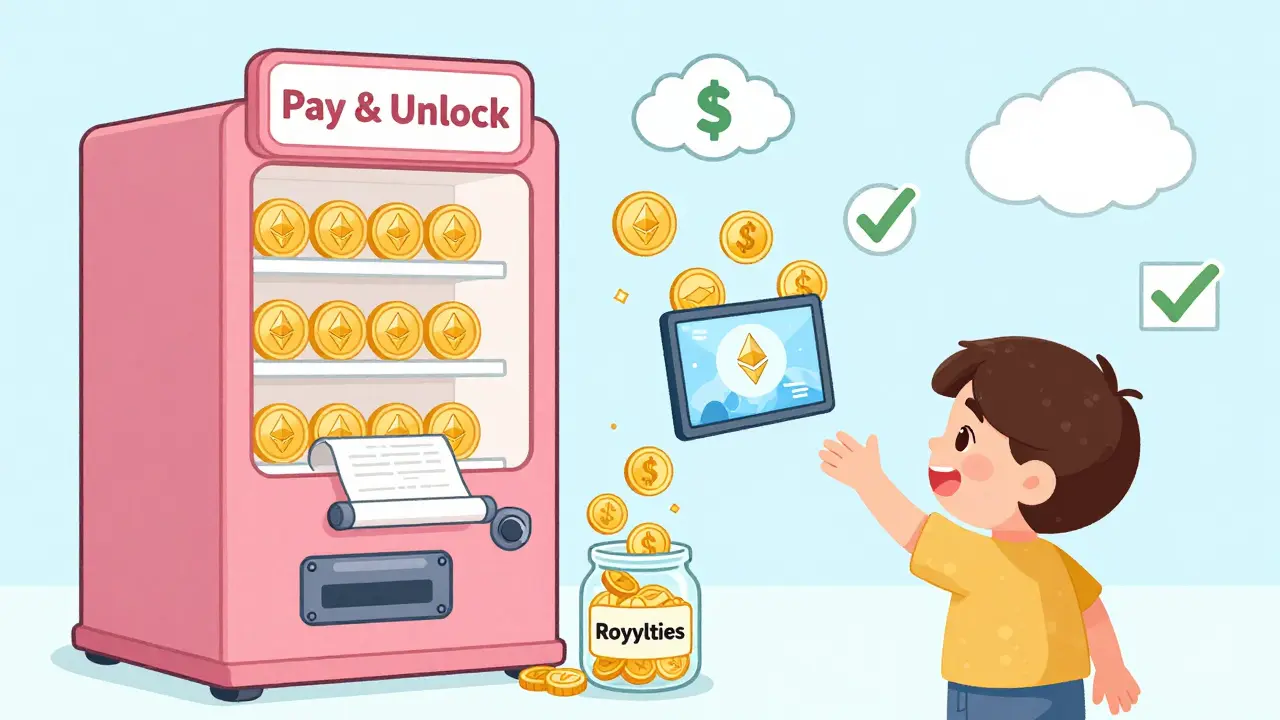
Imagine you publish a tutorial video and charge $5 to access it. With a smart contract, the moment someone pays, they get instant access. No waiting for PayPal clearance. No platform holding your money for 14 days. And if you later update the video, you can code in a rule that only owners of the original NFT get the new version for free.
This isn’t theoretical. Platforms like Base Chain and Polygon have cut transaction fees to under $0.01. That’s less than the cost of a coffee. Before, high gas fees scared people away-70% abandoned wallet setups because of it. Now, creators can offer micro-payments: $0.10 for a short article, $0.50 for a podcast episode. Micropayments that work at scale are finally possible.
Friend.tech and Social Tokens: Earning From Your Fanbase
What if your fans could buy a piece of your brand? Friend.tech made that real. Creators issue social tokens-digital shares tied to their name. Fans buy them to gain access to exclusive chats, early content, or voting rights on future projects.
Since August 2023, Friend.tech has generated over $250 million in sales. Top creators earn between $1 million and $2 million a month-not from ads, not from sponsorships, but from fans investing in their influence. It’s like owning stock in a celebrity, but without the corporate structure. The more engaged your fans are, the more your token rises in value-and so do your earnings.
This model works because it turns passive followers into active participants. Fans aren’t just consuming content-they’re betting on it. And when they win, you win too.
Hybrid Models: Bridging Web2 and Web3
Here’s the catch: most people don’t want to manage a crypto wallet. They don’t know what a seed phrase is. They hate gas fees. They’re not ready to leave YouTube.
That’s why the most promising models right now are hybrid. They keep the familiar feel of Web2 platforms but layer in blockchain benefits behind the scenes.
Take TOKN, a system introduced in February 2025. It lets creators attach a tokenized payment link to any YouTube video, Instagram post, or TikTok. Viewers click the link, pay in crypto or fiat, and get access to bonus content. No wallet needed. No blockchain jargon. The creator still gets paid instantly, earns royalties on resales, and keeps full control.
This is the future: seamless for users, powerful for creators. You don’t have to abandon your audience. You just upgrade how you get paid.
Why This Beats Patreon and OnlyFans
Patreon and OnlyFans built the modern creator economy. But they’re built on rent-seeking. You pay them to reach your fans. They take 20-30%. They can suspend you. They can change your payout schedule. And they don’t give you ownership of your audience.
With blockchain:
- You own your audience data-not the platform.
- You get paid instantly, globally, in seconds-not weeks.
- You earn forever from resales, not just first sales.
- Your content can’t be demonetized unless you break the law.
- You can sell your audience’s access as an asset-if you choose to.
And the numbers back it up. B2B companies using blockchain paywalls see up to 3 times higher content-unlock rates than traditional ones. Why? Because people trust ownership more than subscriptions. If you own something, you treat it differently.
Real-World Adoption: Who’s Doing This Right?
It’s not just indie artists. Major players are testing this too.
- Instagram creators are using NFT loyalty passes. Fans get free access to exclusive content just by holding a token. No purchase needed-just ownership.
- Gaming studios are tokenizing in-game items. Players earn crypto by playing, then trade those items across games. One studio saw 4x higher retention because players had skin in the game-literally.
- Journalists are bundling newsletters as NFTs. Subscribers get voting rights on story topics and earn tokens when others subscribe through their link.
In Asia-Pacific, 160 million people already use tokenized payment systems. 70% of e-commerce there runs through digital wallets. The infrastructure is ready. The mindset is shifting. It’s not a question of if-but how fast.
Barriers Still Exist
This isn’t magic. There are real hurdles.
- Wallet setup still confuses 70% of new users.
- Some platforms don’t explain gas fees clearly.
- Regulations are still unclear in many countries.
- Not all fans want to hold crypto.
The solution? Start simple. Offer a free “loyalty NFT” first. Let people hold it, see what it unlocks, and feel the value before paying. Many creators use this trick: give away a free token for signing up. Later, upgrade to paid tiers. It’s like a free sample-except it’s yours forever.
Also, stick to Layer 2 chains like Base or Polygon. They’re fast, cheap, and easy. Avoid Ethereum mainnet for now unless you’re targeting high-value collectors.
The Bottom Line: Ownership Is the New Subscription
Blockchain content monetization isn’t about replacing YouTube. It’s about giving creators a better way to get paid-and keeping that power in their hands.
Traditional models treat fans as numbers. Blockchain treats them as partners. Instead of begging for ad revenue, you build a community that invests in you. Instead of fearing demonetization, you control your own rules. Instead of waiting for payouts, you get paid instantly, anywhere in the world.
The market is growing fast. It hit $499 million in 2024 and is projected to hit $659 million in 2025. By 2030, it could be over $2.7 billion. The creators who win aren’t the ones chasing algorithms. They’re the ones building ownership economies.
If you create content, you’re not just a producer. You’re a business owner. And blockchain gives you the tools to run it-your way.


Mohamed Haybe
December 5 2025Blockchain? More like blockchain bullshit. India has real problems like power cuts and water scarcity. You think some NFT song will feed a child? This is Silicon Valley delusion dressed up as innovation. Stick to your job.