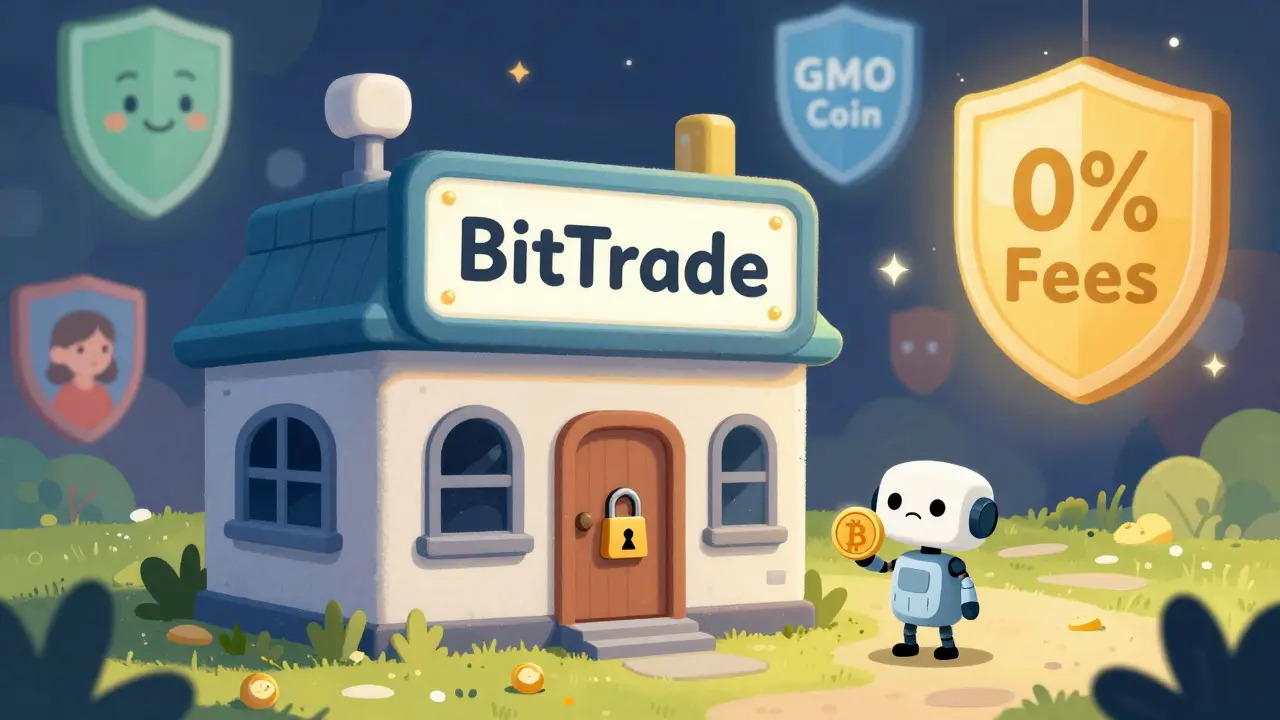
When you hear "BitTrade," you might think it’s just another crypto exchange trying to stand out with zero fees and a clean interface. But here’s the truth: BitTrade isn’t just small - it’s risky. And if you’re considering putting money there, you need to know why.
What Is BitTrade, Really?
BitTrade is a cryptocurrency exchange based in Japan, launched in 2016. It claims to offer spot trading for Bitcoin, Ethereum, and a few other coins, all with 0.00% trading fees - no maker, no taker. Sounds too good to be true? It is. The platform is designed almost entirely for Japanese users, with Japanese-language support and JPY deposits as the only fiat option. There’s no English interface. No multi-currency support. No global reach. It’s not trying to compete with Binance or Coinbase. It’s trying to slip under the radar in Japan’s crowded crypto market. But here’s the problem: it’s not licensed by Japan’s Financial Services Agency (FSA). Not even close. While exchanges like BitFlyer and GMO Coin are regulated, audited, and required to hold customer funds in segregated accounts, BitTrade operates in the gray zone. No oversight. No accountability. No public security details.The Zero-Fee Trap
"Zero fees" is the biggest hook BitTrade uses. But in crypto, if something looks too cheap, it’s usually hiding something. Legitimate exchanges make money through spreads, withdrawal fees, or premium services. BitTrade claims to charge nothing. Yet, it doesn’t disclose how it covers server costs, compliance, or security. That’s not sustainable. It’s either a bait-and-switch - maybe fees kick in after you deposit - or the platform is using your funds for something else. Compare this to Binance, which charges 0.10% per trade but offers insurance funds, cold storage, and multi-signature wallets. Or Coinbase, which has tiered fees but is regulated in the U.S. and EU. BitTrade doesn’t even mention cold storage percentages, insurance, or audit reports. If your coins disappear, there’s no one to call. No regulator to file a complaint with. Just silence.Traffic Numbers Don’t Lie
In January 2024, BitTrade got about 3,105 visits a month. Over 99% came from organic search. That’s not growth - that’s barely breathing. For context, BitFlyer, a licensed Japanese exchange, gets over 1.2 million visits a month. Even smaller players like Liquid or Zaif get 10x more traffic. The numbers get worse. Users spend an average of 21.15 seconds on the site. The bounce rate? 47%. That means nearly half of everyone who lands there leaves immediately. Why? Maybe they saw a warning. Maybe the site felt off. Maybe they tried to deposit and hit a wall. Whatever it is, real users aren’t sticking around.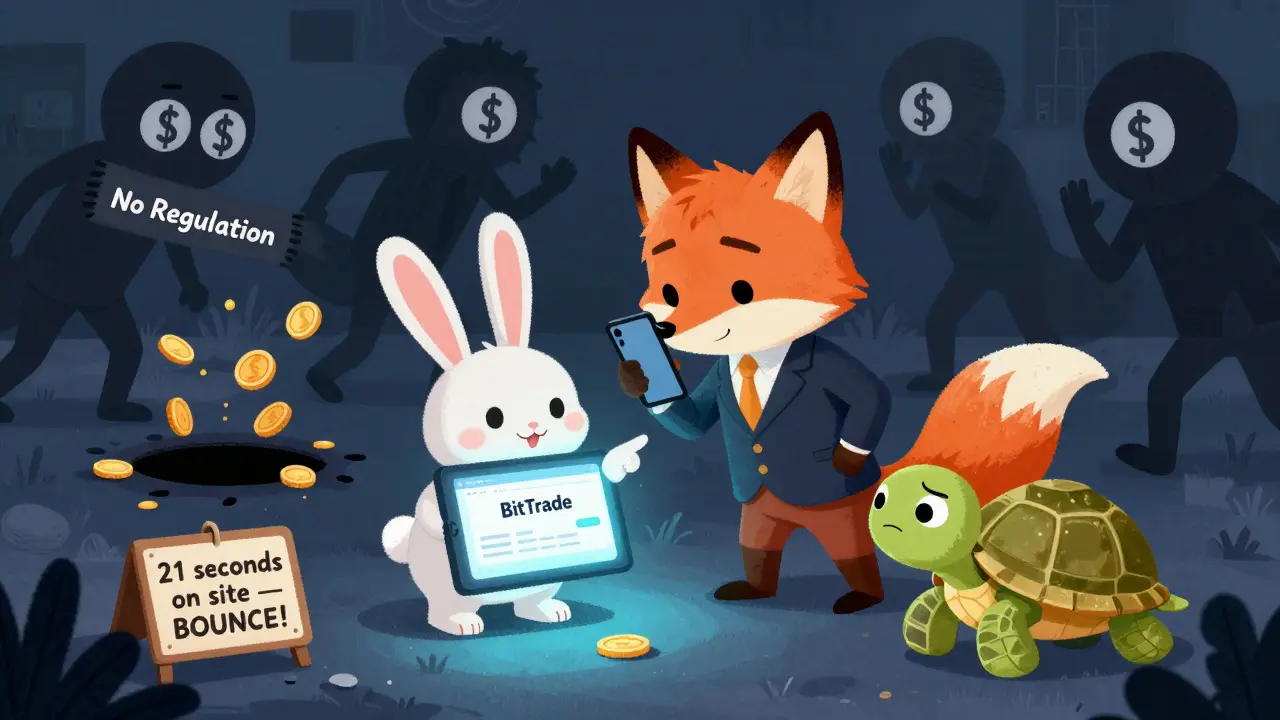
Withdrawal Issues and Scam Reports
This is the part you can’t ignore. On Forex.wikibit.com, a user named Greentea5931 reported being scammed through a romance scheme - they met someone on Tinder, were guided to BitTrade, and then lost their funds. When they tried to withdraw, the platform froze their account. No response. No explanation. Just gone. This isn’t an isolated case. Multiple reports link BitTrade to fake investment schemes where users are lured in by fake profiles, then pushed to trade on BitTrade. The platform doesn’t seem to have any fraud detection or customer support to stop it. If anything, it’s being used as a front. And then there’s the name confusion. A completely different platform called "Bit Trade" or "Bitbon System" promises 72% to 228% returns from "liquidity staking." That’s a textbook Ponzi scheme. Are these the same thing? Probably not. But the similarity is no accident. Scammers copy names to confuse people. And if you’re searching for "BitTrade," you might end up on the wrong site - one that’s even more dangerous.Why Japan’s Regulations Matter
Japan was one of the first countries to regulate crypto. After the Mt. Gox collapse in 2014, they created strict rules: exchanges must be licensed, hold capital reserves, run regular audits, and protect user funds. As of December 2023, only 23 exchanges are licensed by the FSA. BitTrade isn’t one of them. That means if BitTrade gets hacked - and it’s likely to, given its lack of security disclosures - users have zero legal recourse. No compensation. No recovery. Just a website that disappears overnight. Meanwhile, licensed exchanges like BitFlyer have insurance funds covering over ¥20 billion in customer assets. BitTrade? Nothing. No public record. No transparency.
Who Should Avoid BitTrade - And Who Might Still Use It?
If you’re outside Japan - forget it. No English support. No KYC clarity. No way to deposit USD, EUR, or GBP. Even if you’re fluent in Japanese, the lack of regulation makes it a bad bet. If you’re in Japan and you’re looking for a quick, anonymous trade? Maybe you think, "I’ll just use it for small amounts and get out fast." Even then, you’re gambling. The platform has no history of reliability. No track record of handling withdrawals. And no one to hold them accountable if things go wrong. The only people who might still use BitTrade are those who don’t care about safety - people who believe "if I don’t know about it, it’s fine." But in crypto, ignorance isn’t bliss. It’s loss.Alternatives That Actually Work
If you’re in Japan and want a real exchange, go with one that’s licensed:- BitFlyer - Japan’s largest, FSA-licensed, over 1.2 million monthly visits, strong security, JPY support
- GMO Coin - Backed by a major Japanese corporation, regulated, transparent, low fees
- LINE Bitmax - Popular with younger users, easy app, FSA-regulated
Final Verdict: Don’t Risk It
BitTrade isn’t just a small exchange. It’s a red flag wrapped in a clean UI. Zero fees? Probably a trap. No regulation? Huge risk. Low traffic and short visits? Users are leaving for a reason. Withdrawal issues? That’s the final warning. In 2026, with global crypto regulations tightening and scams becoming more sophisticated, you don’t need to gamble on unlicensed platforms. There are dozens of safe, regulated, and user-friendly options - even in Japan. Skip BitTrade. Your crypto isn’t worth risking on a platform that doesn’t even pretend to care about your safety.Is BitTrade a legitimate crypto exchange?
No, BitTrade is not legitimate in the sense of being regulated or trustworthy. It operates without any license from Japan’s Financial Services Agency (FSA) or any other global regulator. While it claims to offer zero trading fees and a simple interface, the lack of oversight, no public security measures, and documented user reports of withdrawal issues make it a high-risk platform. Legitimate exchanges are licensed, audited, and insured - BitTrade is none of these.
Can I withdraw my crypto from BitTrade?
There are credible reports of users being unable to withdraw funds from BitTrade. One user on Forex.wikibit.com described being scammed through a romance scheme and then locked out of their account when trying to cash out. No official response or resolution was provided. While not every user has had this issue, the absence of customer support and regulatory oversight means there’s no guarantee your funds will be accessible when you need them.
Does BitTrade support English or other languages?
No, BitTrade is designed exclusively for Japanese-speaking users. The entire platform - including the website, app, and customer support - is in Japanese. There is no English option, no multilingual interface, and no documentation in other languages. This makes it inaccessible and unsafe for international users who can’t verify what they’re agreeing to.
Why does BitTrade have zero trading fees?
Zero fees are unsustainable for any legitimate exchange. Most platforms make money through spreads, withdrawal fees, or premium services. BitTrade doesn’t disclose how it covers operational costs, which raises red flags. It could be hiding fees in the price spread, using user funds for internal operations, or even running a scam. In crypto, if a platform claims to offer something too good to be true - like zero fees without any other revenue model - it usually is.
Is BitTrade safe for beginners?
Absolutely not. Beginners need clear interfaces, educational resources, and strong security - none of which BitTrade provides. The platform lacks customer support, doesn’t explain risks, and has no safety nets like insurance or cold storage disclosures. Even worse, it’s being used as a front for romance scams. For new users, the safest choice is always a regulated exchange with proven track records like BitFlyer or GMO Coin.
How does BitTrade compare to Binance or Coinbase?
BitTrade doesn’t come close. Binance and Coinbase are global leaders with hundreds of millions of users, multi-currency support, regulatory compliance, insurance funds, and 24/7 customer service. BitTrade has about 3,100 monthly visits, only supports JPY, offers no public security details, and isn’t licensed. Comparing them is like comparing a licensed bank to a cash-only storefront with no name on the door. The risks are completely different.
What should I do if I already have funds on BitTrade?
If you have funds on BitTrade, withdraw them immediately - if you can. Don’t wait. There’s no guarantee the platform will stay online, and withdrawal delays are already reported. Once you’ve moved your assets, never deposit again. Consider this a learning experience: always use regulated exchanges with transparent security practices. If you’re unable to withdraw, treat it as a loss and report the incident to your local financial authority, even if BitTrade is overseas.


Jason Zhang
January 19 2026Zero fees? Yeah right. I saw this site last week and thought it was a joke. No English, no license, no transparency - just a pretty UI and a bunch of ghost traffic. I’ve seen this script before: fake simplicity, real exit scam. If you’re not on BitFlyer or GMO Coin in Japan, you’re just funding someone’s vacation.
And don’t even get me started on those "romance scam" reports. People are getting catfished into depositing on this thing like it’s a crypto dating app. Sad. And predictable.