
There’s no official Asian Fintech (AFIN) airdrop. Not right now. Not anytime soon. And if someone’s telling you otherwise, they’re either mistaken or trying to sell you something.
You’ve probably seen posts on Twitter, Telegram, or Reddit claiming you can get free AFIN tokens just by signing up, connecting your wallet, or sharing a link. These posts look legit. They use the project’s logo. They cite fake price charts. They even link to what seems like a real contract address. But here’s the truth: Asian Fintech (AFIN) has never announced an airdrop. Not on their official channels. Not on CoinMarketCap. Not on Binance. Not anywhere credible.
So why does this myth keep coming back? Because people want free crypto. And scammers know it.
What Is Asian Fintech (AFIN) Really?
Asian Fintech, or AFIN, is a cryptocurrency that claims to be eco-friendly. It says it’s built on Green Bitcoin - a concept where mining runs on solar, wind, and hydro power instead of coal or gas. That sounds great. Who doesn’t want crypto that doesn’t wreck the planet?
But here’s the catch: there’s no public proof. No audit reports. No developer team names. No GitHub activity. No whitepaper you can read. Just a contract address: 0xee9e...f67a72. And even that’s hard to verify because no major blockchain explorer shows any real transaction history tied to it.
According to CoinMarketCap, the total supply is 500 million AFIN tokens. Only 135 million are supposedly in circulation. But if you check Binance, CryptoRank, or CoinGecko, you’ll see something different: $0 price. $0 market cap. $0 trading volume. That’s not a glitch. That’s a red flag.
Why the Price Confusion?
Some sites say AFIN is worth $0.0012. Others say $0. Why the difference?
It’s because AFIN isn’t listed on any major exchange. You can’t buy it on Binance, Coinbase, or Kraken. The $0.0012 price you see on CoinCodex? It’s based on a single decentralized exchange (DEX) with maybe 2 trades a week. That’s not a market. That’s a ghost town.
Even worse, the token’s all-time high was back in 2019 - ₹32.12 in Indian Rupees. That’s over five years ago. Since then, there’s been zero meaningful trading activity. If no one’s buying or selling, the price is just a number someone typed into a spreadsheet.
The Airdrop Myth - How It Works
Here’s how fake airdrops like this one operate:
- You find a post saying “Get 10,000 AFIN tokens for free!”
- You click the link - it takes you to a fake website that looks like the real AFIN site.
- You connect your MetaMask wallet to “claim” your tokens.
- Instantly, your wallet gets drained. All your ETH, USDC, or other tokens vanish.
That’s it. No tokens. No reward. Just a empty wallet and a $500 loss.
These scams are everywhere. They target new crypto users who don’t know how to check legitimacy. They use urgency: “Only 500 spots left!” “Claim before the deadline!” “Official AFIN team announcement!”
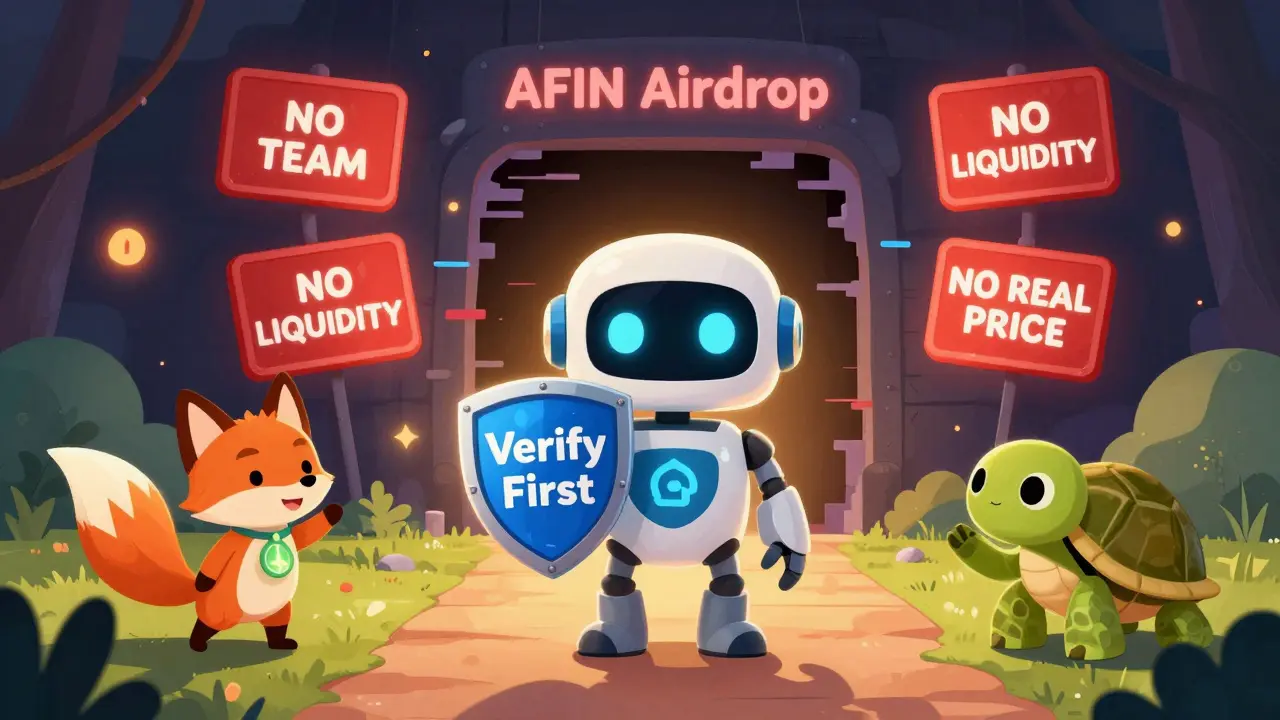
But the real AFIN team? They don’t exist. Or if they do, they’re not doing anything public. No Twitter updates. No Discord announcements. No press releases. No GitHub commits. No community events. Nothing.
Green Bitcoin? What’s That?
AFIN claims to use “Green Bitcoin” - a term that doesn’t exist in real blockchain tech. Bitcoin mining runs on energy. Some miners use renewable sources. But there’s no separate token called “Green Bitcoin.”
This is a classic tactic: invent a fancy phrase that sounds sustainable, then tie it to a worthless token. It’s marketing. Not technology.
Real eco-friendly crypto projects like Chia or Algorand publish detailed energy reports. They name their data centers. They show carbon offsets. AFIN? Nothing. Just a slogan.
Can You Even Buy AFIN?
Technically, yes - but only through a decentralized exchange (DEX) like PancakeSwap or Uniswap, if you can find it. You’d need to connect your wallet, search for the token by its contract address, and swap ETH or BNB for AFIN.
But here’s the problem: you’ll pay high gas fees. You’ll get slippage. And when you try to sell? No one will buy. The bid-ask spread is 100%. You’ll be stuck holding a token with no buyers, no liquidity, and no future.
Binance’s website says you can buy AFIN via their Web3 Wallet. But that’s not a recommendation. That’s a warning. They’re telling you: “We don’t list this. But if you’re dumb enough to try, here’s how to lose your money.”
What Should You Do Instead?
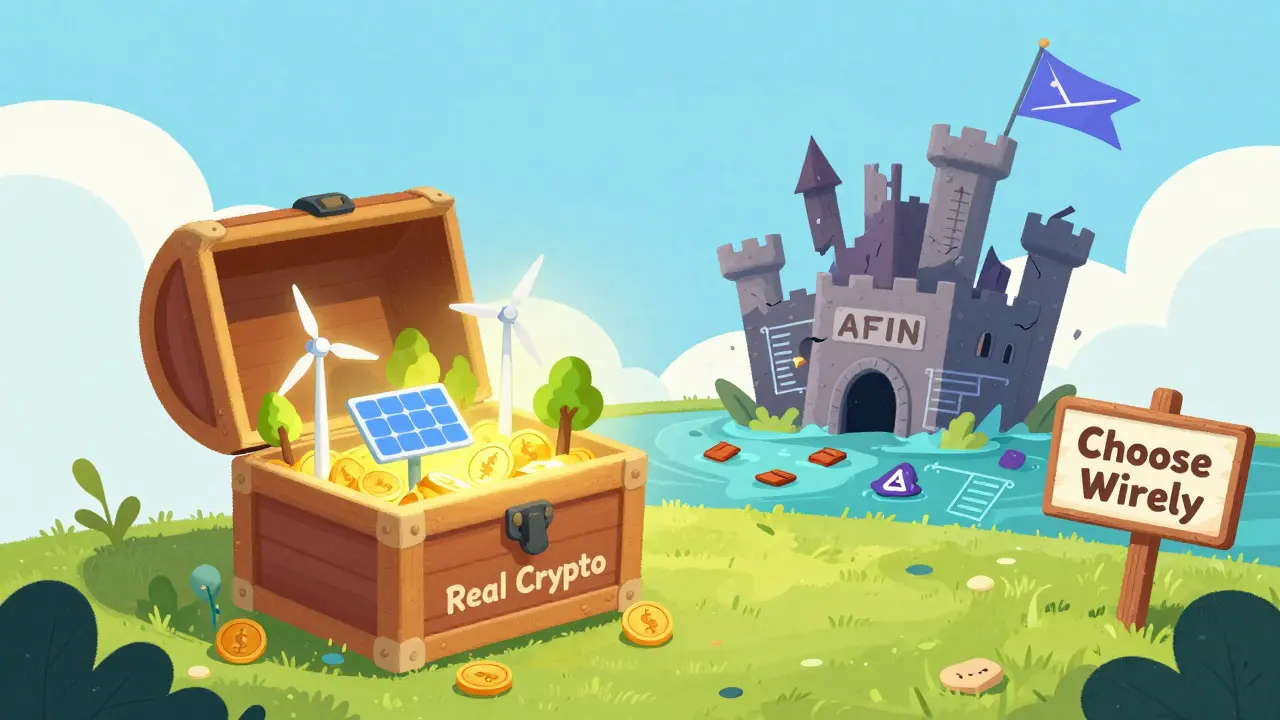
If you’re looking for a real airdrop, stick to projects with:
- Active development teams with public names and LinkedIn profiles
- Verified social media accounts (blue checkmarks, not fake ones)
- Clear airdrop rules published on their official website
- Partnerships with known exchanges or wallets
- Community size in the thousands, not just a handful of bots
Real airdrops don’t ask for your private key. They don’t ask you to send crypto first. They don’t use urgency or fake countdown timers.
And if you’re interested in sustainable crypto, look at projects like:
- Algorand - carbon-neutral blockchain since 2019
- Chia - uses proof-of-space instead of energy-heavy mining
- Stellar - low-energy transactions, used by nonprofits
These projects have track records. They’ve been audited. They’re on major exchanges. They’ve been around for years.
Final Warning: Don’t Fall for the Trap
AFIN isn’t a scam in the traditional sense. It’s not a Ponzi. It’s not a rug pull. It’s worse. It’s a ghost. A dead token with a loud website and a dream it never delivered on.
There’s no airdrop. There’s no future. There’s no liquidity. And if you send any crypto to claim it, you’re just giving money to someone who doesn’t care if you lose it.
Don’t chase free tokens. Don’t trust anonymous projects. Don’t believe hype. If it sounds too good to be true - and it’s tied to a token with $0 volume - it is.
Walk away. Save your money. Come back when you find a real project with real transparency.
Is there an official Asian Fintech (AFIN) airdrop?
No, there is no official Asian Fintech (AFIN) airdrop. No announcement has ever been made on their official website, social media, or major crypto platforms like CoinMarketCap or Binance. Any airdrop claims you see online are fake and designed to steal your crypto.
Why does AFIN show a price on some sites but $0 on others?
AFIN is not listed on any major exchange. The price you see on sites like CoinCodex is based on tiny, unreliable trades on decentralized exchanges with almost no volume. On Binance, CryptoRank, and CoinGecko, it shows $0 because there’s no real trading activity. The price is meaningless.
Can I buy AFIN on Binance or Coinbase?
No, you cannot buy AFIN on Binance, Coinbase, or any other major centralized exchange. Binance only lists it as available via their Web3 Wallet, which means you’d have to trade it on a decentralized exchange - a risky move with no buyers and high fees.
Is Green Bitcoin real?
No, Green Bitcoin is not a real cryptocurrency or technical standard. It’s a marketing term used by AFIN to sound eco-friendly. There is no blockchain or mining system called Green Bitcoin. Real sustainable crypto projects like Algorand and Chia publish verifiable energy reports - AFIN does not.
How do I avoid fake crypto airdrops?
Never connect your wallet to a site just because it promises free tokens. Always check the official project website and social media for announcements. Look for verified accounts, team members, and audit reports. If it asks for your private key or requires you to send crypto first, it’s a scam.
What should I do if I already sent crypto to claim AFIN tokens?
If you’ve already sent crypto, the tokens are likely gone. There’s no way to reverse the transaction. Report the scam to your wallet provider and local authorities if possible. Learn from it: never trust anonymous airdrops again. Real projects don’t need you to chase them - they come to you with clear, public info.


Mollie Williams
January 6 2026It’s strange how we chase ghosts in crypto-tokens with no team, no code, no soul-just a website that looks like it was built in 2017 with Wix and a dream. We’re not just losing money; we’re investing in illusion. And yet, here we are, still clicking, still hoping, still whispering to the void: ‘Maybe this time it’s real.’