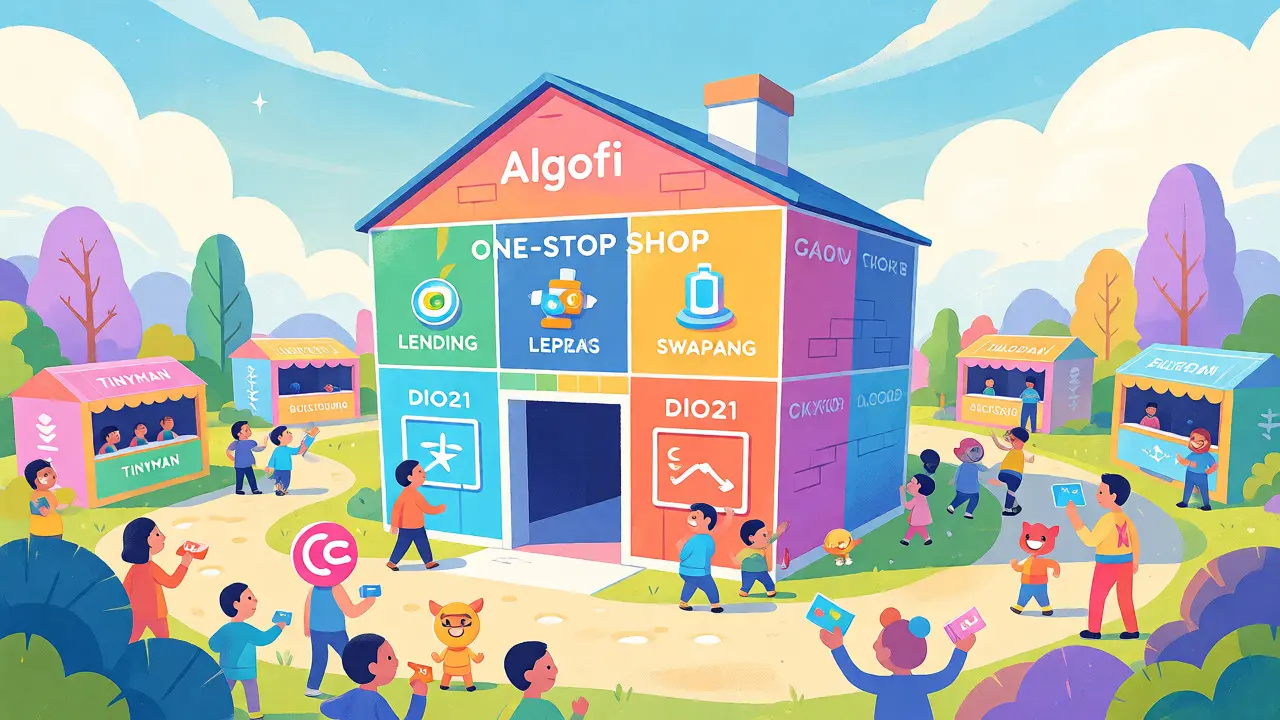
Imagine pouring your savings into a platform that promised to be the heart of a blockchain ecosystem, only to watch it slowly bleed out before officially pulling the plug. That was the reality for many early adopters of Algofi, a comprehensive DeFi protocol on the Algorand blockchain that offered lending, borrowing, and swapping services. If you are digging through old crypto portfolios or researching why certain projects vanished, understanding what went wrong with Algofi is crucial. It wasn’t just another failed startup; it held over half of Algorand’s Total Value Locked (TVL) at its peak, making its collapse a significant event in the decentralized finance world.
The One-Stop Shop That Couldn’t Stay Open
Algofi launched in December 2021 with ambitious goals. The team wanted to create a "one-stop solution" for Algorand users. Instead of hopping between different apps for lending, borrowing, or trading, you could do it all in one place. At the center of this ecosystem sat two key tokens: BANK, the governance token used for voting and rewards, and STBL, an algorithmic stablecoin designed to maintain a $1 peg.
For a while, it looked promising. By July 2023, reports indicated Algofi accounted for 54% of Algorand’s TVL. But here is the catch: having money locked up doesn’t mean people are using the platform. While billions flowed through Ethereum-based protocols, Algofi struggled to generate actual trading volume. The disconnect between high TVL and low activity became a glaring issue that eventually led to its downfall.
Why Did Algofi Shut Down?
You might wonder, if it had so much value locked, why shut it down? The answer lies in liquidity. In decentralized finance, liquidity is oxygen. Without enough buyers and sellers, swaps fail, interest rates stagnate, and yields drop. Reviews from mid-2023 highlighted that swap volume on Algofi’s Decentralized Exchange (DEX) was effectively zero. Users reported that without deep liquidity pools, transactions either didn’t fill or suffered massive slippage.
The decline was rapid. Between February and July 2023, TVL plummeted from a peak of $134.7 million to around $25 million. That’s an 81.5% drop in just five months. When the team announced the shutdown in July 2023, they cited a "confluence of events" that made maintaining the platform viable impossible. Essentially, the cost of running the smart contracts and infrastructure outweighed the revenue generated by a shrinking user base.
Key Features and How They Worked
Before it closed, Algofi offered several distinct services. Understanding these helps explain why some users stayed longer than others.
- Lending and Borrowing: Users could deposit assets like ALGO, USDC, or goBTC to earn interest. These deposits served as collateral for borrowing other assets.
- STBL Stablecoin: You could mint STBL by locking up collateral. This allowed users to stay within the Algorand ecosystem without converting to fiat currency.
- Governance: Holding BANK tokens gave you voting rights on protocol changes. However, voter participation was often criticized as being too low to drive meaningful community-led decisions.
- Swapping: An Automated Market Maker (AMM) allowed users to trade tokens directly on-chain. As noted earlier, this feature saw very little traffic compared to competitors.
Accessing the platform required no traditional sign-up process. You simply connected a compatible wallet, such as Pera Wallet or MyAlgo. This "accountless" approach appealed to privacy-conscious users but also meant there was less friction to leave when things got tough.
Algofi vs. Competitors on Algorand
Algofi wasn’t the only player on the block. To understand its failure, you have to look at who beat it. Specialized protocols often outperformed generalist platforms because they focused on doing one thing extremely well.
| Feature | Algofi | Tinyman | Pact |
|---|---|---|---|
| Primary Focus | All-in-one (Lend/Borrow/Swap) | DEX (Swaps) | DEX (Swaps) |
| Liquidity Depth | Low (caused swap failures) | High (market leader) | Moderate to High |
| User Experience | Complex interface for beginners | Simple, fast swaps | User-friendly routing |
| Status (Nov 2026) | Shut down / Wind-down phase | Active and dominant | Active |
Protocols like Tinyman dominated Algorand’s swapping activity. Users preferred Tinyman because it offered better price execution and deeper liquidity. Algofi tried to compete by bundling everything together, but in doing so, it diluted its focus. A jack-of-all-trades is often a master of none, and in DeFi, mediocrity leads to obsolescence.
What Happened After the Shutdown?
The shutdown wasn’t instantaneous. Algofi entered a "withdrawal-only mode." This means you couldn’t lend, borrow, or swap anymore. You could only withdraw your funds. To facilitate this, the team systematically reduced the collateral factors for various assets. For example, if you had borrowed against ALGO, the percentage of ALGO you needed to keep locked decreased until it hit 0% by December 2023. This allowed everyone to close their positions and exit.
Social media presence largely disappeared, except for a Discord channel dedicated to wind-down updates. Governance proposals were suspended, meaning the DAO effectively stopped functioning. For most intents and purposes, Algofi ceased to exist as an active protocol.
However, rumors persist. Some analysts in late 2025 suggested a potential "reboot" due to new liquidity injections in the Algorand ecosystem. But given the definitive technical wind-down-collateral factors at 0%, halted programs-any revival would essentially require building a new product rather than restarting the old one. Until concrete evidence emerges, treat Algofi as a historical case study rather than a live investment opportunity.
Lessons for DeFi Investors
So, what can we learn from Algofi’s trajectory? First, TVL is a vanity metric if it doesn’t translate to usage. Locking up capital doesn’t pay the bills if nobody trades. Second, specialization often beats generalization in early-stage ecosystems. Users prefer tools that do one job perfectly over clunky all-in-one suites.
If you are holding BANK tokens or trying to recover assets from the era, check official Algorand resources or archived documentation. Most withdrawals should have been completed during the designated window. If you missed it, you might need to interact directly with the remaining smart contracts, though gas fees and complexity make this challenging for small amounts.
Is Algofi still active in 2026?
No, Algofi is not active. The protocol officially announced its shutdown in July 2023 and entered a withdrawal-only mode. By December 2023, collateral factors were reduced to 0%, allowing users to fully exit. While some speculative reports mention a potential reboot, there is no active trading or lending on the original Algofi platform.
What happened to my STBL stablecoins?
During the wind-down period, users were encouraged to redeem their STBL for underlying collateral or swap them for other stablecoins like USDC before liquidity dried up completely. If you held STBL after the final redemption phases, you may need to consult specific Algorand community guides on how to manually unwind any remaining positions via direct contract interaction.
Why did Algofi have low trading volume despite high TVL?
Algofi suffered from poor liquidity depth. Even though many users deposited assets (high TVL), few actually traded them on the DEX. Competitors like Tinyman offered better swap routes and lower slippage, drawing traders away. Additionally, the platform's complex interface deterred casual users who preferred simpler alternatives.
Can I still buy BANK tokens?
You can technically find BANK tokens on secondary markets or DEXs that support Algorand assets, but liquidity is extremely thin. Since the governance utility of BANK ended with the shutdown, the token has lost most of its fundamental value. Buying it now is highly speculative and carries significant risk.
Which wallets worked with Algofi?
Algofi integrated seamlessly with popular Algorand wallets such as Pera Wallet, MyAlgo, and Defly. Because it used an accountless model, you didn't need to create a separate account; you just connected your existing wallet to access the dashboard.