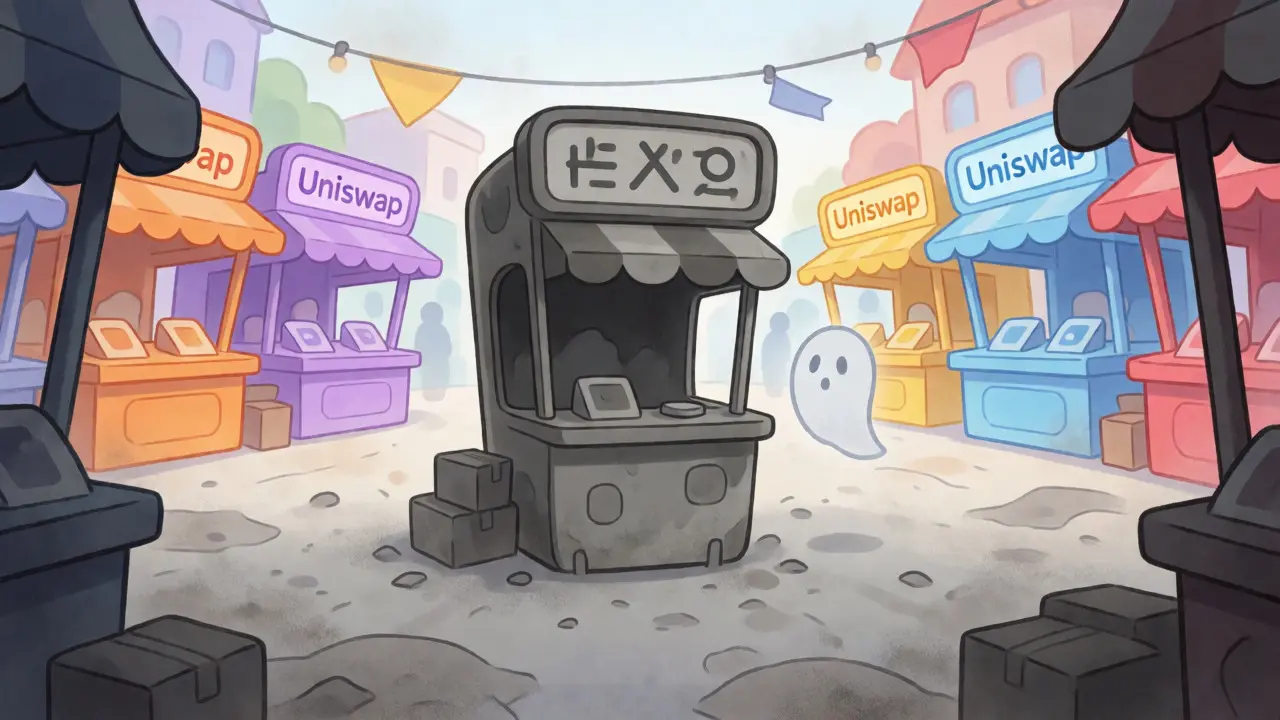
Imagine checking your portfolio and seeing a token that technically exists but has zero circulating supply. That’s the current reality for anyone holding AfroX, the native token of the AfroDex cryptocurrency exchange. If you’re here because you saw a price chart or a wallet balance and wondered if this platform is still worth your time, you’re asking the right questions. Most people assume a crypto exchange means active trading and easy withdrawals. But with AfroDex, the story is different. It’s a decentralized exchange (DEX) launched back in January 2019, built on Ethereum to let users trade ETH and ERC-20 tokens directly without a middleman holding their keys.
But does it work today? The short answer is complicated. While the smart contracts are live, the market activity is practically non-existent. We need to look past the hype cycles of 2019 and see where AfroDex stands in the mature DeFi landscape of 2026. This isn’t just about whether you can buy a token; it’s about whether you can actually sell it, find liquidity, and trust the infrastructure behind it.
The AfroDex Ecosystem and AfroX Token Mechanics
To understand AfroDex, you have to understand its heart: the AfroX token. Unlike centralized exchanges that issue utility tokens for fee discounts, AfroX was designed as the backbone of a peer-to-peer trading protocol. It operates on the Ethereum blockchain, meaning every transaction requires gas fees and interacts with smart contracts. The token contract address is distinct, but the economics are puzzling.
Here is the critical data point that changes everything: while the total supply of AfroX is a massive 700 trillion tokens, the circulating supply is currently reported as zero. Yes, zero. This doesn’t mean the tokens were burned. It usually implies they are locked, held by the team, or simply not distributed into the open market in a way that creates tradable volume. When you look at the price, it sits at roughly $0.00000004 USD. At first glance, that looks like a bargain. But when daily trading volume is effectively $0.00, that price is theoretical. You cannot buy or sell at that rate because there are no buyers or sellers.
| Metric | Value | Implication |
|---|---|---|
| Total Supply | 700 Trillion | High inflation potential if released |
| Circulating Supply | 0 | No real market value established |
| Price (USD) | $0.00000004 | Nominal pricing due to lack of volume |
| Daily Volume | $0.00 | Illiquid asset; hard to exit positions |
| Blockchain | Ethereum | Dependent on ETH gas fees |
How AfroDex Works: Decentralized vs. Centralized Reality
AfroDex positions itself as a decentralized exchange, or DEX. In theory, this is great for security. You keep custody of your funds in your own wallet, like MetaMask or Trust Wallet. There is no company holding your money in a bank account that could go bankrupt. You connect your wallet, approve a transaction, and swap tokens directly via smart contracts.
However, being a DEX doesn’t automatically make a platform successful. In 2019, when AfroDex launched, the DeFi space was nascent. Today, giants like Uniswap and SushiSwap dominate Ethereum-based trading. They offer automated market makers (AMMs) that provide deep liquidity. AfroDex, by contrast, relies on an order book model or simpler peer-to-peer matching that hasn’t attracted enough users to create a healthy market.
If you try to trade on AfroDex today, you might face two issues:
- Liquidity Pools: Without active market makers, the spread between buy and sell orders can be huge. You might buy a token at one price and only find a buyer at half that price.
- Smart Contract Risk: Since the platform is older, ensure the smart contracts haven’t been abandoned. Code rot is real in crypto. If the developers stopped updating the backend interfaces, you might struggle to even load the trading page.

Market Positioning: Why AfroDex Struggled Against Competitors
Let’s be honest about the competition. When AfroDex launched, it entered a crowded field. By 2021, the "DeFi Summer" had exploded, bringing billions of dollars into decentralized finance. Platforms that offered yield farming, staking rewards, and seamless user interfaces captured the market. AfroDex remained relatively quiet.
Compare AfroDex to AFRIDAX, a centralized exchange operating in South Africa under FSCA regulation. AFRIDAX offers fiat on-ramps, customer support, and regulatory clarity. AfroDex offers none of these. It’s purely code. For the average user, that’s a barrier. You need technical know-how to interact with it, and you need to believe in the community to provide liquidity. With zero circulating supply, that community seems dormant.
This isn’t just bad luck; it’s a failure of execution in a winner-takes-all market. Network effects matter in exchanges. The more people using Uniswap, the better the prices become, which attracts more people. AfroDex never reached that critical mass. As a result, it’s now a niche player, possibly serving specific legacy holders rather than new traders.
User Experience and Accessibility Issues
If you’re thinking about trying AfroDex, what should you expect? The user interface (UI) is likely dated compared to modern standards. Most DEXs today offer dark modes, clear gas estimators, and instant swaps. AfroDex’s website provides basic information, but comprehensive reviews of its UX are scarce because few people use it actively.
You won’t find extensive social media chatter or Reddit threads discussing recent trades. This silence is telling. In crypto, noise equals activity. No noise often means the project is either dead or so small it’s irrelevant to the broader market. If you hold AfroX, check your wallet balance carefully. Sometimes, tokens appear in wallets automatically via airdrops or old claims, leading people to think they have valuable assets when they actually hold illiquid dust.
Furthermore, accessibility extends to customer support. On a DEX, there is no "contact us" button for lost transactions. If you send funds to the wrong address or get stuck in a pending transaction, you’re on your own. This self-custody model empowers you but also exposes you to errors that centralized exchanges would fix for you.

Security and Regulatory Considerations
Security is a double-edged sword with AfroDex. On one hand, decentralized platforms reduce counterparty risk. The exchange itself doesn’t hold your coins, so a hack of the exchange’s hot wallet isn’t possible. On the other hand, smart contract vulnerabilities remain a threat. Older projects sometimes have unpatched bugs. Has AfroDex undergone recent audits? Publicly available audit reports from top firms like CertiK or Hacken are rare or outdated for this specific iteration.
Regulatory-wise, AfroDex operates in a gray area common to many DEXs. It doesn’t require KYC (Know Your Customer) verification, which appeals to privacy-focused users. However, this also means it lacks the legal protections of licensed entities. If you’re in the US or Europe, regulations around DeFi are tightening. Ensure that interacting with such a low-volume DEX doesn’t complicate your tax reporting. Every swap is a taxable event in many jurisdictions, and tracking trades on a minor exchange can be a nightmare for accountants.
Is AfroDex Worth Your Time in 2026?
So, should you use AfroDex? Here is a simple decision framework based on your profile:
- The Speculator: If you already hold AfroX from a previous era, selling might be difficult due to zero volume. Holding costs nothing but opportunity cost. Don’t buy more unless you have insider knowledge of a revival.
- The New Trader: Look elsewhere. Uniswap, Sushiswap, or even Layer-2 solutions like Arbitrum offer better liquidity and lower fees. AfroDex doesn’t offer a compelling reason to switch from established platforms.
- The Developer: If you’re interested in studying older DEX architectures, AfroDex is a case study in how network effects kill mediocre products. It’s useful for academic curiosity, not financial gain.
The bottom line is that AfroDex represents a cautionary tale. Launching in 2019 gave it a head start, but failing to capture liquidity meant it got left behind. The zero circulating supply is the biggest red flag. Until that number changes and real trading volume returns, AfroX remains a speculative asset with high risk and low utility.
Is AfroDex a safe exchange to use?
Safety depends on your definition. Technically, it is a decentralized platform, so you retain custody of your funds, reducing the risk of exchange insolvency. However, the lack of recent development updates and low liquidity introduces operational risks. Smart contract vulnerabilities may exist if the code hasn't been recently audited.
Why is the circulating supply of AfroX zero?
A zero circulating supply typically indicates that tokens are locked, held by the founding team, or not yet distributed to the public market. This results in no real market price discovery, making the quoted price largely theoretical until liquidity is injected.
Can I withdraw my AfroX tokens easily?
Since AfroDex is a DEX, your tokens are in your personal wallet. You don't "withdraw" from the exchange; you simply manage them in your Ethereum wallet. However, selling them is hard because there is almost no trading volume to buy them from.
Does AfroDex charge trading fees?
Like most Ethereum-based DEXs, you pay Ethereum network gas fees for every transaction. Additionally, the platform may charge a small percentage fee per swap, though exact current rates are hard to verify due to low activity. Always check the transaction details before confirming.
How does AfroDex compare to Uniswap?
Uniswap dominates the market with billions in daily volume, deep liquidity, and a robust ecosystem of integrations. AfroDex has minimal volume and limited adoption. Uniswap is generally preferred for reliable execution and price accuracy, whereas AfroDex serves a very niche, mostly dormant user base.


Indu Nair
September 10 2026Look, I get the frustration with zero liquidity, but we need to look at this through a lens of potential rather than just current metrics. The fact that the smart contracts are still live is actually a testament to the resilience of early DeFi architecture, and for those of us who believe in the philosophical underpinning of decentralization, that matters more than daily volume numbers right now. We are seeing a market correction where only the truly committed projects survive, and AfroDex might be one of those quiet survivors that hasn't had its moment yet because the broader market was distracted by hype cycles.
I honestly think it’s too early to write off the ecosystem entirely when you consider how much infrastructure has been built on Ethereum since 2019. If there is any community effort to re-inject liquidity or if a new narrative emerges around legacy DEXs, this could flip overnight. It’s not about being naive; it’s about recognizing that value in crypto often precedes price discovery by years, sometimes decades. We should be supportive of these older protocols because they paved the way for the giants we use today, and their continued existence proves that code can outlast marketing budgets. Let’s not let short-term volatility blind us to the long-term utility of non-custodial trading options that have stood the test of time without massive VC backing.